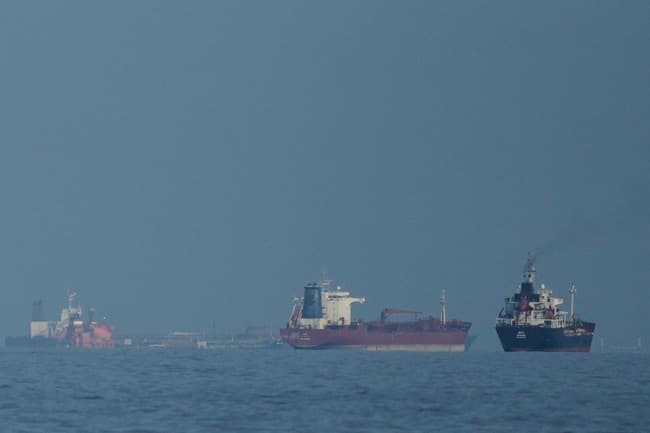
 Tankers at sea near a strait, evoking the ship struck by Iran.
Iran Strikes Ship Hours After Trump's 'Economic D-Day' Sanctions
Left says
- •Ongoing military and economic pressure has not produced the swift capitulation the administration promised, raising questions about the war's endgame and whether continued escalation is achieving stated goals.
- •Diplomatic efforts by Qatar and Pakistan to revive direct U.S.-Iran talks show that regional actors see negotiation, not further sanctions or strikes, as the path to de-escalation.
- •The human and economic toll on ordinary Iranians and global shipping continues to mount, with the war stretching toward six months and no clear timetable for resolution.
- •Trump's own rhetoric about achieving a decisive 'victory' sits uneasily with continued attacks and an economy that analysts say the new sanctions are unlikely to actually cripple.
Right says
- •The strike underscores that Iran remains a hostile, unpredictable actor that responds to diplomatic and economic pressure with violence rather than good-faith negotiation.
- •The Trump administration's sanctions and naval blockade are working to squeeze Iran's already struggling economy, forcing Tehran to seek workarounds like the Oman shipping deal.
- •Iran's insistence that the U.S. lift its blockade and revert to prior truce terms before reopening the strait shows Tehran, not Washington, is the obstacle to peace.
- •Trump has been clear that the campaign will continue as long as necessary, signaling resolve rather than retreat despite the lack of a fixed timetable.
Common Take
High Consensus- A tanker was struck by an unknown projectile near the Strait of Hormuz, damaging its engine room and disabling the vessel, with the crew reported safe.
- The Trump administration unveiled new sanctions, dubbed an 'Economic D-Day,' aimed at cutting off Iran's illicit oil revenue.
- Iran and Oman have been negotiating a temporary shipping corridor through the Strait of Hormuz, though full reopening depends on U.S.-Iran developments.
- Qatar and Pakistan are actively working to bring the U.S. and Iran back to the negotiating table.
The Arguments
Left argues
Nearly six months into the war, with sanctions rebranded as an 'economic D-Day' but presented without firm timelines or deadlines, the gap between the administration's triumphant rhetoric and the war's open-ended reality raises real questions about whether escalation is achieving anything beyond prolonging the conflict.
Right counters
Wars and sanctions regimes rarely succeed on fixed timetables, and Trump has been explicit that the campaign continues 'as long as necessary' — that's a statement of resolve, not evidence of failure, especially as Iran's economy continues to buckle.
Right argues
Iran's response to fresh sanctions was to strike another tanker within hours, the same pattern of violence it has repeatedly chosen over genuine negotiation, reinforcing the case that Tehran is not a good-faith actor amenable to diplomacy alone.
Left counters
Treating every unclaimed attack as proof of Iranian bad faith ignores that the region has multiple armed actors (including the Houthis) and that continued strikes may just as easily reflect the failure of a strategy of pressure-without-talks as they do Iranian intransigence.
Right argues
Iran's own insistence that the U.S. must lift its naval blockade and revert to prior truce terms before it will reopen the strait shows that Tehran, not Washington, is the party blocking a return to normal shipping and de-escalation.
Left counters
Framing Iran as the sole obstacle glosses over the fact that the U.S. blockade and sanctions are themselves acts of pressure that Iran reasonably wants addressed as part of any deal — it's a negotiation over mutual concessions, not simply Iranian obstruction.
Left argues
The active diplomatic push by Qatar and Pakistan, and Iran's own parallel effort with Oman to reopen Hormuz, demonstrate that regional actors view negotiated de-escalation, not further sanctions or strikes, as the realistic path forward.
Right counters
The Iran-Oman shipping arrangement was announced explicitly in defiance of the Trump administration's demands and conditioned on the U.S. abandoning its blockade — that's not evidence diplomacy is working, it's evidence Iran is trying to route around U.S. pressure rather than yield to it.
Left argues
Analysts quoted across multiple outlets suggest the new sanctions package is unlikely to actually cripple Iran's economy, undercutting the administration's 'Economic D-Day' framing and suggesting the policy is more rhetorical than strategically sound.
Right counters
Iran's need to strike a revenue-sharing deal with Oman just to get partial shipping moving again, and its economy 'reeling even before the war broke out' per contemporaneous reporting, is itself evidence that the pressure campaign is inflicting real and mounting costs.
Challenge Questions
These questions target genuine internal contradictions — meant to provoke honest reflection.
Right asks Left
“If the left's critique is that sanctions and strikes haven't produced quick capitulation, what alternative sequence of concessions would end the war without simply rewarding Iran's tanker attacks and blockade-defying maneuvers?”
Left asks Right
“If Iran's economy is being squeezed effectively enough to force it toward workarounds like the Oman deal, why does the administration still describe the war's endpoint only as 'as long as necessary' rather than pointing to any concrete sign that pressure is nearing its goal?”
Outlier Report
Left Fringe
Anti-war progressives like Rep. Ilhan Omar and commentators such as Mehdi Hasan would argue the war itself is illegitimate and driven by manufactured urgency, a more extreme position than the synopsis' focus on 'endgame questions.' This represents roughly 15-20% of the left.
Right Fringe
Hawkish figures like Sen. Lindsey Graham or commentators such as Mark Levin would push for even harsher military action rather than just sanctions, viewing the current approach as too restrained. This represents roughly 15-20% of the right.
Noise Assessment
Much of the intense partisan framing on cable news and X is performative signaling for base audiences; most ordinary Americans have low information and moderate, ambivalent views on an ongoing foreign conflict with unclear stakes.
Sources (7)
The United States has launched Operation Economic Outcast to cut off Iran's "illicit revenue" sources, including smuggled oil
As U.S. economic pressure bites, Iran touts a plan with Oman to get ships moving through the Strait of Hormuz and suggests the next move is Trump's.
Iran and Oman’s foreign ministers on Tuesday said they are setting up the framework of a temporary corridor for commercial vessels to pass through the Strait of Hormuz, the key commercial waterway whose traffic has been stymied amid the U.S. war on Iran. Omani Foreign Minister Badr al-Busaidi wrote on the social platform X that the…
<p>As the U.S. attempts once again to pressure Iran into negotiating, it seems like Iran has given its answer to the U.S. in the form of another strike in the strait. </p> <p>The post <a href="https://www.twz.com/news-features/ship-struck-in-strait-of-hormuz-hours-after-trumps-economic-d-day-campaign-on-iran-unveiled">Ship Struck In Strait Of Hormuz Hours After Trump’s “Economic D-Day” Campaign On Iran Unveiled</a> appeared first on <a href="https://www.twz.com">TWZ</a>.</p>