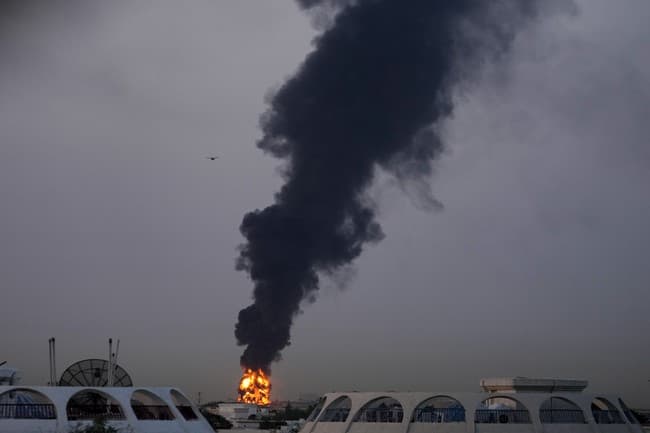
 Black smoke billows from burning infrastructure amid reported attack in UAE
Iran Strikes UAE Despite Month-Old Ceasefire Agreement
Left says
- •The attacks represent a dangerous escalation that threatens regional stability and could drag the U.S. into another Middle East conflict
- •Iran's violations of the ceasefire demonstrate the fragility of diplomatic agreements and the need for sustained international pressure to prevent further aggression
- •The targeting of civilian infrastructure like fuel facilities and commercial shipping lanes endangers innocent lives and global economic interests
Right says
- •Iran's repeated ceasefire violations prove the regime cannot be trusted and only responds to strength, not diplomatic concessions
- •The genocidal Iranian regime continues its pattern of terrorism against peaceful neighbors while the international community fails to hold it accountable
- •Trump's naval operation to protect shipping lanes was necessary given Iran's ongoing threats to critical global trade routes
Common Take
High Consensus- Iran fired missiles and drones at UAE territory, with some intercepted by air defenses and others causing fires at fuel facilities
- The attacks occurred approximately one month after a ceasefire agreement was announced
- U.S. naval forces engaged Iranian vessels in the Strait of Hormuz, destroying six Iranian boats
- The incidents threaten regional stability and international shipping through critical waterways
The Arguments
Left argues
Iran's ceasefire violations demonstrate the fragility of diplomatic agreements and create a dangerous escalation that threatens to drag the U.S. into another costly Middle East conflict. The targeting of civilian infrastructure and commercial shipping lanes endangers innocent lives and critical global economic interests.
Right counters
Diplomatic agreements are only meaningful when backed by credible deterrence, and Iran's repeated violations prove the regime only responds to strength, not concessions that they interpret as weakness.
Right argues
Iran's pattern of attacking peaceful neighbors while violating ceasefire agreements proves the regime cannot be trusted and requires sustained pressure rather than diplomatic engagement. Trump's naval operation to protect shipping lanes was a necessary response to Iran's ongoing threats to critical global trade routes.
Left counters
Military escalation risks creating a broader regional conflict that could destabilize global energy markets and draw the U.S. into another prolonged Middle East war, undermining long-term strategic interests.
Left argues
The attacks on UAE fuel facilities and shipping lanes threaten global economic stability by targeting critical energy infrastructure that affects worldwide oil prices and supply chains. International pressure and coordinated sanctions offer a more sustainable path than military confrontation.
Right counters
Iran has consistently ignored international pressure and sanctions while continuing its aggressive behavior, demonstrating that only credible military deterrence can protect vital economic interests and regional allies.
Right argues
The Iranian regime's immediate violation of the ceasefire within hours of its announcement, followed by continued attacks on multiple countries, reveals a fundamental pattern of bad faith that makes diplomatic solutions ineffective. Only decisive action can protect U.S. allies and interests.
Left counters
Military responses often escalate conflicts beyond their original scope, and sustained diplomatic engagement with regional partners offers better prospects for long-term stability than reactive military operations.
Challenge Questions
These questions target genuine internal contradictions — meant to provoke honest reflection.
Right asks Left
“If diplomatic pressure and international agreements have repeatedly failed to constrain Iranian aggression, as evidenced by immediate ceasefire violations, what specific mechanisms would actually prevent Iran from continuing to threaten regional stability and global economic interests?”
Left asks Right
“If Iran only responds to strength and cannot be trusted in diplomatic agreements, how does military escalation avoid the risk of creating a broader regional war that could ultimately harm the very allies and economic interests you seek to protect?”
Outlier Report
Left Fringe
Progressive anti-war activists like CodePink's Medea Benjamin and some Squad members like Rashida Tlaib who might blame U.S. military presence for escalating tensions rather than focusing on Iranian violations. Represents roughly 15-20% of the left.
Right Fringe
Hardline hawks like John Bolton and some Trump supporters calling for immediate military strikes on Iran rather than measured responses. Represents approximately 25-30% of the right.
Noise Assessment
Moderate noise level - most discourse reflects genuine policy differences rather than performative positioning, though some amplification occurs around military intervention debates.
Sources (3)
<p>The United Arab Emirates reported that four missiles were fired toward its territory from <a href="https://www.axios.com/world/iran" target="_blank">Iran</a> on Monday, and that it was actively engaging with another "missile and drone attack."</p><ul><li>There were also fires reported at a fuel facility in the UAE and on ships off its coast. Iran has not claimed responsibility for any of the apparent attacks.</li></ul><p><strong>Why it matters: </strong>This would be the first time Iran attacked a Gulf state since the ceasefire was announced nearly a month ago. The U.S. and Iran may now be on the precipice of a return to war. </p><hr /><p><strong>State of play: </strong>The incidents come after President Trump <a href="https://www.axios.com/2026/05/04/trump-iran-strait-hormuz-operation" target="_blank">launched a new initiative</a> to "guide" ships through the <a href="https://www.axios.com/2026/05/04/strait-hormuz-closure-unthinkable-scenarios" target="_blank">Strait of Hormuz</a>, and Iran threatened to respond with "force."</p><ul><li>CENTCOM commander Adm. Brad Cooper told reporters on Monday that after the U.S. began the operation, Iran fired cruise missiles at Navy ships and drones at commercial vessels. All were "engaged" and no U.S. Navy ships or U.S.-flagged ships were hit, he said.</li><li>Six Iranian small boats were eliminated by U.S. forces, Cooper said.</li></ul><p><strong>Driving the news: </strong>The UAE's Defense Ministry said three cruise missiles coming from Iran were intercepted and a third fell into the sea, and told its citizens the loud booms heard inside the country were the result of those aerial interceptions.</p><ul><li>Less than an hour later, the Defense Ministry said it was responding to another attack.</li><li>Separately, a government media office in the <a href="https://x.com/FjMediaoffice/status/2051320742726566284" target="_blank">emirate of Fujairah</a> said a drone had struck a fuel facility there, starting a fire.</li><li>The U.K.'s maritime operations center also said it had received reports of a fire in the engine room of a cargo vessel off of Dubai, and of a second vessel on fire off the coast of the UAE, both with unknown causes.</li></ul><p><em>This story is breaking news. Please check back for updates.</em></p>
The United Arab Emirates (UAE) reported missile and drone launches over its airspace on Monday, the first attacks from Tehran since the U.S.-Iran ceasefire went into effect last month.  The UAE Defense Ministry said Iran fired four cruise missiles. Three were intercepted, and the fourth one landed in the sea. The sounds of explosions over the country’s…