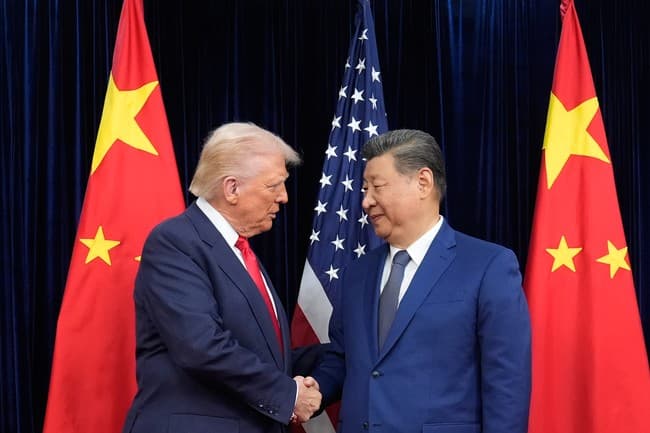
 Trump and Xi Jinping shake hands with US and Chinese flags
Iran War May Weaken Trump's Hand in High-Stakes Xi Summit
Intra-Party Split Detected
Some Republicans like Gingrich see potential for breakthrough while others worry Iran conflict undermines Trump's negotiating position
Left says
- •Trump's military engagement in Iran has significantly weakened his negotiating position by stretching U.S. resources and creating strategic vulnerabilities that Xi can exploit
- •The war has damaged America's credibility with allies in the region who worry Trump might trade away security commitments to China in exchange for economic concessions
- •China now holds increased leverage as Iran's oil crisis affects global markets and Beijing can position itself as a stabilizing force while America is distracted by conflict
Right says
- •Trump's strong action against Iran demonstrates American resolve and actually strengthens his position by showing Xi that the U.S. will use force to protect its interests
- •The meeting represents a major diplomatic opportunity where Trump's proven willingness to take decisive military action gives him credibility in negotiations with China
- •Trump's personal relationship with Xi and his track record of securing trade victories through tough negotiations position him well despite temporary complications from Iran
Common Take
High Consensus- The Trump-Xi summit carries enormous stakes for U.S.-China relations and global economic stability
- Iran will be a significant topic of discussion given China's economic ties to Iranian oil markets
- Trade deficits, technology competition, and regional security issues remain central challenges between the two superpowers
- The timing and outcome of this meeting could reshape the trajectory of U.S.-China competition
The Arguments
Right argues
Trump's decisive military action against Iran demonstrates American resolve and credibility, showing Xi that the U.S. will use force to protect its interests rather than backing down from challenges. This proven willingness to take tough action strengthens Trump's negotiating position by establishing that his threats carry real weight.
Left counters
Military engagement in Iran has stretched U.S. resources thin and created strategic vulnerabilities that China can exploit, while also damaging America's credibility with regional allies who now worry Trump might sacrifice their security interests for economic concessions with Beijing.
Left argues
The Iran war has fundamentally weakened Trump's negotiating leverage by forcing the U.S. to fight on multiple fronts while China can position itself as a stabilizing force in global markets disrupted by Iranian oil shortages. Asian allies fear Trump will trade away security commitments to secure better economic terms with China.
Right counters
Trump's track record of securing trade victories through tough negotiations, combined with his personal relationship with Xi, positions him well to leverage America's demonstrated military resolve into diplomatic gains despite temporary complications from Iran.
Left argues
China now holds increased leverage as Iran's oil crisis affects global energy markets, allowing Beijing to present itself as a responsible stakeholder while America appears distracted and overextended by military conflict. This shift in global perception undermines U.S. diplomatic influence.
Right counters
The summit represents a major diplomatic opportunity where Trump's proven decisiveness gives him credibility in high-stakes negotiations, and his ability to project strength through military action actually enhances rather than diminishes his bargaining position with Xi.
Right argues
Trump's personal relationship with Xi Jinping and his previous success in securing trade agreements through direct negotiations give him unique advantages that transcend temporary military complications. His willingness to use both economic and military pressure tools demonstrates comprehensive American power.
Left counters
Regional allies' concerns about potential security trade-offs reveal how the Iran conflict has created doubt about American reliability, giving China an opening to exploit these fractures in U.S. alliance relationships during negotiations.
Challenge Questions
These questions target genuine internal contradictions — meant to provoke honest reflection.
Right asks Left
“If military action against Iran truly weakens America's position, why would China view a militarily engaged United States as less threatening rather than more unpredictable and dangerous to provoke?”
Left asks Right
“How can Trump's demonstrated willingness to use military force be seen as strengthening his negotiating position when it has clearly strained resources and created new strategic vulnerabilities that China can exploit?”
Outlier Report
Left Fringe
Progressive anti-war activists like CodePink's Medea Benjamin and some Squad members like Rep. Rashida Tlaib who argue any military action automatically undermines all diplomatic efforts represent about 15-20% of the left coalition.
Right Fringe
Hardline hawks like Sen. Tom Cotton and former UN Ambassador John Bolton who believe military action should be escalated rather than used as diplomatic leverage represent about 25% of the right coalition.
Noise Assessment
Moderate noise level - most discourse reflects genuine disagreement about foreign policy strategy rather than performative positioning, though some partisan figures amplify talking points beyond their actual beliefs.
Sources (10)
How the summit could change the course of U.S.-China competition.
The war in Iran, trade, artificial intelligence and Taiwan are expected to be on the agenda. But expectations are modest.
Beijing is signaling that it is ready for a trade showdown, and it is building up a legal arsenal in preparation.
Asian nations worry that the president might trade security commitments for better economic terms with China during his planned meeting with Xi Jinping this week.
The U.S. war against Iran threatens to be a dark cloud following President Trump to his high-stakes meeting with Chinese President Xi Jinping later this week.  Trump is expected to meet with Xi on Thursday and Friday in a trip postponed because of the war from early April. This time, Trump plans to travel to…
On Sunday, Sen. Jack Reed (D-R.I.) said that President Trump is heading into his meeting with Chinese President Xi Jinping in a “weakened” position. “President Trump is going into this meeting terribly weakened,” Reed, the top Democrat on the Senate Armed Services Committee, told host Shannon Bream on “Fox News Sunday.” “He has involved ourselves…
Former Speaker Newt Gingrich (R-Ga.) said the upcoming meeting between President Trump and Chinese President Xi Jinping could yield a “remarkable breakthrough” Gingrich appeared on the “Cats Roundtable” radio show hosted by John Catsimatidis on WABC 770 AM, where he said Trump’s visit to Beijing is “the biggest thing in the near future.” Trump requested to move…
As the May 14-15 summit between President Trump and Xi Jinping approaches, the U.S. is racing to freeze the Iran crisis before it weakens their hand at the table, while China's leverage increases and Saudi Arabia diversifies its security relationships.