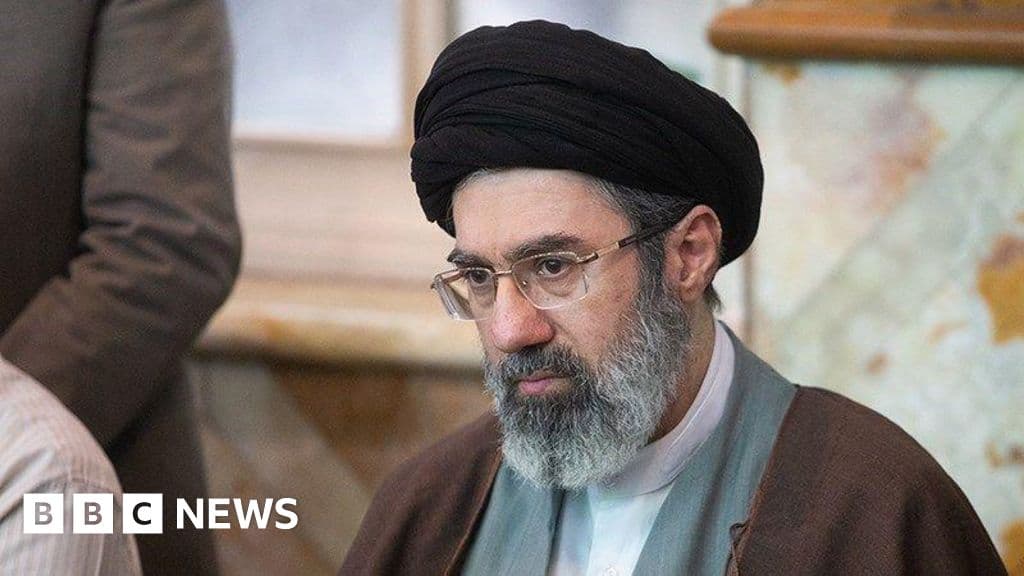
 Mojtaba Khamenei, Iran's new supreme leader, in clerical attire
Iran's Supreme Leader Succession Raises Dynastic Rule Questions
Left says
- •The succession represents continuity during a crisis period when Iran faces military strikes from the U.S. and Israel
- •Mojtaba Khamenei's selection signals the Islamic Republic's defiance against foreign pressure and attempts to maintain stability
- •The 56-year-old has deep knowledge of Iran's power structures through his behind-the-scenes role assisting his father
- •His close ties to the Revolutionary Guard Corps position him to coordinate Iran's military response effectively
Right says
- •The hereditary succession contradicts the Islamic Republic's founding principles of merit-based religious leadership over dynastic rule
- •Mojtaba Khamenei's extensive London real estate portfolio, including properties near the Israeli Embassy, raises questions about corruption and sanctions evasion
- •His lack of elected office or senior government experience makes him an unqualified lightweight for such a critical position
- •President Trump's warning that any new leader needs U.S. approval or won't last long demonstrates American leverage over Iran's leadership
Common Take
High Consensus- Mojtaba Khamenei, 56, has been selected by Iran's Assembly of Experts as the country's third Supreme Leader
- He has maintained a low public profile throughout his life, never holding elected office or giving public speeches
- The succession comes after his father was killed in U.S.-Israeli strikes on February 28
- He has close connections to Iran's Islamic Revolutionary Guard Corps and played a behind-the-scenes role in his father's administration
The Arguments
Left argues
Mojtaba Khamenei's selection provides crucial continuity during an unprecedented crisis, as Iran faces coordinated military strikes from the U.S. and Israel that have already killed his father and wife. His decades of behind-the-scenes experience managing Iran's power structures and close coordination with the Revolutionary Guard Corps position him to effectively lead the country's military response during this existential threat.
Right counters
Continuity during crisis doesn't justify abandoning the Islamic Republic's foundational principles of merit-based religious leadership, and his lack of any elected office or senior government experience makes him fundamentally unqualified to lead a nation under attack.
Right argues
The hereditary succession directly contradicts the Islamic Republic's founding ideology that rejected dynastic monarchy in favor of religious leadership chosen for theological standing and proven governance, not bloodline. This represents a fundamental betrayal of the 1979 revolution's core principles that overthrew the Shah's hereditary rule.
Left counters
The Assembly of Experts, the legitimate constitutional body responsible for selecting the Supreme Leader, voted decisively for Mojtaba Khamenei based on his qualifications and the urgent need for stable leadership during wartime, not merely his family connection.
Right argues
Mojtaba Khamenei's extensive London real estate portfolio, including luxury apartments overlooking the Israeli Embassy purchased with Iranian oil funds, demonstrates corruption and sanctions evasion that undermines his moral authority to lead. His global property empire worth hundreds of millions contradicts the Islamic Republic's stated values of economic justice.
Left counters
These property allegations, while concerning, pale in comparison to the immediate need for experienced leadership during active military conflict, and his deep knowledge of Iran's financial and security apparatus makes him uniquely qualified to coordinate the country's defense.
Left argues
The succession signals Iran's defiance against foreign pressure and demonstrates the regime's determination to maintain independence despite U.S. and Israeli attempts to destabilize the country. Mojtaba's selection shows that Iran will not bow to external demands about its internal leadership choices.
Right counters
President Trump's explicit warning that any new leader needs U.S. approval or 'won't last long' demonstrates that American military and economic leverage gives the U.S. effective veto power over Iran's leadership, making this defiance potentially short-lived.
Right argues
Mojtaba Khamenei is fundamentally a 'lightweight' with no electoral mandate, no senior government experience, and no public record of leadership, making him an unqualified choice for such a critical position during wartime. His secretive nature and lack of public engagement demonstrate unfitness for supreme leadership.
Left counters
His decades of managing his father's affairs and coordinating with Iran's security apparatus provided invaluable behind-the-scenes experience in the actual mechanics of power, while his low public profile reflects the traditional discretion expected of potential successors rather than incompetence.
Challenge Questions
These questions target genuine internal contradictions — meant to provoke honest reflection.
Right asks Left
“If continuity and stability during crisis are the primary justifications for Mojtaba's selection, how do you reconcile supporting a succession process that fundamentally abandons the Islamic Republic's founding principles of merit-based religious leadership over hereditary rule?”
Left asks Right
“If Mojtaba Khamenei's extensive foreign real estate holdings and wealth accumulation through Iranian oil funds represent the kind of corruption and sanctions evasion you typically condemn, how can you simultaneously argue he lacks the moral authority to lead while supporting his removal?”
Outlier Report
Left Fringe
Progressive anti-war activists like CodePink's Medea Benjamin may argue for complete U.S. non-interference in Iran's internal succession, representing roughly 15% of the left who oppose any U.S. involvement in Middle East leadership transitions.
Right Fringe
Hardline interventionists like John Bolton or Tom Cotton may advocate for immediate military action to prevent the succession entirely, representing approximately 20% of the right who favor direct regime change operations over diplomatic pressure.
Noise Assessment
Moderate noise level - most coverage reflects genuine policy differences about U.S. engagement with Iran, though Trump's dramatic statements about 'approval' generate some performative responses amplifying hawkish positions.
Sources (9)
Many expect the 56-year-old, who has largely kept a low profile, to continue his father's hardline policies.
<p>Former Iranian Supreme Leader Ayatollah Ali Khamenei's son, Mojtaba Khamenei, was selected to be the next Supreme Leader of Iran, according to multiple reports.</p> <p>The post <a href="https://www.breitbart.com/middle-east/2026/03/08/ayatollah-ali-khameneis-son-mojtaba-selected-as-supreme-leader-of-iran/" rel="nofollow">Ayatollah Ali Khamenei’s Son, Mojtaba, Selected as Supreme Leader of Iran</a> appeared first on <a href="https://www.breitbart.com" rel="nofollow">Breitbart</a>.</p>
The next supreme leader of Iran will be the late Ayatollah Ali Khamenei’s son, Mojtaba Khamenei, Iran’s clerical body that appoints the country’s supreme leader announced on Sunday. Iran’s Assembly of Experts said the younger Khamenei had been chosen with a “decisive vote” and urged Iranians to rally behind him, putting an emphasis on the ...
The succession of the slain leader’s son is seen as a signal of the Islamic republic’s defiance of Israel and the United States, and of continuity during crisis.
A secretive figure within the Islamic Republic, Mojtaba Khamenei was not seen publicly in the days after an Israeli airstrike targeting the supreme leader's offices killed his 86-year-old father at the start of the war.
Mojtaba Khamenei, a son of Iran's late supreme leader, has been named his successor, Iranian state TV announced early Monday.
Iranian clerics elected the son of the late Supreme Leader Ayatollah Ali Khamenei as the next leader of the country, Iranian state media reported Sunday, as the U.S. and Israel continue to pummel the country with military strikes. Mojtaba Khamenei was elected by a body of 88 Iranian clerics in the wake of the death…
The clerical body that will choose Iran's next supreme leader, succeeding the slain Ayatollah Ali Khamenei, has more or less reached a majority consensus, Assembly of Experts member Ayatollah Mohammadmehdi Mirbaqeri said on Sunday.