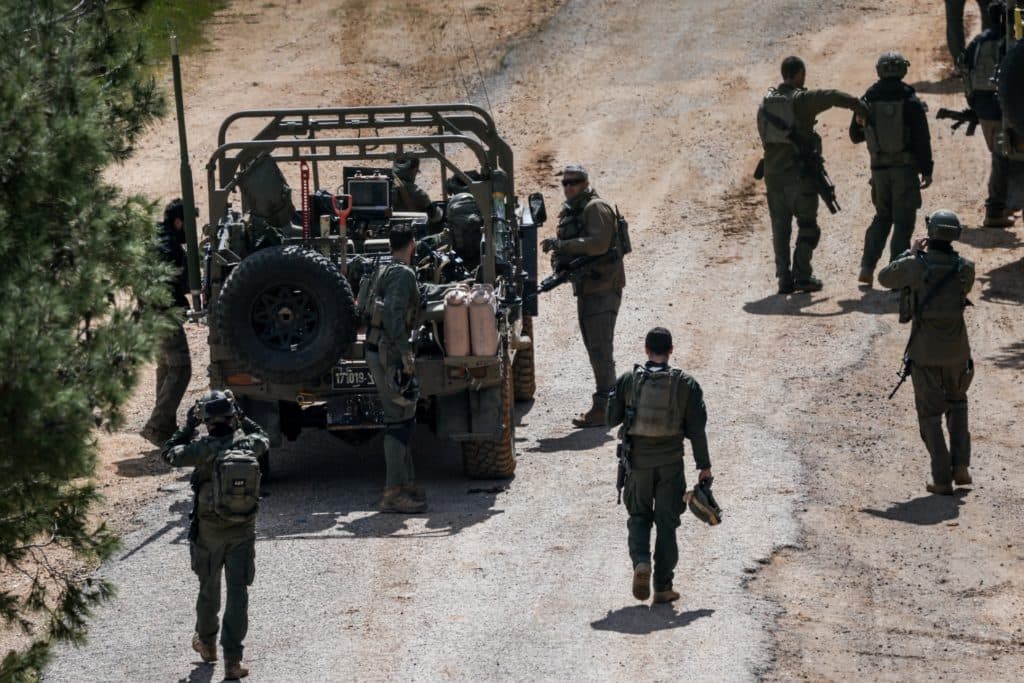
 Israeli soldiers conduct ground operations near Lebanon border
Israel Plans Massive Lebanon Ground Invasion to Seize Territory
Left says
- •The operation amounts to ethnic cleansing as Israel orders mass displacement of over 800,000 Lebanese civilians who are fleeing north with nowhere to go, sleeping on pavements in winter
- •Israel's Finance Minister threatened to turn Lebanon into 'another Gaza,' indicating plans for devastating destruction of civilian infrastructure and prolonged occupation
- •The escalation represents grave war crimes with strikes on schools and hospitals, requiring international accountability through the International Criminal Court
- •The massive ground invasion will devastate Lebanon's already fragile state and economy, dragging the country into the epicenter of a broader regional war
Right says
- •Israel's expanded ground operation is necessary to dismantle Hezbollah's military infrastructure and push terrorist forces away from the border to protect Israeli civilians
- •The operation has full U.S. backing under the Trump administration, which recognizes Israel's right to defend itself against Hezbollah's rocket attacks and coordinated assault with Iran
- •Hezbollah triggered this escalation by launching over 200 missiles in coordination with Iran, forcing Israel to abandon ceasefire negotiations and pursue military action
- •The Lebanese government's diplomatic efforts failed to control Hezbollah, leaving military action as the only viable option to achieve lasting security for northern Israel
Common Take
High Consensus- Over 800,000 Lebanese civilians have been displaced and at least 773 people killed since the conflict began
- The Trump administration is pushing for direct Israel-Lebanon talks on a postwar agreement while managing the crisis through diplomatic channels
- The conflict has entered its third week with significant impacts on regional stability and global oil supply chains
- Both Israeli and Lebanese populations face serious security threats and humanitarian consequences from the ongoing military operations
The Arguments
Right argues
Israel's ground operation is a necessary defensive response to Hezbollah's coordinated attack with Iran that launched over 200 missiles, forcing Israel to abandon ceasefire negotiations and protect its northern border communities.
Left counters
The massive displacement of 800,000+ Lebanese civilians and threats to turn Lebanon into 'another Gaza' reveal this is not defensive but an offensive operation aimed at territorial seizure and collective punishment.
Left argues
The operation constitutes ethnic cleansing as Israel orders mass evacuation of entire populations with nowhere to go, leaving people sleeping on pavements in winter while systematically destroying civilian infrastructure.
Right counters
Israel issues evacuation warnings precisely to minimize civilian casualties while targeting Hezbollah's military infrastructure that the group deliberately embeds in civilian areas, making surgical strikes impossible.
Left argues
Strikes on schools and hospitals represent clear war crimes that require International Criminal Court accountability, as there is mounting evidence of grave violations of international humanitarian law.
Right counters
These facilities are legitimate military targets when Hezbollah uses them to store weapons and launch attacks, and Israel has the right to defend itself against a terrorist organization that systematically violates the laws of war.
Right argues
The Lebanese government's diplomatic efforts failed to control Hezbollah or implement UN Resolution 1701, leaving military action as the only viable option to achieve lasting security and push terrorist forces away from the border.
Left counters
A prolonged Israeli occupation of southern Lebanon will devastate the country's fragile state and economy, creating the very instability that breeds extremism rather than achieving long-term security.
Left argues
The operation will drag Lebanon into the epicenter of a broader regional war, destabilizing an already fragile state and potentially creating a humanitarian catastrophe that serves no legitimate security purpose.
Right counters
Hezbollah already dragged Lebanon into this conflict by coordinating with Iran's attack, and only dismantling their military capabilities will prevent future escalations that threaten both Israeli and Lebanese civilians.
Challenge Questions
These questions target genuine internal contradictions — meant to provoke honest reflection.
Right asks Left
“If Israel's actions constitute ethnic cleansing and war crimes as you claim, why do you not equally condemn Hezbollah's deliberate strategy of embedding military assets in civilian areas and launching 200+ missiles at Israeli population centers?”
Left asks Right
“If this operation is truly defensive and aimed at protecting Israeli civilians, how do you reconcile the stated goal of seizing territory south of the Litani River with claims of self-defense, and why does Israel's Finance Minister explicitly threaten to turn Lebanon into 'another Gaza'?”
Outlier Report
Left Fringe
Squad members like Rashida Tlaib and Ilhan Omar who call for complete arms embargos and BDS against Israel represent approximately 15% of the left, taking more absolutist anti-Israel positions than mainstream Democratic opposition.
Right Fringe
Christian Zionist leaders like John Hagee and far-right figures like Nick Fuentes who either demand unlimited Israeli expansion or oppose it for antisemitic reasons represent roughly 20% of the right, diverging from standard Republican pro-Israel but measured positions.
Noise Assessment
High amplification on social media from both pro-Israel and pro-Palestinian activist networks creates outsized visibility for extreme positions, while most Americans remain focused on domestic economic concerns rather than Middle East conflicts.
Sources (4)
<p><a href="https://www.axios.com/world/israel" target="_blank">Israel</a> is planning to significantly expand its ground operation in <a href="https://www.axios.com/2026/03/06/lebanon-israel-iran-irgc-hezbollah" target="_blank">Lebanon</a>, aiming to seize the entire area south of the Litani River and dismantle Hezbollah's military infrastructure, Israeli and U.S. officials say.</p><p><strong>Why it matters:</strong> This could be the largest Israeli ground invasion of its northern neighbor since 2006, dragging Lebanon to the epicenter of the escalating <a href="https://www.axios.com/2026/03/13/trump-iran-surrender-hormuz-oil" target="_blank">war with Iran</a>.</p><hr /><ul><li>"We are going to do what we did in Gaza," a senior Israeli official said, referring to the flattening of buildings Israel says Hezbollah uses to store weapons and launch attacks.</li></ul><p><strong>The big picture: </strong>An operation of this size and scale could lead to a prolonged Israeli occupation of southern Lebanon.</p><ul><li>Lebanon's government is deeply alarmed that the renewed war — triggered by Hezbollah's decision to <a href="https://www.axios.com/2026/03/02/iran-war-israel-hezbollah-lebanon" target="_blank">launch rockets at Israel</a> — will devastate the country.</li><li>The Trump administration backs a major Israeli operation to disarm Hezbollah, but is also pressing to limit the damage to the Lebanese state and pushing for <a href="https://www.axios.com/2026/03/09/lebanon-israel-hezbollah-peace-talks" target="_blank">direct Israel-Lebanon talks</a> on a postwar agreement.</li></ul><p><strong>Driving the news:</strong> Until days ago, Israeli Prime Minister <a href="https://www.axios.com/2026/03/03/trump-netanyahu-call-iran-war-israel-coordination" target="_blank">Benjamin Netanyahu's government</a> was still trying to contain the Lebanon escalation in order to stay focused on Iran, according to Israeli officials.</p><ul><li>That calculus changed Wednesday when Hezbollah launched more than 200 missiles in a massive coordinated attack with Iran, which fired dozens of its own.</li><li>"Before this attack we were ready for a ceasefire in Lebanon, but after it there is no way back from a massive operation," a senior Israeli official said.</li></ul><p><strong>State of play:</strong> The IDF has had three armored and infantry divisions on the Lebanese border since the start of the Iran war, with some ground forces conducting limited incursions over the past two weeks.</p><ul><li>On Friday, the IDF announced it's sending reinforcements to the border and mobilizing additional reserves ahead of the expanded ground operation.</li><li>"The goal is to take over territory, push Hezbollah's forces north and away from the border, and dismantle its military positions and weapons depots in the villages," the official said. </li></ul><p><strong>The other side:</strong> Hezbollah leader Naim Qassem said Friday that the Lebanese government's diplomatic track had failed to achieve sovereignty or protect Lebanese civilians — and therefore "there is no solution except resistance."</p><ul><li>"When the enemy threatens a ground invasion, we tell him: this is not a threat, but one of the traps you will fall into," Qassem said.</li><li>"Because every advance of a ground invasion allows the resistance fighters to achieve gains and results through close confrontation with the enemy."</li></ul><p><strong>Zoom in:</strong> The IDF has issued evacuation orders across southern Lebanon and — for the first time — to villages and towns north of the Litani River, as well as to Hezbollah's stronghold in Beirut's southern suburbs.</p><ul><li>Around 800,000 Lebanese civilians have been displaced since the start of the conflict. At least 773 people have been killed, many of them civilians.</li></ul><p><strong>Behind the scenes:</strong> The Trump administration asked Israel not to bomb Beirut's international airport or other Lebanese state infrastructure during the operation, U.S. and Israeli officials say.</p><ul><li>U.S. officials said Israel agreed to spare the airport — but stopped short of committing to protect other state infrastructure. On Friday, the IDF bombed a bridge in southern Lebanon it claimed Hezbollah was using to move forces and weapons.</li><li>An Israeli official said they will consult with Washington on a case-by-case basis: "We feel we have full U.S. backing for this operation," the official told Axios.</li><li>"The Israelis have to do what they have to do to stop the Hezbollah shelling," a U.S. official said.</li></ul><p><strong>The intrigue:</strong> Netanyahu has tasked former minister Ron Dermer with managing the Lebanese file during the war, according to U.S. and Israeli officials.</p><ul><li>Dermer will handle contacts with the Trump administration and lead any negotiations with the Lebanese government if direct talks begin in the coming weeks, the officials said.</li><li>On the American side, the file is being managed by Trump adviser Massad Boulos, who is also the U.S. envoy for Africa.</li><li>Boulos, who is Tiffany Trump's father-in-law, has been in contact with Israeli, Lebanese and Arab officials in recent days to facilitate direct talks between Israel and Lebanon.</li></ul><p><strong>What to watch:</strong> The Lebanese government has indicated in recent days it is ready to hold direct talks on the terms of a ceasefire with Israel, immediately and without preconditions.</p><ul><li>Sources say the Trump administration wants to use those negotiations to lay the groundwork for a broader deal that would formally end the state of war between Israel and Lebanon — ongoing since 1948.</li></ul>
It is the seventh day of the U.S.-Israeli war on Iran, and Israel is escalating attacks on Lebanon after ordering the entire population of southern Lebanon to flee. This comes as Israel’s far-right Finance Minister Bezalel Smotrich threatened to turn areas of Lebanon into another Gaza in a video shared on social media Thursday. “The word on everyone’s mouths here is ethnic cleansing,” says Lylla Younes, an investigative journalist speaking with <em>Democracy Now!</em> from Beirut. “People are basically fleeing north with nowhere to go. Shelters are filling up rapidly. People are sleeping on the pavement in the winter nights.”</p> <p>Human rights lawyer Omar Shakir, the new executive director of <span class="caps">DAWN</span>, has urged Iran to give the International Criminal Court jurisdiction over apparent crimes committed by the U.S. and Israel in strikes on schools and hospitals. “There is more and more evidence emerging every single day of grave war crimes being carried out by the United States and Israel,” he says. “The Israeli government, because of impunity, is emboldened across the region. And unless we see a strong response from states that are willing to use the tools of accountability, … the risk to civilians across the region will continue to grow.”
IDF troops conduct 'ground operations' in Lebanon
The war with Iran has entered its third week, shipping traffic through the critical Strait of Hormuz remains effectively shut off, and the shockwaves to the global supply chain of oil are being felt, with gas prices on the rise. President Trump himself is demanding help from U.S. allies to secure the strait. Nick Schifrin reports.