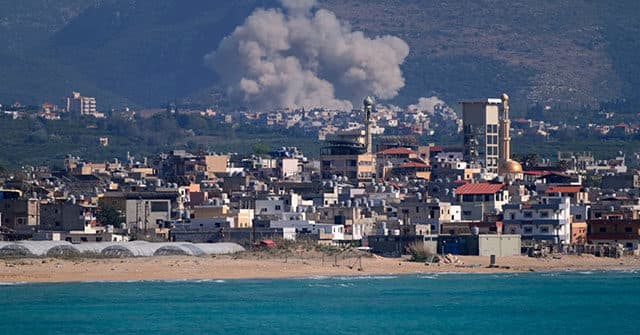
 Smoke rises over Beirut cityscape showing aftermath of Israeli strikes
Israel Strikes Beirut Despite Trump Warning, Risking Iran Escalation
Left says
- •Israel's attack on Beirut violates the fragile ceasefire and undermines diplomatic efforts to prevent regional war escalation
- •The strike occurred despite Trump's explicit warnings against such action, showing Netanyahu's disregard for U.S. diplomatic leadership
- •Iran's threatened retaliation could unravel ongoing U.S.-Iran negotiations and reignite broader Middle East conflict
- •Israel has conducted over 3,400 strikes since the ceasefire began, demonstrating systematic violations of the agreement
Right says
- •Israel exercised its legitimate right to self-defense after Hezbollah violated the ceasefire by launching missiles at northern Israel
- •Hezbollah rejected the U.S.-brokered ceasefire terms and continues attacking Israeli territory, making Israeli retaliation necessary
- •The targeted strike hit a Hezbollah command center in their stronghold, focusing on legitimate military infrastructure rather than civilians
- •Israel notified the Trump administration beforehand and scaled down the attack to minimize impact on ongoing diplomatic negotiations
Common Take
High Consensus- Iran has threatened retaliation against Israel following the Beirut strikes, raising concerns about regional escalation
- Hezbollah rejected the full ceasefire agreement terms and continues launching attacks on northern Israel
- The U.S. supports diplomatic solutions while backing Israel's right to self-defense
- At least two people were killed and a dozen wounded in the Israeli strike on Beirut's southern suburbs
The Arguments
Right argues
Israel exercised legitimate self-defense after Hezbollah rejected the U.S.-brokered ceasefire and continued launching missiles at Israeli territory, making retaliation necessary to protect Israeli civilians.
Left counters
Israel has conducted over 3,400 strikes since the ceasefire began, demonstrating systematic violations that far exceed any proportional response to Hezbollah's actions and undermine the entire diplomatic framework.
Left argues
The strike occurred despite Trump's explicit warnings against such action, showing Netanyahu's disregard for U.S. diplomatic leadership and potentially unraveling ongoing U.S.-Iran negotiations.
Right counters
Israel notified the Trump administration beforehand and scaled down the attack to minimize diplomatic impact, while the U.S. officially supported Israel's right to self-defense and blamed Hezbollah for continuing hostilities.
Left argues
Iran's threatened retaliation could reignite broader Middle East conflict and destroy the fragile diplomatic progress made through U.S.-Iran negotiations.
Right counters
Iran's threats demonstrate that it uses Lebanon as a proxy battleground and refuses to accept legitimate Israeli self-defense, making diplomatic solutions impossible without addressing Hezbollah's continued aggression.
Right argues
The targeted strike hit a Hezbollah command center in their stronghold, focusing on legitimate military infrastructure rather than civilians, which is a proportional response to terrorist attacks.
Left counters
The strike killed at least two people and wounded a dozen others, and represents an escalation that violates the ceasefire agreement regardless of the target's military nature.
Left argues
Israel's pattern of over 3,400 strikes since the ceasefire demonstrates systematic violations that have displaced nearly one-fifth of Lebanon's population and destroyed entire neighborhoods.
Right counters
These strikes are necessary responses to Hezbollah's continued attacks and refusal to withdraw from southern Lebanon as required by the ceasefire terms, with Israel acting within its rights under the agreement.
Challenge Questions
These questions target genuine internal contradictions — meant to provoke honest reflection.
Right asks Left
“If Israel has conducted over 3,400 strikes while claiming to follow a ceasefire agreement, how can you argue that Israel is genuinely committed to diplomatic solutions rather than using the ceasefire as cover for continued military operations?”
Left asks Right
“If Hezbollah explicitly rejected the ceasefire terms and continues launching missiles at Israeli civilians, how can you expect Israel to maintain restraint indefinitely while its citizens remain under attack?”
Outlier Report
Left Fringe
Progressive Squad members like Alexandria Ocasio-Cortez and Rashida Tlaib who frame any Israeli military action as aggression regardless of context, representing roughly 15% of the left coalition.
Right Fringe
Hardline pro-Israel voices like Ben Shapiro and evangelical leaders who support unlimited Israeli military action without regard for U.S. diplomatic concerns, representing about 20% of the right coalition.
Noise Assessment
Moderate noise level - most discourse reflects genuine policy disagreements about Middle East strategy rather than performative positioning, though some amplification occurs around Iran escalation fears.
Sources (5)
<p>Israel struck Beirut's southern suburbs Sunday in retaliation to a Hezbollah missile attack on northern Israel, Israeli officials said.</p><p><strong>Why it matters:</strong> Iran threatened last week to launch a missile attack against Israel if it attacks Beirut, while the U.S. has backed Israel's right to self-defence. Such a move could unravel U.S.–Iran negotiations and reignite the war.</p><hr /><ul><li>A U.S. defense official tells Axios that U.S. forces in the Middle East "are prepared for defense" in case Iran implements its threats and launches new attacks.</li><li>Israel notified the Trump administration before the strike, a U.S. official and two other sources with knowledge tell Axios.</li><li>"The United States supports Israel's right to self-defense and stands with the legitimate Government of Lebanon as it works to deliver a better future for its citizens," a second U.S. official tells Axios. Hezbollah "must stop firing immediately and allow these agreements to take effect."</li></ul><p><strong>Driving the news:</strong> Israeli Prime Minister Benjamin Netanyahu said the strike answered Hezbollah missiles fired at northern Israel earlier Sunday, which the Israeli military says it intercepted.</p><ul><li>Israeli officials said the Beirut strike targeted a Hezbollah command center in Dahieh — a Shia district known as a Hezbollah stronghold. </li><li>At least two people were killed and a dozen wounded, according to Lebanon's state news agency. </li></ul><p><strong>Threat level: </strong>Senior Iranian lawmakers publicly threatened retaliation.</p><ul><li>Ebrahim Rezaei, a member of the Iranian parliament's national security committee, <a href="https://x.com/EbrahimRezaei14/status/2063625762947707228" target="_blank">wrote on X</a> that Iran "will give a decisive and painful response to the Zionist regime's attack on Dahieh."</li><li>He told followers to "watch the skies" over Israel tonight.</li><li>Iranian speaker of parliament and chief negotiator Mohammad Bagher Ghalibaf echoed that.</li><li>Ghalibaf <a href="https://x.com/mb_ghalibaf/status/2063652758402527527" target="_blank">wrote on X</a>: "They neither adhere to the ceasefire nor believe in dialogue, and with the naval blockade and violation of agreements on Lebanon, they showed that they only understand the language of force. The naval blockade against the Iranian nation and today's U.S. green light to the Zionist regime turn American and regime bases and assets in the region into legitimate targets. Our armed forces are ready as always."</li></ul><p><strong>Behind the scenes:</strong> The Israelis told the Trump administration that Hezbollah's continued attacks on northern Israel violate a ceasefire, giving Israel the right to hit Beirut, the sources told Axios.</p><ul><li>The Israelis made clear they will continue hitting the Beirut every time Hezbollah launches attacks against northern Israel.</li><li>The White House and the State Department didn't immediately respond to a request for comment. </li></ul><p><strong>Catch up quick:</strong> On Monday, President <a href="https://www.axios.com/politics-policy/donald-trump" target="_self">Trump</a> put the brakes on Israel's plan to launch massive strikes on Beirut in response to Hezbollah's drone and missile strikes.</p><ul><li>Trump lashed out at Netanyahu in an <a href="https://www.axios.com/2026/06/01/trump-netanyahu-israel-lebanon-call" target="_self">expletive-laden call</a>.</li><li>After the call, Trump announced a partial ceasefire that included an Israeli commitment not to attack Beirut in return for Hezbollah stopping attacks on Israeli border towns.</li><li>On Wednesday, <a href="https://www.axios.com/world/israel" target="_self">Israel</a> and Lebanon <a href="https://www.axios.com/2026/06/03/israel-lebanon-ceasefire-hezbollah-us" target="_blank">agreed</a><strong> </strong>to a full ceasefire, contingent on Hezbollah halting attacks and withdrawing its operatives from the area south of the Litani River in Lebanon.</li><li><a href="https://www.axios.com/2026/06/01/lebanon-full-ceasefire-hezbollah-israel-nabih-berri" target="_self">Hezbollah</a> rejected the terms Thursday. Without Hezbollah's agreement, the ceasefire stayed "on paper."</li></ul><p><strong>What they're saying:</strong> A U.S. official said Hezbollah has a choice: It "can continue fighting a pointless war, or it can finally allow the return of the displaced and the reconstruction of Lebanon."</p><ul><li>"The terms on the table are fair, have the consent of both sovereign governments, and provide a clear path to end the fighting," the official said. Hezbollah "is exclusively to blame for any continuation of hostilities."</li><li>The official said the U.S. sees the process as a way to strengthen Lebanon's sovereignty while improving Israel's security.</li></ul><p><em>Editor's note: This story was updated to add Iranian officials' comments and updated comment from two U.S. sources.</em></p>
<p>Lebanese Defense Minister Michel Menassa said on Monday that Israel has conducted 3,491 airstrikes against targets in Lebanon since the U.S.-brokered “ceasefire” began on April 17.</p> <p>The post <a href="https://www.breitbart.com/middle-east/2026/06/08/lebanons-defense-minister-counts-3491-israeli-strikes-since-ceasefire-began/" rel="nofollow">Lebanon’s Defense Minister Counts 3,491 Israeli Strikes Since Ceasefire Began</a> appeared first on <a href="https://www.breitbart.com" rel="nofollow">Breitbart</a>.</p>
Iran and Israel exchanged fire overnight in the most serious escalation since a U.S.-Iranian truce was reached in April. Iran launched a wave of missiles at northern Israel in retaliation for Israeli attacks near Beirut on Sunday. Israel responded with attacks on Iran, with explosions reported in Tehran, Tabriz and Isfahan. This comes as peace talks appear stalled between the United States and Iran, largely over Iran’s insistence that any agreement must include Lebanon and halt Israel’s attacks on that country. President Donald Trump has also repeatedly expressed frustration with Israeli Prime Minister Benjamin Netanyahu, and reports from <span class="caps">NBC</span> News and <em>The New York Times</em> indicate the Pentagon is growing increasingly concerned over Israel spying on U.S. officials.</p> <p>“I was not surprised by the Iranian attack on Israel,” says analyst Trita Parsi, who notes that Iran’s leaders want to “extend their deterrence” to Lebanon. “What is perhaps a bit surprising is … that the Israelis defied Trump’s expressed wishes.”
Israeli drones have killed at least eight people in Lebanon despite an announcement Monday by U.S. President Donald Trump that both Israel and Hezbollah had agreed to stop fighting. Trump’s intervention came as Israel threatened new strikes on the southern suburbs of Beirut, leading Iran to suspend indirect negotiations with the U.S. to protest Israel’s expanding military offensive in Lebanon. Since March 2, Israel has killed more than 3,400 people in Lebanon while seizing large swaths of the country and displacing about one-fifth of the population.</p> <p>Lebanon is “a weak state, it doesn’t have a lot of leverage, and a lot of people are concerned,” says Associated Press reporter Kareem Chehayeb in Beirut. “They sort of feel beholden to the regional and global powers on their fate.”
<p>IDF eliminates Hamas Nukhba commander behind Kissufim massacre during October 7 attack.</p> The post <a href="https://legalinsurrection.com/2026/06/idf-strikes-hezbollahs-beirut-stronghold-as-terror-group-rejects-ceasefire-attacks-northern-israel/">IDF Strikes Hezbollah’s Beirut Stronghold as Terror Group Rejects Ceasefire, Attacks Northern Israel</a> first appeared on <a href="https://legalinsurrection.com">Le·gal In·sur·rec·tion</a>.