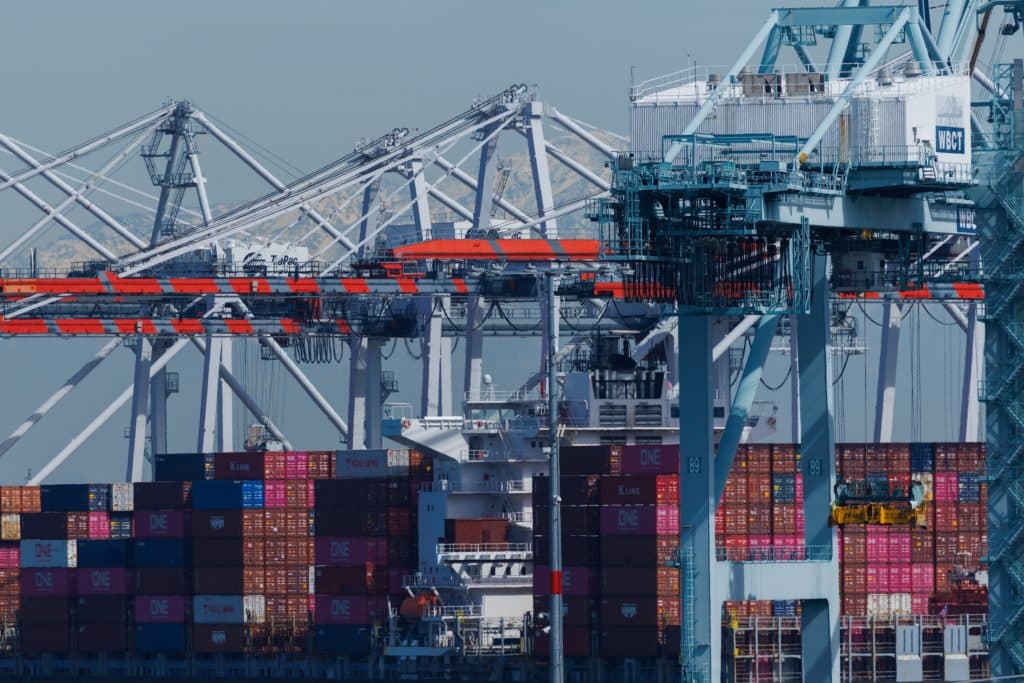
 Shipping containers including China Shipping at a port, representing international trade affected by tariffs.
Judge Orders Billions in Refunds for Trump's Illegal Tariffs
Left says
- •The Supreme Court's 6-3 ruling confirms these tariffs exceeded presidential authority and violated constitutional limits on executive power
- •Companies like Costco, FedEx, and Kohl's that have pledged to pass refunds directly to customers will help offset the financial burden Trump's policies placed on American consumers
- •The refunds with interest represent accountability for an administration that imposed economically harmful trade policies without proper legal authority
- •This ruling demonstrates the importance of judicial oversight in preventing executive overreach on trade policy
Right says
- •The tariffs were implemented as legitimate trade policy tools to protect American industries and workers from unfair foreign competition
- •The legal challenge represents an attempt to undermine presidential authority over trade policy during a time when aggressive action was needed to address trade imbalances
- •The refund process will create significant administrative burden and costs for Customs and Border Protection, requiring manual review of over 70 million entries
- •The Supreme Court's narrow legal interpretation fails to account for the president's need for flexibility in responding to economic threats and trade disputes
Common Take
High Consensus- The Supreme Court ruled 6-3 that the tariffs were unconstitutional under the International Emergency Economic Powers Act
- U.S. Court of International Trade Judge Richard Eaton ordered refunds with interest for all affected importers
- Customs and Border Protection faces the unprecedented task of processing refunds for potentially billions of dollars across millions of shipments
- The refund process is expected to take approximately 45 days to implement according to CBP
The Arguments
Left argues
The Supreme Court's 6-3 ruling definitively established that Trump exceeded his constitutional authority by imposing these tariffs under IEEPA, making the refunds a matter of basic legal accountability and restoration of illegally collected funds.
Right counters
The narrow legal interpretation ignores the president's legitimate need for flexible trade policy tools to respond quickly to economic threats and unfair foreign competition that was harming American workers and industries.
Right argues
The refund process will impose massive administrative costs on CBP, requiring manual review of over 70 million entries in an unprecedented operation that diverts resources from essential border security and trade enforcement functions.
Left counters
CBP already processes refunds regularly when importers overpay duties, and as the judge noted, 'they do it every day' - the scale is larger but the process is routine and legally required to remedy constitutional violations.
Left argues
Companies like Costco, FedEx, and Kohl's have committed to passing refunds directly to consumers, helping offset the financial burden that Trump's illegal tariffs placed on American families through higher prices.
Right counters
These tariffs were necessary protective measures against unfair foreign trade practices, and undermining presidential trade authority through retroactive legal challenges weakens America's ability to defend its economic interests.
Right argues
The tariffs served as legitimate policy tools to protect American industries from unfair competition and address serious trade imbalances that were costing American jobs and weakening domestic manufacturing.
Left counters
Regardless of policy intentions, the Constitution requires proper legal authority for such actions, and the Supreme Court clearly ruled that IEEPA did not provide the president with authority to impose these specific tariffs.
Left argues
The refunds with interest represent essential judicial oversight preventing executive overreach, demonstrating that no president can circumvent constitutional limits on trade policy authority even during economic disputes.
Right counters
This ruling hamstrings future presidents from taking swift action against economic threats by imposing rigid legal constraints that ignore the dynamic nature of international trade and the need for executive flexibility.
Challenge Questions
These questions target genuine internal contradictions — meant to provoke honest reflection.
Right asks Left
“If these tariffs were truly harmful to American consumers and the economy, why did it take years of legal challenges to overturn them rather than immediate congressional action or broader public outcry demanding their removal?”
Left asks Right
“How can you argue that these tariffs were necessary and legitimate policy tools while simultaneously accepting that the Supreme Court ruled 6-3 that the president lacked the legal authority to impose them under existing law?”
Outlier Report
Left Fringe
Progressive trade policy advocates like Lori Wallach may argue these refunds don't go far enough in addressing broader trade policy harms, representing approximately 10-15% of the left.
Right Fringe
Trump loyalists and trade hawks like Peter Navarro or Robert Lighthizer likely defend the original tariff authority and criticize judicial overreach, representing roughly 20-25% of the right.
Noise Assessment
Moderate noise level - the legal ruling creates clear factual boundaries that limit extreme partisan interpretation, though framing of 'illegal' vs 'overturned' tariffs generates some performative disagreement.
Sources (4)
In a defeat for the Trump administration, a federal judge in New York ruled Wednesday that companies that paid tariffs struck down last month by Supreme Court are due refunds. Judge Richard Eaton of the U.S. Court of International Trade wrote that "all importers of record'' were "entitled to benefit'' from the Supreme Court ruling that struck down sweeping double-digit import taxes President Donald Trump imposed last year under the 1977 International Emergency Economic Powers Act (IEEPA).
A federal judge ruled Wednesday that companies are owed refunds for tariffs imposed by President Donald Trump that were later overturned by the Supreme Court. The U.S. Court of International Trade handed down the ruling in a case filed by Atmus Filtration Inc. It applies to all importers of record for goods subject to the duties, which were implemented via executive orders under the International Emergency Economic Powers Act (IEEPA). The ruling comes after the Supreme Court's Feb. 20 landmark 6-3 decision in Learning Resources Inc. v. Trump, finding the tariffs were unconstitutional because the president did not have the authority to levy them under IEEPA.
In our news wrap Friday, U.S. Customs and Border Protection says it should have a process ready in about 45 days to start refunding invalidated tariffs to hundreds of thousands of companies, storms are rolling across the central U.S. with forecasters warning of possible tornadoes and GOP Rep. Tony Gonzales is vowing to finish out his term after announcing he won't seek re-election.
<p>Trade court directs customs to repay importers with interest after supreme court ruled tariffs unlawful</p><p>A US trade court judge on Wednesday ordered the government to begin paying potentially billions of dollars in refunds to importers who paid <a href="https://www.theguardian.com/business/tariffs">tariffs</a> that the <a href="https://www.theguardian.com/us-news/us-supreme-court">supreme cour</a>t said last month were collected illegally. Richard Eaton, a judge of the US Court of International Trade in Manhattan, ordered the government to finalize the cost of bringing millions of shipments into the US without assessing a tariff, according to a court filing. He ordered the refunds to be made with interest.</p><p>When merchandise is brought into the United States, an importer pays an estimated amount at entry which is then finalized around 314 days later, a process known as liquidation. Eaton directed Customs and Border Protection (CBP) to finalize the entry cost on shipments without the tariff being assessed, resulting in a refund.</p> <a href="https://www.theguardian.com/business/2026/mar/05/trump-tariff-refunds-supreme-court">Continue reading...</a>