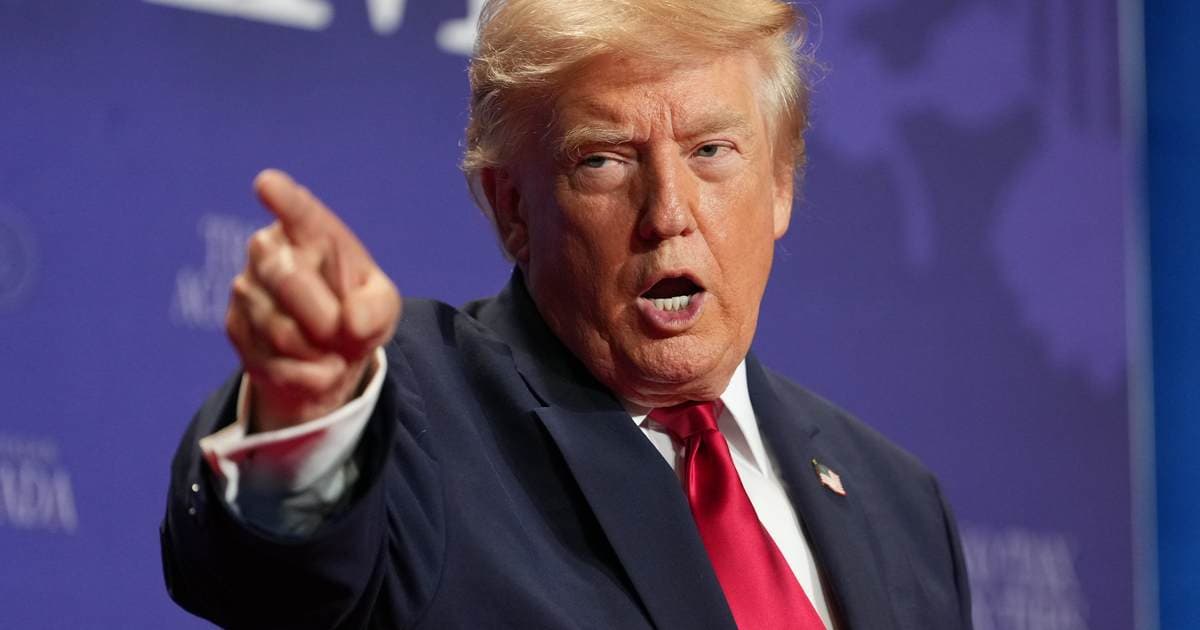
 Donald Trump gestures while speaking, the subject of the lawsuit ruling.
Judge Rules Trump Can't Sue Pollster Over Bad Poll
Left says
- •The ruling reinforces that political speech, including flawed or inaccurate polling, receives the highest level of First Amendment protection and cannot be repackaged as consumer fraud.
- •The judge's 64-page opinion warns that allowing this lawsuit to proceed would chill journalism and public debate by making news organizations fear legal liability for honest reporting errors.
- •USA Today Co.'s legal counsel frames the decision as a broader defense against attempts to use 'fake news' accusations to punish outlets for coverage those in power dislike.
- •This case is seen as part of a pattern in which courts have consistently rejected Trump's efforts to use litigation to punish media companies over disputed coverage.
Right says
- •The Des Moines Register poll was a dramatic outlier showing Harris ahead in Iowa just days before Trump won the state by 13 points, a 16-point miss that fueled national headlines favorable to Harris.
- •Trump and his co-plaintiffs, including Rep. Mariannette Miller-Meeks and former Sen. Brad Zaun, argued the poll amounted to a deliberately misleading act designed to interfere with the election and mislead voters.
- •Trump's legal team maintains the poll's fraud is real and plans to appeal to the Iowa Supreme Court, arguing such conduct 'cannot be allowed to stand.'
- •The case reflects a broader concern that media organizations face little accountability even when their pre-election polling turns out to be dramatically wrong.
Common Take
High Consensus- The Des Moines Register poll, published three days before the 2024 election, showed Harris leading Trump by three points among likely Iowa voters, while Trump ultimately won the state by 13 points.
- Iowa District Court Judge Scott Beattie dismissed the entire lawsuit against J. Ann Selzer, her polling company, the Des Moines Register, and Gannett/USA Today Co.
- The ruling centered on First Amendment protections for political speech rather than a determination of whether the poll itself was accurate or produced in good faith.
- Trump's legal team has indicated it will appeal the decision to the Iowa Supreme Court.
The Arguments
Left argues
Political speech, including polling that turns out to be inaccurate, receives the highest level of First Amendment protection, and allowing consumer fraud claims to be used against it would open the door to punishing journalists for honest mistakes.
Right counters
Protecting honest errors is reasonable, but Trump's team argues this poll wasn't a mere mistake — it was a statistical outlier so extreme it raises legitimate questions about intent that deserve judicial scrutiny rather than blanket immunity.
Right argues
A poll missing the actual result by 16 points, published days before the election and widely amplified by national media, is a legitimate basis for concern that something beyond ordinary polling error was at play, especially given the political stakes.
Left counters
Polling errors of this magnitude, while embarrassing, are a known risk of survey methodology and do not by themselves prove fraudulent intent; treating bad predictions as fraud would criminalize the inherent uncertainty of political forecasting.
Left argues
The judge's 64-page ruling carefully explains that permitting this suit to proceed would impose a chilling effect on journalism generally, discouraging outlets from reporting on contested public affairs for fear of costly litigation over any error.
Right counters
That reasoning risks creating a de facto shield for media organizations regardless of how egregious or consequential their errors are, leaving voters with no meaningful recourse when polling data appears to be manipulated to influence an election.
Right argues
The involvement of sitting elected officials as co-plaintiffs, and Trump's stated intent to appeal to the Iowa Supreme Court, shows this is a serious legal challenge to what they view as a pattern of unaccountable media conduct, not a frivolous grievance.
Left counters
Courts have repeatedly rejected similar lawsuits by Trump against media organizations, suggesting a consistent legal analysis under the First Amendment rather than any bias against his claims specifically.
Left argues
Framing this decision as part of a broader defense of press freedom highlights a real pattern: multiple courts have found that using 'fake news' accusations or fraud claims to punish disputed coverage does not hold up legally, reinforcing the press's role as a check on power.
Right counters
Consistent judicial rejection of these suits could also reflect a legal system reluctant to hold powerful media institutions accountable, rather than proof that every such claim, including this one involving genuine outlier data, lacks merit.
Challenge Questions
These questions target genuine internal contradictions — meant to provoke honest reflection.
Right asks Left
“If political speech protections are meant to safeguard honest debate and error, how does the left distinguish between an innocent polling mistake and a scenario where a poll's timing and magnitude of error appear strategically beneficial to one candidate, without simply assuming good faith by default?”
Left asks Right
“If the legal theory here is that a bad poll constitutes consumer fraud, what limiting principle would prevent virtually any wrong prediction, forecast, or opinion journalism from being subject to similar lawsuits whenever it displeases a powerful plaintiff?”
Outlier Report
Left Fringe
Figures like Marc Elias and some media-accountability commentators go further, framing any Trump legal action against press/pollsters as inherently authoritarian; this view represents roughly 15-20% of the left, more absolutist than the general center-left consensus.
Right Fringe
Commentators like Mike Cernovich and some MAGA-aligned pundits argue the poll was intentionally fraudulent 'election interference' rather than simply inaccurate, a more conspiratorial framing held by perhaps 20-25% of the right, beyond the more moderate 'media bias/accountability' critique shared by mainstream conservatives.
Noise Assessment
High noise ratio: much of the loudest commentary (both 'fake news' framing and 'authoritarian lawsuit' framing) is amplified by partisan media figures and social media accounts, while most ordinary Americans likely view this as a straightforward, low-salience legal ruling about press freedom rather than a major political battle.
Sources (6)
A district judge tossed an election interference lawsuit by President Trump against the Des Moines Register, parent company USA Today Co. (formerly Gannett) and pollster Ann Selzer, rejecting claims that its inaccurate pre-election poll amounted to consumer fraud. Why it matters: The dismissal is an early court test of Trump's broader push to use litigation against media organizations over coverage he disputes.
<p>A district judge tossed an <a href="https://www.axios.com/2024/12/17/trump-iowa-poll-election-lawsuit-des-moines-register" target="_blank">election interference lawsuit</a> by President Trump against the Des Moines Register, parent company USA Today Co. (formerly Gannett) and pollster <a href="https://www.axios.com/local/des-moines/2025/01/08/free-speech-group-representing-j-ann-selzer-against-trump-lawsuit" target="_blank">Ann Selzer</a>, rejecting claims that its inaccurate <a href="https://www.axios.com/local/des-moines/2024/11/06/selzer-poll-falls-flat-for-iowa-democrats" target="_blank">pre-election poll</a> amounted to consumer fraud.</p><p><strong>Why it matters</strong>: The dismissal is an early court test of <a href="https://www.axios.com/politics-policy/donald-trump" target="_blank">Trump's </a>broader push to use litigation against <a href="https://www.axios.com/business/media" target="_blank">media</a> organizations over coverage he disputes. </p><ul><li>Trump's lawyers say they will appeal.</li></ul><hr /><p><strong>Zoom in</strong>: In his ruling, Judge Scott Beatle said the plaintiff's attempt to use fraud law to allege liability on the poll was not a valid legal argument because political speech is protected by the <a href="https://www.axios.com/2026/08/18/abc-fcc-first-amendment-lawsuit" target="_blank">First Amendment</a>. </p><ul><li>"As such, the only question before the Court is whether the Petition states a claim the law recognizes," Beatle wrote.</li><li>"At its core, the Plaintiffs' Petition seeks to stretch both Iowa statutory and common law beyond their current bounds, turning speech that enjoys the highest category of First Amendment protection into a liability."</li><li>"After considering the parties' arguments, the Court must conclude that the protection is too great and the reach is too far. The case must therefore be dismissed," he wrote. </li></ul><p><strong>What they're saying</strong>: "Today is a victory for the First Amendment—and for the essential role of a free press in American democracy. We are gratified that the Court recognized what this meritless lawsuit sought to obscure: that claims of "fake news" are little more than an attempt to punish news outlets for coverage those in power do not like," said Polly Grunfeld Sack, USA TODAY Co, Chief Legal Counsel. </p><ul><li>"A free press is fundamental to an informed public and a vibrant democracy. This decision reaffirms the enduring First Amendment principles that empower journalists and sends a message to those who think they can intimidate the press through legal action."</li></ul><p><strong>The other side:</strong> A spokesperson for Trump's legal team said the president would "take his powerful case to the Iowa Supreme Court," while repeating his allegations that the poll was intended to interfere in the election.</p><ul><li>"Such fraud cannot be allowed to stand," the spokesperson said.</li></ul><p><strong>The big picture</strong>: The lawsuit is part of a <a href="https://www.axios.com/2026/08/18/trump-media-defamation-lawsuits" target="_blank">broader effort</a> by Trump and his Administration to target media companies with legal action for what they believe is unfair coverage. </p><ul><li>To date, the courts have mostly sided with media companies, citing the strength of the First Amendment. </li></ul><p><strong><em>Editor's note: This story has been updated with comments from Trump's legal team.</em></strong></p>
An Iowa judge has tossed President Trump’s lawsuit against pollster J. Ann Selzer and The Des Moines Register over polling numbers they published days before the 2024 general elections. In a Wednesday ruling, Iowa District Court Judge Scott J. Beattie went against Trump’s claims that the poll, which showed former Vice President Kamala Harris leading…
An Iowa judge has shut down President Trump's lawsuit against Iowa pollster Ann Selzer and The Des Moines Register, saying their flawed survey work is protected by the First Amendment.
The case centered on a 2024 poll that showed Kamala Harris leading Donald Trump by three percentage points among likely voters in Iowa.