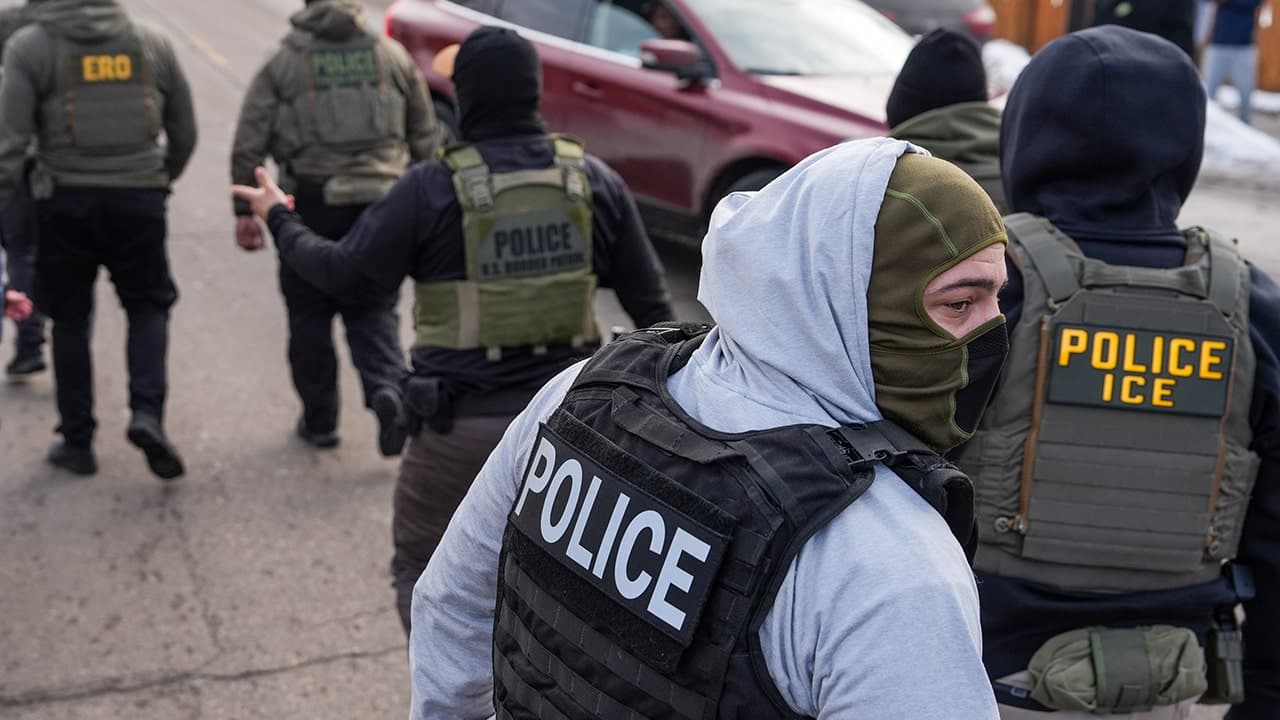
Judge Splits Ruling: ICE Masks Allowed, Cooperation Ban Stands
Left says
- •Masked, unidentified federal agents create real public safety risks by making it impossible for bystanders and local police to distinguish legitimate ICE operations from impersonators or vigilantes.
- •New York's transparency requirements were a good-faith policy response to community fear and confusion during immigration enforcement actions, not an attempt to obstruct federal law.
- •The ruling on the cooperation ban is a significant win, affirming that states cannot be forced to spend local resources or deputize their officers to help carry out federal immigration enforcement.
- •Officials plan to keep fighting the mask ruling through appeal, since they view transparent policing as essential to community trust regardless of the court's constitutional analysis.
Right says
- •The ruling reinforces that only the federal government can set policies governing how its own agents carry out law enforcement duties, and states cannot override that through local legislation.
- •New York's mask ban was seen as a deliberate attempt to hinder ICE operations rather than a neutral safety measure, and courts in California, Virginia, and Pennsylvania have struck down similar laws.
- •The decision is framed as a clear vindication of the Trump administration's authority to conduct immigration enforcement without interference from state governments.
- •The preserved 287(g) cooperation ban is acknowledged as a legitimate exercise of state authority, since federal law makes local participation in immigration enforcement voluntary rather than mandatory.
Common Take
High Consensus- Judge Mae D'Agostino issued a preliminary injunction blocking New York's mask and identification requirements while allowing the 287(g) cooperation ban to stand.
- The judge acknowledged New York's transparency concerns as well-intentioned even while ruling the mask law likely unconstitutional under the Supremacy Clause.
- Similar ICE mask bans have already been blocked by federal judges in California, Virginia, and Pennsylvania.
- Governor Hochul and Attorney General James are reviewing further legal options and are expected to appeal the mask ruling.
The Arguments
Left argues
Masked, unidentified agents make it impossible for bystanders and local police to distinguish real ICE operations from impersonators or vigilantes, creating genuine public safety risks that New York's transparency law was designed to address.
Right counters
The judge herself acknowledged this safety concern but ruled that only the federal government can dictate the operational policies of its own agents; sympathy for the policy goal doesn't override the constitutional requirement that states cannot regulate federal law enforcement.
Right argues
The Supremacy Clause and a string of similar rulings in California, Virginia, and Pennsylvania establish a clear, consistent legal principle: states cannot impose their own uniform requirements on how federal agents conduct federal law enforcement operations.
Left counters
The consistency of these rulings doesn't resolve whether the underlying safety rationale is legitimate policy or pretext for obstruction; New York's AG argued the law was a neutral rule of general applicability that didn't contradict any actual federal directive, a good-faith distinction courts have been too quick to dismiss.
Right argues
New York's mask ban was, in substance, a deliberate attempt to hinder ICE operations rather than a neutral safety measure, since it specifically targeted federal immigration enforcement rather than mask-wearing generally.
Left counters
The judge explicitly stated New York 'appears to be well-intentioned in its pursuit of transparent policing,' undercutting the claim that obstruction was the primary motive rather than a genuine response to community fear and confusion during enforcement actions.
Left argues
The preserved 287(g) ban is a major win affirming that states cannot be forced to spend local resources or deputize their own officers to carry out federal immigration enforcement, preserving core state sovereignty over local law enforcement priorities.
Right counters
This is not actually a partisan victory but a straightforward application of settled law, since federal statute already makes local participation in 287(g) agreements voluntary; the ruling simply confirms existing law rather than breaking new ground favoring states.
Right argues
The ruling is a clear vindication of the Trump administration's authority to conduct immigration enforcement free from state interference, reinforcing federal supremacy over a patchwork of local rules.
Left counters
Framing this as a full vindication ignores that the administration lost half the case; New York's ability to bar local cooperation with ICE significantly limits the practical reach of federal enforcement on the ground regardless of the mask ruling.
Challenge Questions
These questions target genuine internal contradictions — meant to provoke honest reflection.
Right asks Left
“If transparent policing and public safety are the true motivations behind the mask law, why did New York target only federal immigration agents rather than imposing the same face-covering and identification rules on all law enforcement officers operating in the state?”
Left asks Right
“If the principle is that states cannot dictate how federal agents perform their duties, why is it acceptable to celebrate the 287(g) ruling as a legitimate exercise of state authority to refuse cooperation, rather than viewing it too as improper state interference with federal immigration enforcement?”
Outlier Report
Left Fringe
Groups like Democratic Socialists of America and activists (e.g., some in the 'Abolish ICE' movement) who view any ICE presence, masked or not, as illegitimate — likely 10-15% of the left.
Right Fringe
Commentators like Tom Homan or figures on outlets like Blaze Media who argue even the cooperation ban should be struck down as obstruction of federal law - roughly 15-20% of the right who want no limits on state-federal immigration cooperation.
Noise Assessment
High performative amplification on both sides via cable news and social media hot takes, but underlying public opinion is more centrist and ambivalent, with most Americans holding nuanced views that combine support for ICE's mission with discomfort over masked, unidentified agents.
Sources (6)
<img src="https://www.theblaze.com/media-library/federal-court-slaps-down-new-york-and-hands-victory-to-trump-and-ice.jpg?id=67569464&width=1245&height=700&coordinates=0%2C38%2C0%2C38" /><br /><br /><p>A federal court issued a preliminary ruling that <a href="https://gothamist.com/news/federal-judge-blocks-new-yorks-ban-on-ice-agents-wearing-masks" target="_blank">blocked</a> New York officials from banning federal immigration agents from wearing masks and other coverings.</p><p>Democratic New York Gov. Kathy Hochul signed the Face Covering and Identification Acts in May in order to rein in ICE operations in the state.</p><p class="pull-quote">'We stand firm in our belief that masked agents do not make New York safer, and our offices are reviewing all legal options at this time.'</p><p>The Department of Justice sued against the order and argued that it violated the "sovereign function" of the United States.</p><p>Linda Fang of the New York State Attorney General's office argued that the law did not contradict any law issued by the federal government.</p><p>"When the federal government has not spoken, it can be subject to general rules that impact its function," Fang said.</p><p>U.S. District Judge Mae D'Agostino sided with the government in the ruling Monday.</p><p>"The United States has demonstrated a likelihood that it will succeed on its claim that the Face Covering and Identification Acts directly regulate federal officers in violation of the Supremacy Clause," D'Agostino wrote.</p><p>However, D'Agostino allowed New York to continue banning cooperation agreements between local governments and ICE.</p><p>The judge described the ban as the "appropriate means of furthering New York's legitimate interests in protecting public welfare and choosing how state and local resources are expended."</p><p>New York Attorney General Letitia James and Gov. Hochul <a href="https://ag.ny.gov/press-release/2026/attorney-general-james-and-governor-hochul-defend-new-york-287g-ban-federal" target="_blank">released</a> a joint statement about the ruling.</p><p>"As we have said from the start, New York’s ban on 287(g) agreements is legal and will keep our communities safe. Local law enforcement should be focused on local matters, and New York taxpayers should not have to foot the bill for any collaboration with ICE," the joint statement reads.</p><p>"While the court enjoined enforcement of New York's mask ban, we stand firm in our belief that masked agents do not make New York safer, and our offices are reviewing all legal options at this time," they added.</p><p><em></em><strong>RELATED: </strong><a href="https://www.theblaze.com/news/trump-pirro-reflecting-pool-dropped" target="_blank"><strong>Trump is reportedly FURIOUS at Jeanine Pirro — and may fire her</strong></a></p><p class="shortcode-media shortcode-media-youtube"> <span class="rm-shortcode" style="display: block; padding-top: 56.25%;"></span> </p><p>Democratic New York state Sen. Patricia Fahy said officials were likely to appeal the decision.</p><p>"We always knew there was a constitutional debate on this," said Fahy. "But either way, we know that the push from us, along with others, has been effective in sending the message that this was totally outrageous — the actions of ICE."</p><p><em>Like Blaze News? Bypass the censors, sign up for our newsletters, and get stories like this direct to your inbox. </em><em><a href="https://www.theblaze.com/newsletters/theblaze-articlelink" rel="noopener noreferrer" target="_self">Sign up here</a></em><em>!</em></p>
A federal judge temporarily blocked New York from enforcing a law requiring ICE and other federal agents to remove masks and display identification during operations.
Judge Mae D’Agostino of the Northern District of New York partially granted the DOJ's request for a preliminary injunction, ruling that the federal government is likely to succeed at trial.
<p>Judge puts hold on mask ban while allowing state law prohibiting cooperation between police and ICE to stand</p><p>A <a href="https://www.theguardian.com/us-news/new-york">New York</a> law banning US Immigration and Customs Enforcement (<a href="https://www.theguardian.com/us-news/ice-us-immigration-and-customs-enforcement">ICE</a>) agents from wearing face coverings and requiring that they wear visible identification has been put on hold by a federal judge. But a state law prohibiting cooperation between local police departments and ICE has been allowed to stand.</p><p>The mask ruling comes after federal judges have blocked similar laws in California, <a href="https://www.courthousenews.com/judge-blocks-virginia-ice-mask-ban-on-eve-of-implementation/">Virginia </a>and <a href="https://www.reuters.com/legal/government/us-judge-halts-philadelphias-ice-out-ban-masked-federal-law-enforcement-agents-2026-07-02/">Pennsylvania</a> that sought to ban federal immigration agents from covering their faces. They are still required to wear agency identification badges and badge numbers.</p> <a href="https://www.theguardian.com/us-news/2026/aug/04/judge-blocks-new-york-ban-ice-officers-masks">Continue reading...</a>
A federal judge on Monday blocked New York from enforcing a law banning federal immigration officers from wearing face masks and requiring them to display identification. U.S. District Judge Mae D’Agostino of the Northern District of New York issued a preliminary injunction against the state’s mask and identification requirements, finding the Justice Department is likely…
A federal judge has blocked New York's new law barring ICE officers from wearing masks while on duty in the state, but allowed another law that blocks localities from signing cooperation agreements with the deportation agency.