Justice Jackson Talks Judicial Neutrality on Michelle Obama's Podcast
Intra-Party Split Detected
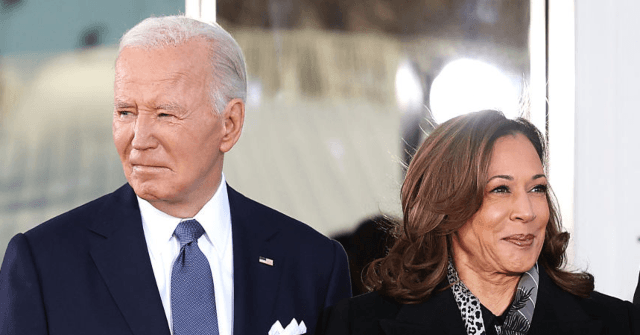
Harris's snub of Biden and embrace of Supreme Court expansion/Electoral College abolition highlight tensions within Democratic ranks between Biden and Harris factions, and between moderate and progressive positioning ahead of 2028.
Left says
- •Justice Jackson's comments reflect an effort to explain and reinforce the judiciary's commitment to fairness and impartiality to a broad public audience, not to make a partisan statement.
- •Appearing on a podcast hosted by Michelle Obama does not itself compromise judicial neutrality, since justices routinely speak publicly, write books, and give interviews without recusing themselves from their duties.
- •Jackson explicitly described the internal ethics screening process she uses to avoid conflicts of interest, showing a good-faith effort to maintain impartiality rather than disregard it.
- •Judicial dissents that critique the reasoning or consequences of majority opinions are a normal, longstanding part of how justices across the ideological spectrum operate, not evidence of bias.
Right says
- •Jackson's choice to discuss judicial neutrality specifically on a podcast hosted by the wife of a former Democratic president strikes many as a glaring lack of self-awareness.
- •Jackson's confirmation was explicitly tied by the nominating president to her race and gender, undercutting claims that identity and background play no role in judicial selection or perspective.
- •Her dissenting opinions in cases involving the Trump administration and race-based admissions are cited as examples of rhetoric that goes beyond neutral legal analysis into pointed political commentary.
- •Critics argue that a justice who repeatedly limits public appearances to avoid the 'appearance of partiality' should recognize that a podcast run by a prominent partisan figure raises exactly that concern.
Common Take
High Consensus- Justice Jackson stated on the podcast that judges should avoid even the appearance of partiality and described steps she takes to screen appearances and media exposure for ethical conflicts.
- Both sides agree public confidence in an impartial judiciary is an important value for the legal system.
- The conversation took place on the July 2026 episode of 'IMO with Michelle Obama & Craig Robinson.'
- Jackson's written dissents in cases like Trump v. CASA and Students for Fair Admissions are matters of public record that both sides reference, even if they interpret their tone differently.
The Arguments
Right argues
Choosing to discuss the importance of judicial neutrality specifically on a podcast hosted by Michelle Obama, wife of a former Democratic president, reflects a striking lack of self-awareness about how such appearances look to the public.
Left counters
Justices routinely give interviews, write books, and appear on media of all kinds without it constituting a conflict of interest; the substance of what Jackson said about ethics screening matters more than the venue.
Right argues
Jackson's confirmation was explicitly framed by President Biden around her race and gender, which undercuts any claim that identity plays no role in judicial selection or perspective, making her comments on pure neutrality ring hollow.
Left counters
The circumstances of a nomination do not determine how a justice actually rules; Jackson's record should be judged by her legal reasoning, not by the political framing used to select her.
Right argues
Jackson's dissents — accusing colleagues of enabling a Trump 'wrecking ball' or showing 'let-them-eat-cake obliviousness' — use rhetoric that goes beyond legal analysis into pointed political commentary, undermining her claimed commitment to neutrality.
Left counters
Sharp, even provocative dissents are a longstanding tradition across the ideological spectrum — conservative justices like Scalia were famous for them — and disagreement over reasoning is not evidence of partisan bias.
Left argues
Jackson explicitly described the internal ethics screening process she uses to vet invitations and avoid conflicts of interest, demonstrating a good-faith, systematic effort to maintain impartiality rather than a disregard for it.
Right counters
If that screening process still permitted an appearance on a podcast run by a prominent Democratic political figure, it calls into question how rigorous or meaningful the screening actually is.
Left argues
Jackson's remarks were aimed at explaining the judiciary's commitment to fairness to a broad public audience, an educational function that justices across ideological lines perform without it being read as partisan advocacy.
Right counters
The educational intent doesn't erase the optics problem — critics argue that a justice who says she limits appearances to avoid even the 'appearance of partiality' should have recognized this specific venue as a clear exception to that stated principle.
Challenge Questions
These questions target genuine internal contradictions — meant to provoke honest reflection.
Right asks Left
“If venue and audience genuinely don't affect perceptions of judicial neutrality, why does Jackson herself say she declines many invitations specifically to avoid the 'appearance of partiality' — and what distinguishes this podcast from those she turns down?”
Left asks Right
“If sharp dissenting rhetoric from a liberal justice is treated as proof of bias, does the same standard apply to similarly forceful dissents from conservative justices, and if not, why not?”
Outlier Report
Left Fringe
Some progressive legal commentators (e.g., certain MSNBC contributors) argue Jackson's critics are engaging in bad-faith racial/gender-based attacks and that no genuine neutrality concern exists; this represents maybe 15-20% of left-leaning opinion.
Right Fringe
Figures like Libs of TikTok and some Blaze/Breitbart commentators go further, framing Jackson as a 'DEI hire' whose rulings are inherently illegitimate rather than just poorly timed messaging; this more extreme framing represents perhaps 25-30% of right-leaning commentary.
Noise Assessment
High — much of the reaction is driven by viral social media mockery (Lisa McClain, Marsha Blackburn, Libs of TikTok tweets) that amplifies partisan talking points well beyond what average Americans are likely paying attention to or forming strong opinions on.
Sources (6)
<img src="https://www.theblaze.com/media-library/ketanji-brown-jackson-mocked-after-discussing-need-for-justices-to-appear-neutral-while-on-obama-s-podcast.jpg?id=67562538&width=1245&height=700&coordinates=25%2C0%2C26%2C0" /><br /><br /><p>This week, U.S. Supreme Court Justice Ketanji Brown Jackson discussed with Michelle Obama, of all people, the importance of justices appearing impartial — and so far, the reactions to their conversation have been just about what you'd expect. </p><p>She <a href="https://youtu.be/iFIDaoSek94?t=3432" rel="noopener noreferrer" target="_blank">told</a> the hosts on the Wednesday episode of "IMO with Michelle Obama & Craig Robinson" that "we all have to believe that there is a judicial system that is going to be fair, that is going to be neutral, that when you bring your dispute to the court, that judge doesn't have any pre-existing stake in the particular issue."</p><p class="pull-quote">'Can't make this up.'</p><p>It's a surprising take, considering Jackson's background.</p><p>For one thing, former President Joe Biden explicitly <a href="https://time.com/6158335/ketanji-brown-jackson-presidential-constitutionalism-supreme-court/" rel="noopener noreferrer" target="_blank">chose</a> Jackson for the Supreme Court on the basis of her race and sex, though she <a href="https://www.theblaze.com/news/video-ketanji-brown-jackson-says-she-can-t-define-the-word-woman-because-she-s-not-a-biologist" target="_blank">said</a> during her confirmation hearing that she could not define "woman" because she's "not a biologist."</p><p> Jackson has also made a habit of penning bias-saturated jeremiads that have in some cases been extreme enough to <a href="https://www.theblaze.com/news/even-sotomayor-bewildered-by-ketanji-brown-jacksons-dissenting-opinion" target="_blank">raise the eyebrows</a> of even other liberals on the bench. For instance, she:</p><ul><li><a href="https://www.supremecourt.gov/opinions/24pdf/24a1174_h3ci.pdf#page=3" target="_blank">insinuated</a> in her lone dissenting opinion in <em>Trump v. American Federation of Government Employees</em> that President Donald Trump was some sort of power-hungry menace and that those on the bench who failed to stop his "wrecking ball" were sycophantic enablers whose decision was both "hubristic and senseless";</li><li><a href="https://www.supremecourt.gov/opinions/24pdf/24a884_8n59.pdf" target="_blank">claimed</a> in her dissenting opinion for <em>Trump v. CASA Inc. </em>that the Trump administration's request to address universal injunctions — which the high court found "likely exceed the equitable authority that Congress has given to federal courts" — amounted to a request "to engage in unlawful behavior";</li><li><a href="https://www.supremecourt.gov/opinions/22pdf/20-1199_l6gn.pdf" target="_blank">accused</a> her colleagues in <em></em><em>Students for Fair Admissions v. Harvard</em> of "let-them-eat-cake obliviousness" for their colorblind approach and claimed that race-based college admissions address "the well-documented 'intergenerational transmission of inequality' that still plagues our citizenry" to the "benefit of us all"; and</li><li><a href="https://www.supremecourt.gov/opinions/25pdf/24-539_fd9g.pdf" target="_blank">echoed</a> LGBT ideologues in her lone dissenting opinion in <em>Chiles v. Salazar</em>, claiming that "a robust professional consensus now acknowledges that sexual orientations and gender identities range widely" and that reality-affirming therapy for trans-identifying kids was ineffective and harmful.</li></ul><p>Despite these opinions, Jackson and Obama seem to believe that Jackson has been a relatively neutral jurist. </p><p><strong>RELATED: <a href="https://www.theblaze.com/news/platners-replacement-in-maine-is-a-family-man-just-not-in-the-way-voters-might-expect" target="_blank">Platner's replacement in Maine is a family man — just not in the way voters might expect </a></strong></p><p class="shortcode-media shortcode-media-youtube"> <span class="rm-shortcode" style="display: block; padding-top: 56.25%;"></span> </p><p>Obama pressed Jackson about whether she has to closely monitor her exposure to news, media, and other content "so that there isn't a bias."</p><p>After noting that certain individuals employed at the court screen her invitations for various appearances and events "to make sure that there are no ethical conflicts," Jackson replied that "there are lots of limits on what judges can do, and I try to be very, very mindful and scrupulous with respect to that because, as you say, our obligation is to be unbiased in our approach."</p><p>"And, so, you have to then navigate all the sources that could make for an appearance of partiality, which you want to avoid," the Biden nominee continued. "So there are lots of things that I end up not accepting for that reason. News sources, I think, you know, I don't have a lot of time — unfortunately, you know — but I do, you know, the normal, general media sources are made available, and I think it's harder when you're talking about — there's so much social media now."</p><p>Jackson's expression of concern about bias and perceptions of bias while in the company of a rank partisan like Michelle Obama struck some critics as insincere or at the very least tone-deaf.</p><p>House Republican Conference Chairwoman Lisa McClain (R-Mich.) highlighted the cognitive dissonance, <a href="https://x.com/RepLisaMcClain/status/2082906586847084777?s=20" target="_blank">writing</a>, "Justice Ketanji Brown Jackson says SCOTUS must avoid even the appearance of political bias ... while appearing on Michelle Obama's podcast."</p><p>Sen. Marsha Blackburn (R-Tenn.) <a href="https://x.com/MarshaBlackburn/status/2083217083412644261?s=20" rel="noopener noreferrer" target="_blank">wrote</a>, "Ketanji Brown Jackson finds a way to inject political bias into just about everything she does. Whether it's attending the Grammys, joining Michelle Obama's podcast, or refusing to define the word woman, she couldn't care less about remaining impartial."</p><p>"DEI hire justice Ketanji Brown Jackson says she's careful about which public engagements she accepts because she has to be impartial ... As she appears on MICHELLE OBAMA's podcast," Libs of TikTok <a href="https://x.com/libsoftiktok/status/2082936053984272444?s=20" rel="noopener noreferrer" target="_blank">tweeted</a>. "Can't make this up."</p><p><em>Like Blaze News? Bypass the censors, sign up for our newsletters, and get stories like this direct to your inbox. </em><em><a href="https://www.theblaze.com/newsletters/theblaze-articlelink" rel="noopener noreferrer" target="_self">Sign up here</a></em><em>!</em></p>
<p>Former Vice President Kamala Harris (D) failed to mention her ex-boss when asked who she thought were America's most effective presidents. </p> <p>The post <a href="https://www.breitbart.com/politics/2026/08/01/watch-kamala-harris-ignores-joe-biden-and-names-fdr-jfk-and-lbj-as-most-effective-presidents/" rel="nofollow">WATCH: Kamala Harris Ignores Joe Biden and Names FDR, JFK, and LBJ as ‘Most Effective’ Presidents</a> appeared first on <a href="https://www.breitbart.com" rel="nofollow">Breitbart</a>.</p>
‘Don’t make me do that’
Former Vice President Kamala Harris endorsed Supreme Court expansion and abolishing the Electoral College at the National Urban League Conference while weighing a 2028 run.
<p>Biden should not take the omission personally. Harris was only asked for three presidents. She gave four and still could not find room for him.</p> The post <a href="https://legalinsurrection.com/2026/08/kamala-harris-brutally-snubs-biden-in-presidential-rankings/">Kamala Harris Brutally Snubs Biden in Presidential Rankings</a> first appeared on <a href="https://legalinsurrection.com">Le·gal In·sur·rec·tion</a>.