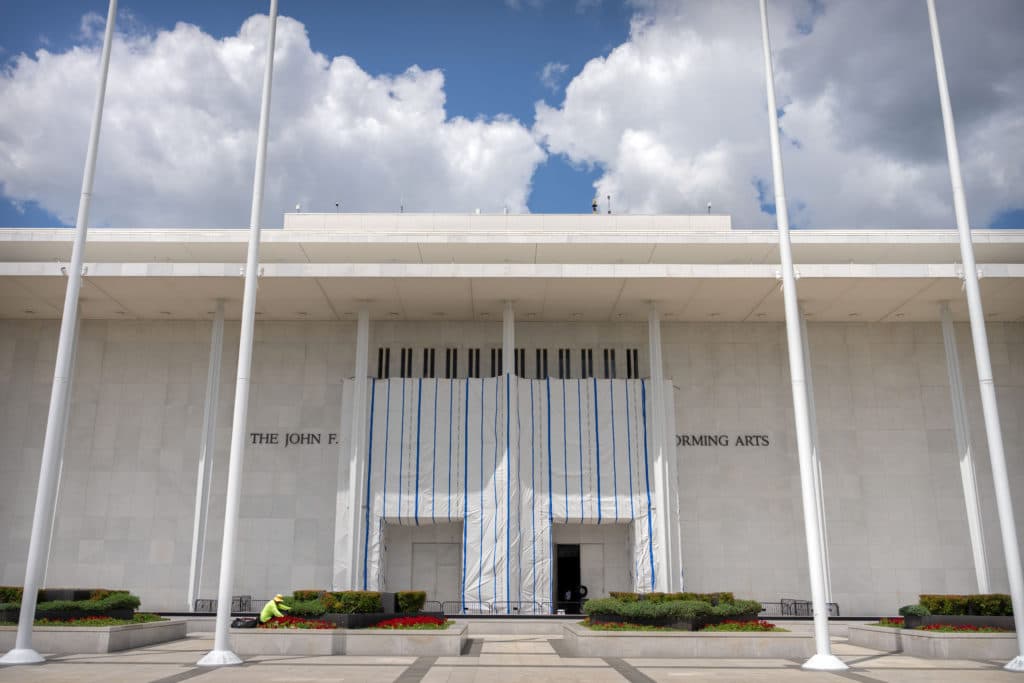
 The Kennedy Center's facade shrouded for renovations under a cloudy sky.
Kennedy Center board defies judge, revives Trump name plan
Left says
- •A Trump-handpicked board is again voting to override a federal judge's finding that the original closure decision was 'ill-informed and seemingly preordained,' raising concerns about disregard for judicial oversight.
- •The board met via a non-public Zoom call and Democratic ex-officio members say they still haven't been given access to assessments about the closure's impact, suggesting a lack of transparency around a decision affecting a major national cultural institution.
- •Renaming the center to credit Trump personally ('Restored and Renovated by President Donald J. Trump') is viewed as part of a broader pattern of the president imprinting his name and image on Washington institutions.
- •Critics worry this sets a precedent where a board stacked with political allies can simply re-vote to bypass an unfavorable court ruling rather than address the substantive concerns the judge raised.
Right says
- •The board, now armed with a detailed 163-page, $250 million renewal plan, argues it has addressed the judge's concerns about insufficient information by presenting a thorough proposal this time.
- •Supporters see the renovation as a legitimate and overdue safety and infrastructure investment, including structural repairs and acoustical upgrades, not merely a political gesture.
- •Keeping the Reach open as a memorial to John F. Kennedy demonstrates the board still intends to honor the center's namesake while modernizing the facility.
- •Advocates argue the board, composed of the president's appointees, has the authority to make these institutional decisions and is simply exercising its governance role as intended.
Common Take
High Consensus- The Kennedy Center board voted Thursday to close the main building for a two-year, $250 million renovation and to add Trump's name back to the facility.
- A federal judge, Christopher Cooper, previously blocked a similar closure plan in May, ruling the board's process was insufficiently informed.
- The board's latest decision is subject to further review by the same federal judge and could trigger new legal challenges.
- The Reach, the center's newer addition, will remain open for limited programming and as a memorial to President Kennedy during the closure.
The Arguments
Left argues
A board stacked with the president's political allies is simply re-voting to bypass a federal judge's finding that the original decision was 'ill-informed and seemingly preordained,' rather than genuinely correcting the deficiencies he identified.
Right counters
The board this time produced a detailed 163-page, $250 million plan addressing structural repairs, acoustics, and logistics—precisely the kind of substantive information the judge said was missing, which is a direct response to the ruling, not an evasion of it.
Right argues
The renovation addresses genuine, long-documented safety and infrastructure problems at an aging facility, and a detailed plan with specific costs and engineering scope shows the board did its homework this time.
Left counters
If the renovation were purely about safety and infrastructure, it wouldn't need to be bundled with renaming the building after a sitting president in a self-congratulatory inscription, which suggests the substance is secondary to the symbolism.
Left argues
Holding the vote via a private, non-public Zoom call, and continuing to withhold impact assessments from Democratic ex-officio members, undermines the transparency that should accompany decisions about a major national cultural institution.
Right counters
Board meetings on operational matters are routinely conducted this way, and the release of a lengthy formal plan to the public and press demonstrates the substance of the decision was not hidden, even if the meeting itself was closed.
Right argues
The board is composed of duly appointed trustees exercising exactly the governance authority Congress vested in them, and courts should be cautious about substituting their judgment for that of the institution's own leadership on internal management decisions.
Left counters
That authority is not unlimited—the same judge already ruled that renaming requires Congressional action, and simply re-voting to defy that legal boundary treats the board's authority as absolute when it demonstrably is not.
Left argues
The push to rename the center 'Restored and Renovated by President Donald J. Trump' fits a broader pattern of imprinting the president's personal name and image onto Washington's institutions, raising concerns about self-aggrandizement using public and quasi-public assets.
Right counters
The plan explicitly preserves the Reach as a functioning memorial to JFK, showing the board still intends to honor the center's original namesake even while crediting the renovation's benefactor—two things that are not mutually exclusive.
Challenge Questions
These questions target genuine internal contradictions — meant to provoke honest reflection.
Right asks Left
“If the board now presents a 163-page, $250 million detailed plan with specific structural and acoustical justifications, what precise standard of 'sufficient information' would satisfy your objections short of blocking the renovation altogether?”
Left asks Right
“If the board's authority to rename the building was already curtailed by a judge who found Congress alone can authorize such changes, on what legal basis does re-voting on the same renaming proposal cure that defect rather than simply repeating it?”
Outlier Report
Left Fringe
Figures like Rep. Jamie Raskin and some Guardian/MSNBC commentators who frame this as authoritarian overreach and demand congressional intervention represent maybe 15-20% of the left, pushing beyond concerns about transparency into constitutional-crisis framing.
Right Fringe
Pro-Trump commentators like Charlie Kirk or accounts on X celebrating the renaming as a cultural 'winning' moment and dismissing judicial review entirely represent roughly 15-20% of the right, going beyond the 'legitimate governance' framing into overt personality-cult territory.
Noise Assessment
Moderate-to-high; much of the intense reaction is concentrated among politically engaged partisans on social media, while most Americans likely have limited awareness of or interest in Kennedy Center board governance specifics.
Sources (6)
The Kennedy Center board voted on Thursday to close for two years for renovations and to again add President Trump’s name to the facade, Rep. Joyce Beatty said.
<p>The Kennedy Center board voted Thursday to again add President <a href="https://www.axios.com/politics-policy/donald-trump" target="_blank">Trump's</a> name to the John F. Kennedy Center for the Performing Arts, per <a href="https://www.nytimes.com/2026/08/13/arts/design/kennedy-center-closure-board-vote-trump.html" target="_blank">multiple</a> <a href="https://apnews.com/live/trump-leavitt-rubio-bessent-kennedy-center-updates-08-13-2026" target="_blank">reports</a>.</p><p><strong>Why it matters: </strong>The move challenges a federal judge's ruling back in May that only Congress could change the name of the performing arts venue, and that Trump's name must be <a href="https://www.axios.com/2026/06/12/trump-kennedy-center-name-removal" target="_blank">removed</a>. That process was completed in June. </p><p><em>Editor's note: This is a breaking news story. Please check back for updates.</em></p>
The board voted to close the Washington, D.C., arts complex's main campus for a $250 million renovation — three months after a federal judge temporarily blocked a similar closure.
The Kennedy Center will move forward with a two-year closure of the sprawling performing arts venue to allow for substantial renovation work, while some outdoor programming may continue.
<p>In May, a judge issued a temporary block on Trump’s demand to close the arts institution for renovations after the board – mostly handpicked by the president – voted unanimously in favor</p><ul><li><p><a href="https://www.theguardian.com/news/2026/feb/17/sign-up-for-the-breaking-news-us-email-to-get-newsletter-alerts-direct-to-your-inbox?utm_medium=ACQUISITIONS_STANDFIRST&utm_campaign=BN22326&utm_content=signup&utm_term=standfirst&utm_source=GUARDIAN_WEB">Sign up for the Breaking News US email</a></p></li></ul><p><strong>Donald Trump’s <a href="https://www.theguardian.com/us-news/2026/aug/10/trump-vaccines-executive-order-measles">executive order </a>on vaccines does not change the US recommendations for the shots – but experts say it does create confusion and doubt about vaccines, which will lead to more illness and possibly deaths among children and will make it harder for families and pediatricians to protect them.</strong></p><p>The executive order was an <a href="https://www.theguardian.com/us-news/2026/aug/10/trump-vaccines-executive-order-measles">attempt to reinstate</a> sweeping changes to the vaccine schedule made earlier this year by Robert F Kennedy Jr, secretary of the US Department of Health and Human Services and a longtime vaccine opponent – changes that were later <a href="https://www.theguardian.com/us-news/2026/mar/16/judge-blocks-rfk-jr-vaccine-policy-changes">halted</a> by a federal judge.</p> <a href="https://www.theguardian.com/us-news/live/2026/aug/13/karoline-leavitt-white-house-primaries-trump-politics-latest-updates">Continue reading...</a>
The board of the John F. Kennedy Center for the Performing Arts voted for the second time Thursday to close the building for renovations, according to The New York Times. The decision would close the Kennedy Center’s main building, while the Reach, a new building on campus, would remain open for some events and keep…