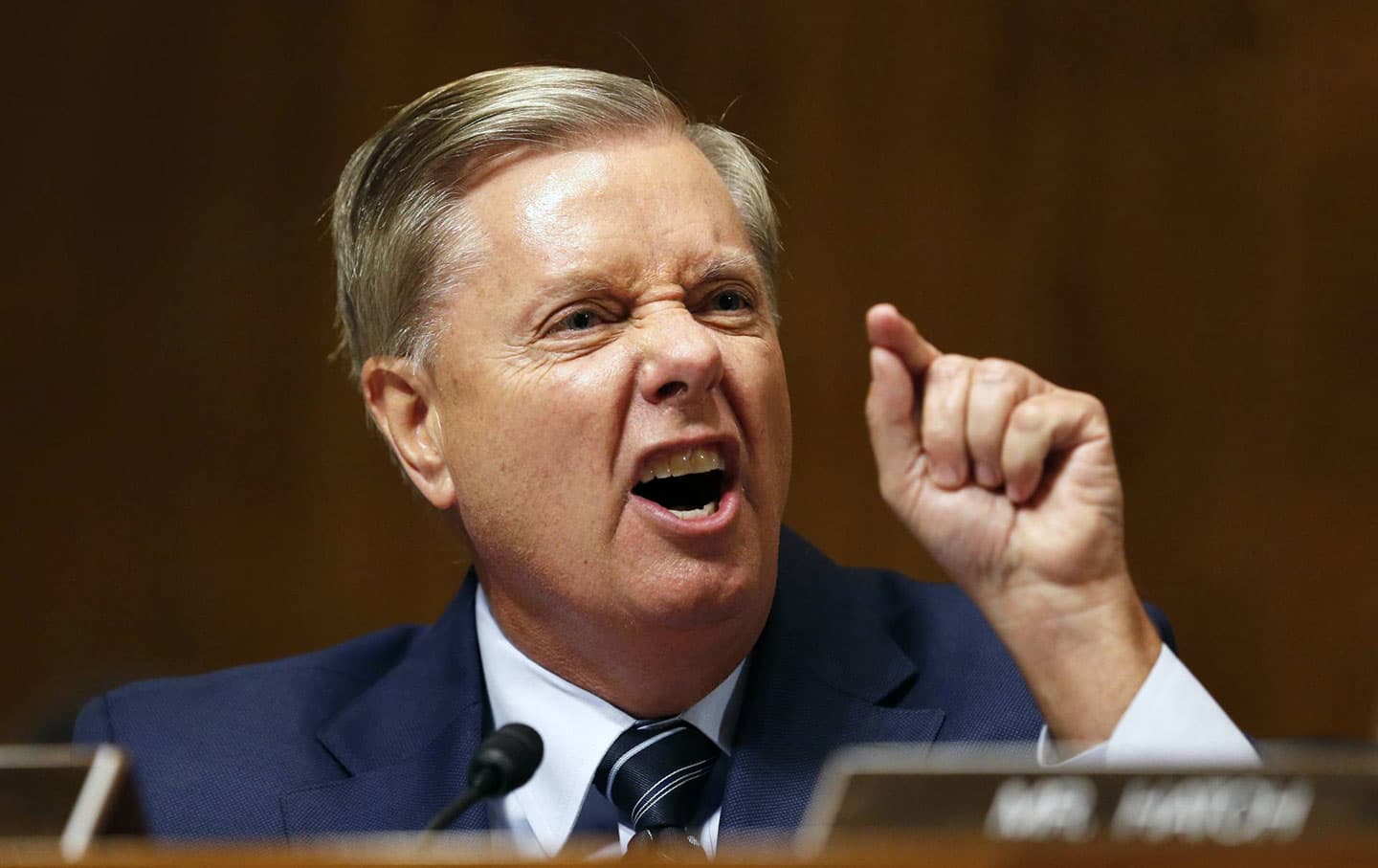
 Lindsey Graham speaks animatedly during a Senate hearing.
Lindsey Graham Dies: War Hero Ally or Warmongering Trump Sycophant?
Intra-Party Split Detected
Most left-leaning outlets (The Nation, Democracy Now) offer scathing critiques of Graham's warmongering and Trump loyalty, while Axios (lean left) provides a more measured, nostalgic remembrance emphasizing his bipartisan relationships and personal rapport with reporters.
Left says
- •Graham never met a war he didn't want to escalate, from Iraq and Afghanistan to Iran, Ukraine, and even a proposed preemptive strike on North Korea, prioritizing military intervention over diplomacy throughout his career.
- •His transformation from fierce Trump critic in 2016 to one of Trump's most obsequious defenders reflects a calculated bid to preserve influence and keep the U.S. war machine funded rather than any genuine change of heart.
- •His theatrical, angry defense of Brett Kavanaugh during the Christine Blasey Ford hearings revealed a willingness to dismiss credible testimony from a sexual assault survivor to secure a partisan judicial win.
- •His foreign policy showed an unwavering commitment to Israel's interests that critics say often superseded broader U.S. or humanitarian considerations.
Right says
- •Graham was a principled hawk in the mold of his close friend and mentor John McCain, believing American military strength and global engagement, wisely used, serves as a force for good in the world.
- •He built a decades-long record of bipartisanship, working with Democrats on immigration reform and voting to confirm Obama's Supreme Court nominees Sotomayor and Kagan.
- •He was willing to break with his own party when he felt it mattered, forcefully condemning the January 6 Capitol attack on the Senate floor and saying "enough is enough."
- •His alliance with Trump was less about personal loyalty and more about ensuring a seat at the table to counter isolationist voices like Rand Paul and keep robust national security policy alive within the GOP.
Common Take
High Consensus- Graham died unexpectedly at age 71 after what his office called a brief and sudden illness, just hours after returning from his tenth trip to Ukraine since 2022.
- He was one of the most recognizable and durable figures in Washington, remaining relevant across the Clinton, Bush, Obama, and Trump eras.
- His closest political bond was with the late Sen. John McCain, whose hawkish worldview and skepticism of Vladimir Putin he shared.
- His relationship with Donald Trump marked a dramatic shift from his earlier, sharply critical stance toward the future president.
The Arguments
Left argues
Graham's record shows a consistent preference for military escalation over diplomacy across two decades and multiple theaters—Iraq, Afghanistan, Iran, North Korea, and Ukraine—suggesting a worldview that reflexively favors force.
Right counters
Graham's hawkishness stemmed from a coherent, McCain-derived belief that American strength deters aggression and that failures of will (like premature withdrawal from Iraq or Afghanistan) create worse outcomes than sustained engagement.
Right argues
Graham maintained a genuine decades-long record of bipartisanship, including co-authoring immigration reform with Democrats and being the only Republican Judiciary Committee member to back both Sotomayor and Kagan, showing he wasn't merely a partisan operator.
Left counters
That earlier record makes his later transformation into Trump's most obsequious defender more damning, not less—it shows a man who abandoned principle for proximity to power once Trump proved politically dominant.
Left argues
Graham's furious, theatrical defense of Kavanaugh during credible sexual assault testimony revealed a willingness to prioritize partisan judicial wins over taking a survivor's account seriously.
Right counters
Graham's anger reflected genuine outrage at what he and many others saw as an unsubstantiated, eleventh-hour smear campaign against a nominee with no corroborating witnesses, not indifference to sexual assault victims generally.
Right argues
Graham's alliance with Trump can be read as strategic rather than sycophantic—a calculated effort to remain 'in the room' and counterbalance isolationist voices like Rand Paul, preserving a hawkish wing within a GOP drifting toward non-interventionism.
Left counters
If influence was the goal, the fact that Graham so rarely won open disagreements with Trump on Russia and consistently 'sang from Trump's song sheet' after private meetings suggests the access came at the cost of actual influence, not in service of it.
Left argues
Graham's foreign policy exhibited what critics call a 'slavish dedication to Israel,' repeatedly backing military action that served Israeli strategic interests even when it risked broader U.S. entanglement, as with Iran.
Right counters
Graham would argue that supporting a key democratic ally against shared adversaries like Iran is not subordinating U.S. interests but advancing them, consistent with decades of bipartisan U.S. policy toward Israel.
Challenge Questions
These questions target genuine internal contradictions — meant to provoke honest reflection.
Right asks Left
“If Graham's turn toward Trump is dismissed as pure cynical self-preservation, how do you square that with his forceful, politically costly condemnation of January 6 on the Senate floor, which ran directly against his own stated interest in staying in Trump's good graces?”
Left asks Right
“If Graham's alliance with Trump was really about preserving hawkish influence against isolationists, why did he so consistently defer to Trump's more dovish instincts on Russia rather than using his supposed leverage to change Trump's mind?”
Outlier Report
Left Fringe
Jeremy Scahill and Democracy Now represent an anti-interventionist fringe (roughly 15-20% of the left) framing Graham as essentially a war criminal; The Nation's Jeet Heer and Elie Mystal represent a harsher moralistic condemnation ('evil,' 'odious') held by maybe 20-25% of very progressive commentators, not the median Democratic voter.
Right Fringe
Isolationist/America First figures like Tucker Carlson and some Rand Paul-aligned commentators (roughly 10-15% of the right) viewed Graham as a reckless warmonger who dragged the GOP into costly foreign entanglements, diverging sharply from mainstream Republican reverence for him as a McCain-style hawk.
Noise Assessment
High noise ratio—obituary discourse is dominated by ideologically activated commentators (Scahill, Mystal, Heer) producing vivid, quotable condemnations that circulate widely online, while average Americans' views of Graham are far more muted, mixed, or indifferent, reflecting low salience of Senate foreign policy debates to most voters.
Sources (7)
<p><strong>Sen. Lindsey Graham </strong>(R-S.C.), who <a href="https://apnews.com/article/lindsey-graham-dies-south-carolina-bfa556e170f2df22ce9ffc7165da3dfa" target="_blank">died</a> at 71 last evening from what his office <a href="https://x.com/LindseyGrahamSC/status/2076185414721847673" target="_blank">called</a> a "brief and sudden illness," found a way to remain relevant through nearly every phase of modern Washington.</p><p><strong>The big picture: </strong>Graham first rose<strong> </strong>to national prominence in 1999 as one of the House managers during President Bill Clinton's Senate impeachment trial. </p><hr /><ul><li>After winning election to the Senate in 2002, Graham became one of President George W. Bush's most reliable defenders.</li><li>Graham's closest political ally,<strong> </strong>and best friend in the Senate, was the late Sen. John McCain (R-Ariz.). The two shared a hawkish worldview, a deep skepticism of Vladimir Putin and a belief that American power, when used wisely, could be a force for good.</li></ul><p><strong>Zoom out: </strong>Long before Graham became a Sunday show regular, he was McCain's loyal wingman — riding the campaign bus, bantering with reporters and smoothing out conflicts among McCain senior aides.</p><ul><li>Graham was friendly with the press, throwing back White Russians and telling political tales from South Carolina. To the end, reporters called him directly on his cellphone. Sometimes he called <em>them.</em></li></ul><p><strong>State of play: </strong>Like much of Washington, Graham changed during the Trump era. He grew more guarded with reporters, and could be short with them in the Senate subway. </p><ul><li>He forged a close working relationship, and a frequent golfing partnership, with the president who once dismissed McCain, a naval aviator and prisoner of war in Vietnam, as "<a href="https://www.politico.com/story/2015/07/trump-attacks-mccain-i-like-people-who-werent-captured-120317" target="_blank">not a war hero</a>."</li><li>Graham and Trump were largely aligned on Iran. But they often diverged on Russia. Graham consistently pressed for tougher sanctions on Putin, while Trump sought to preserve room for engagement.</li></ul><p><strong>After private meetings</strong> at the White House, Graham invariably sang from Trump's song sheet.</p><p><strong>Go deeper: </strong><a href="https://www.axios.com/2026/07/12/lindsey-graham-dies-suddenly-71" target="_blank">Sen. Lindsey Graham dies suddenly at 71</a> </p>
Republican Senator Lindsey Graham of South Carolina, one of the most prominent supporters of war in Washington, has died at the age of 71 after what his office called a “brief and sudden illness.” He was a vocal supporter of the 2003 U.S. invasion of Iraq, a leading backer of the U.S.-Israeli war on Iran and a proponent of more U.S. military support for Ukraine. He also pushed for a permanent occupation of Afghanistan and once called for a preemptive attack on North Korea.</p> <p>Graham “never met a war of aggression that he didn’t passionately back,” says Jeremy Scahill, co-founder of <em>Drop Site News</em>, who adds that the late senator also had a “slavish dedication to Israel over the interests of the United States and the rest of the world.”
The South Carolina senator passed away unexpectedly at age 71.
He should have put American democracy first
South Carolina’s senior senator is dead at 71
<p>Elie Mystal</p> <div><img alt="" src="https://www.thenation.com/wp-content/uploads/2026/07/Lindsey_Graham-Kavanaugh_hearing.jpg" /></div> <div> <div class="wp-block-the-nation-dek article-title__dek"> <p>The senator’s infamous cry of rage spoke not only to his cruelty but also to his larger role in changing the court.</p> </div> </div> <p>The post <a href="https://www.thenation.com/article/politics/lindsey-graham-kavanaugh-supreme-court/">Lindsey Graham’s Defense of Brett Kavanaugh Told Us Everything</a> appeared first on <a href="https://www.thenation.com">The Nation</a>.</p>
<p>Jeet Heer</p> <div><img alt="" src="https://www.thenation.com/wp-content/uploads/2026/07/AP26193248081266.jpg" /></div> <div> <div class="wp-block-the-nation-dek article-title__dek"> <p>Conspiracy theorists liked to say that Graham’s Trump sycophancy was a result of blackmail. But the truth is worse: He stuck with Trump to keep the US war machine going.</p> </div> </div> <p>The post <a href="https://www.thenation.com/article/politics/lindsey-graham-obituary-trump/">Lindsey Graham Chose Evil</a> appeared first on <a href="https://www.thenation.com">The Nation</a>.</p>