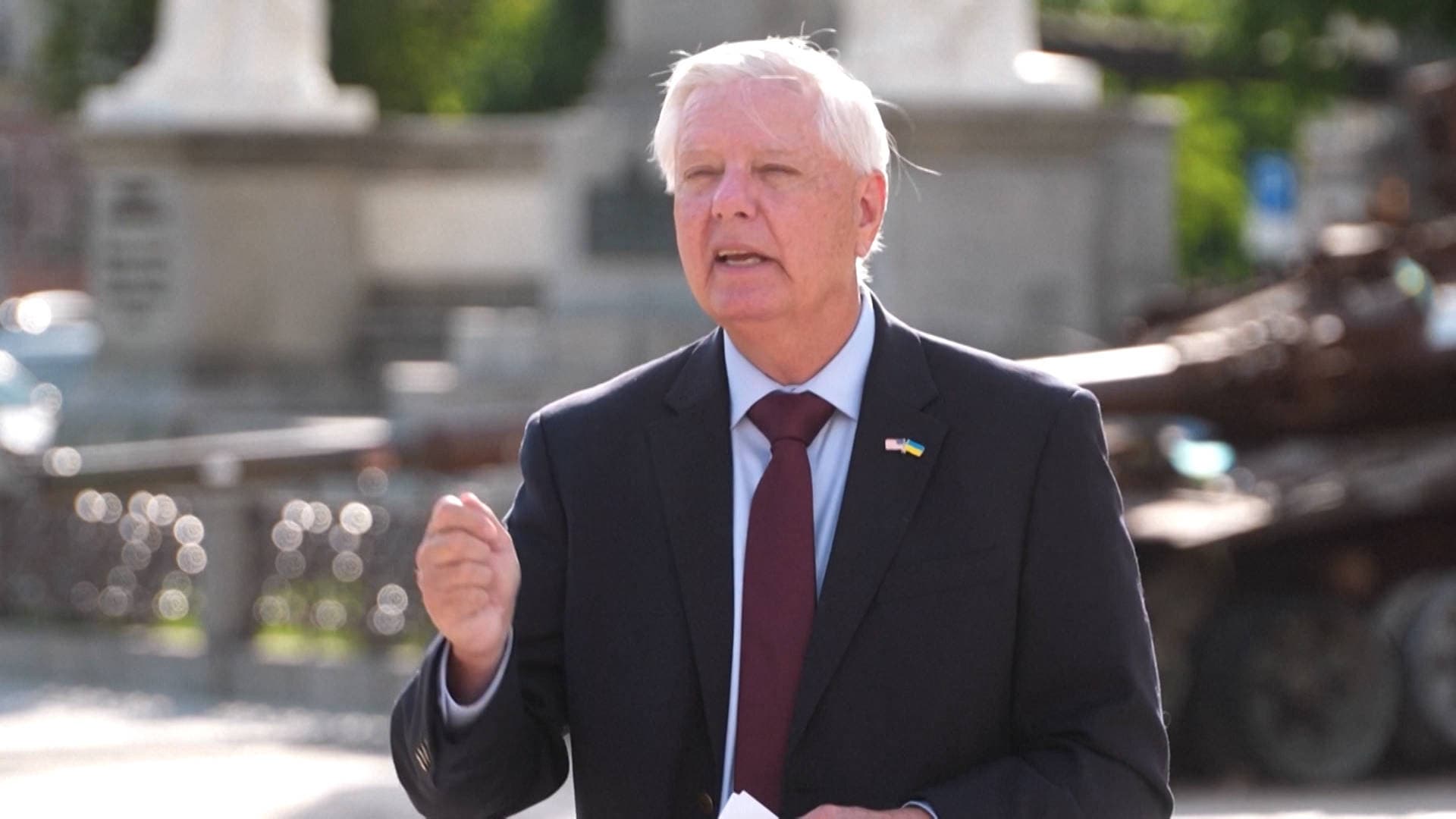
 Senator Lindsey Graham speaking outdoors, wearing a Ukraine flag pin.
Lindsey Graham's Death: War Hero or Warmonger?
Intra-Party Split Detected
Some conservatives (Blaze/Tea Party-aligned voices) historically distrusted Graham as insufficiently loyal to the MAGA movement despite later praising his effectiveness, while others on the right embraced him as a hawkish ally of Trump; his neoconservative interventionism also drew criticism from libertarian-leaning and populist-right factions skeptical of foreign wars.
Left says
- •Graham's legacy is defined by relentless advocacy for military intervention, from championing the 2003 Iraq invasion to pushing for a permanent occupation of Afghanistan and backing preemptive strikes on North Korea.
- •His unwavering support for the U.S.-Israeli war on Iran and prioritization of Israeli interests over broader U.S. and global concerns reflects a foreign policy record that consistently favored escalation over diplomacy.
- •Graham's late-career transformation into a Trump loyalist and golf partner, despite Trump's mockery of his best friend John McCain as 'not a war hero,' reveals a willingness to subordinate principle to political survival.
- •His final act in office, pushing for more military support in Ukraine just before his death, fits a decades-long pattern of favoring military solutions over peaceful resolution.
Right says
- •Graham's fierce, unscripted defense of Brett Kavanaugh during his 2018 confirmation hearing became a defining moment that many conservatives credit with helping save the nomination and reshaping his reputation among the base.
- •As chair of the Senate Budget Committee, Graham was instrumental in shepherding major legislation, including immigration enforcement funding, through difficult negotiations and unified Democratic opposition.
- •His hawkish worldview, shared with his close friend and mentor John McCain, reflected a genuine and long-held belief that American military strength, when used judiciously, serves as a force for good in the world.
- •Despite conservative skepticism of him for years, particularly from Tea Party factions who tried to primary him, Graham proved himself a consistently effective legislator who got things done for his party's agenda.
Common Take
High Consensus- Graham died at age 71 after what his office described as a brief and sudden illness.
- He was one of the most hawkish and consistently interventionist voices in modern American politics, supporting military action in Iraq, Afghanistan, Iran, and Ukraine.
- His closest political relationship was with the late Senator John McCain, with whom he shared a foreign policy worldview centered on American power projection.
- Graham's political identity shifted notably during the Trump era, moving from a bipartisan-minded reformer to a close Trump ally, even as the two diverged on Russia policy.
The Arguments
Left argues
Graham's decades-long record shows a consistent preference for military escalation over diplomacy, from championing the Iraq invasion to backing preemptive strikes on North Korea and pushing for permanent occupation of Afghanistan, culminating in his final push for more Ukraine military aid days before his death.
Right counters
Graham's hawkishness stemmed from a genuine, long-held conviction shared with mentor John McCain that American military strength, applied judiciously, deters aggression and protects allies, not from reflexive bloodlust—and history vindicated many of his warnings about Putin and other authoritarian threats.
Right argues
Graham's fierce, unscripted defense of Brett Kavanaugh in 2018 was a pivotal moment that reshaped his standing with the conservative base and demonstrated a willingness to fight when it mattered most, even at the cost of his prior bipartisan reputation.
Left counters
That same episode reveals the pattern critics point to: Graham's positions shifted dramatically based on political survival and proximity to power, from McCain's principled maverick sidekick to a Trump-aligned partisan warrior, undermining the idea that his stances reflected fixed principle rather than adaptation to whoever held power.
Left argues
Graham's late-career embrace of Trump—including becoming a frequent golf partner—despite Trump's public mockery of McCain, his closest friend and mentor, as 'not a war hero,' reveals a willingness to subordinate personal loyalty and principle to political expediency.
Right counters
Graham's alliance with Trump allowed him to remain an effective legislator and chair of the Senate Budget Committee, where he delivered concrete results like immigration enforcement funding, proving that pragmatic relationship-building—even with someone he disagreed with on Russia—served his constituents and party better than rigid isolation.
Left argues
Graham's 'slavish dedication to Israel,' as critics describe it, including leading the charge for the U.S.-Israeli war on Iran, prioritized a foreign government's interests over broader U.S. and global stability concerns.
Right counters
Framing strong U.S.-Israel alignment as against American interests ignores that many in both parties view a secure Israel and a contained Iran as central to U.S. strategic interests in the Middle East, not a betrayal of them.
Right argues
As Senate Budget Committee chair, Graham proved himself a highly effective legislator who successfully shepherded major legislation through unified Democratic opposition and internal GOP infighting, a concrete governing achievement that outlasts ideological debates about his worldview.
Left counters
Legislative effectiveness in service of policies critics view as harmful—like escalatory military funding or aggressive immigration enforcement—isn't a neutral virtue; the question is not whether Graham was skilled at getting things done, but whether the things he did were good.
Challenge Questions
These questions target genuine internal contradictions — meant to provoke honest reflection.
Right asks Left
“If military strength deterring authoritarian aggression (as with Russia and Ukraine) is dismissed as mere warmongering, what alternative approach would the left concede might have better protected Ukrainian sovereignty, and does that critique apply consistently to all interventions or selectively based on which country is involved?”
Left asks Right
“If Graham's pivot toward Trump is celebrated as pragmatic effectiveness, how does the right reconcile that with the fact that Graham spent years as McCain's loyal wingman decrying exactly the kind of transactional, principle-free politics Trump embodied—was the shift strategic wisdom or capitulation?”
Outlier Report
Left Fringe
Jeremy Scahill and Democracy Now represent a more radical anti-interventionist left (~15-20% of the left) that frames Graham's foreign policy record as morally equivalent to war crimes; this is more extreme than mainstream Democratic views, which are critical of hawkishness but less inflammatory.
Right Fringe
Figures like John Doyle (Blaze Media) represent a MAGA-aligned faction (~30% of the right) that reframes Graham almost entirely around loyalty to Trump and the Kavanaugh moment, minimizing his interventionist record; this contrasts with more traditional/establishment conservatives (e.g., some Economist-aligned or National Review-style conservatives) who are more ambivalent about his neoconservatism.
Noise Assessment
High noise ratio — much of the intense framing (both 'warmonger' and 'hero' narratives) is being driven by ideological media and commentators rather than reflecting broad public sentiment, which for a recently deceased senator tends to be muted, respectful, and less polarized than online discourse suggests.
Sources (7)
Would you like to hear about my interactions with the late Republican Sen. Lindsey Graham during my 20 years as a reporter in Washington, D.C.? Didn't think so, and anyway, what's on my mind is Lindsey Graham and you.
Senator Lindsey Graham has died. But what did his neoconservatism and hawkishness have to do with his home state of South Carolina?
<p><strong>Sen. Lindsey Graham </strong>(R-S.C.), who <a href="https://apnews.com/article/lindsey-graham-dies-south-carolina-bfa556e170f2df22ce9ffc7165da3dfa" target="_blank">died</a> at 71 last evening from what his office <a href="https://x.com/LindseyGrahamSC/status/2076185414721847673" target="_blank">called</a> a "brief and sudden illness," found a way to remain relevant through nearly every phase of modern Washington.</p><p><strong>The big picture: </strong>Graham first rose<strong> </strong>to national prominence in 1999 as one of the House managers during President Bill Clinton's Senate impeachment trial. </p><hr /><ul><li>After winning election to the Senate in 2002, Graham became one of President George W. Bush's most reliable defenders.</li><li>Graham's closest political ally,<strong> </strong>and best friend in the Senate, was the late Sen. John McCain (R-Ariz.). The two shared a hawkish worldview, a deep skepticism of Vladimir Putin and a belief that American power, when used wisely, could be a force for good.</li></ul><p><strong>Zoom out: </strong>Long before Graham became a Sunday show regular, he was McCain's loyal wingman — riding the campaign bus, bantering with reporters and smoothing out conflicts among McCain senior aides.</p><ul><li>Graham was friendly with the press, throwing back White Russians and telling political tales from South Carolina. To the end, reporters called him directly on his cellphone. Sometimes he called <em>them.</em></li></ul><p><strong>State of play: </strong>Like much of Washington, Graham changed during the Trump era. He grew more guarded with reporters, and could be short with them in the Senate subway. </p><ul><li>He forged a close working relationship, and a frequent golfing partnership, with the president who once dismissed McCain, a naval aviator and prisoner of war in Vietnam, as "<a href="https://www.politico.com/story/2015/07/trump-attacks-mccain-i-like-people-who-werent-captured-120317" target="_blank">not a war hero</a>."</li><li>Graham and Trump were largely aligned on Iran. But they often diverged on Russia. Graham consistently pressed for tougher sanctions on Putin, while Trump sought to preserve room for engagement.</li></ul><p><strong>After private meetings</strong> at the White House, Graham invariably sang from Trump's song sheet.</p><p><strong>Go deeper: </strong><a href="https://www.axios.com/2026/07/12/lindsey-graham-dies-suddenly-71" target="_blank">Sen. Lindsey Graham dies suddenly at 71</a> </p>
<img src="https://www.theblaze.com/media-library/image.jpg?id=67163164&width=1245&height=700&coordinates=0%2C0%2C0%2C0" /><br /><br /><p>Lindsey Graham’s death marks the end of one of the most consequential — and controversial — careers in modern Republican politics.</p><p>And while many conservatives loved to hate him while he was alive, BlazeTV host John Doyle believes that few knew how much the longtime South Carolina senator actually accomplished for their movement.</p><p>“You may remember September 27, 2018. If you were online that day, you already remember exactly where you were. Brett Kavanaugh is being potentially confirmed to be a Supreme Court justice, and it’s not looking good,” Doyle begins.</p><p>“He’s dying on live television. There are accusations from that woman ... doing the crocodile tears, and we all had to just pretend that OK, yes, believe all women. So true. Republicans on the committee are looking like hostages,” he recalls.</p><h3></h3><br /><span class="rm-shortcode" style="display: block; padding-top: 56.25%;"></span><p>“And then the man the Tea Party spent, like, a decade trying to primary just leans into his microphone and has a little bit of a patriot go-off moment. He says, ‘This is the most unethical sham since I’ve been in politics,’” he continues, referencing Lindsey Graham.</p><p>“Conservative media started cutting, you know, Lindsey Graham 2.0 highlight reels. Literally, in my first-ever video in October 2018, I covered this story, and I called this man based,” he adds.</p><p>Kavanaugh then got confirmed, despite the slogan “Believe all women” being repeated by feminists all over the country.</p><p>“In a room on camera with a Supreme Court seat on the line, the senator willing to torch 20 years of his kind of, like, bipartisan reputation — that was Lindsey Graham,” Doyle says.</p><p>“Everyone on that committee had the same microphone, and one guy chose to use it, and that was Lindsey Graham,” he adds.</p><p>Not only that, but for the last two years, Graham chaired the Senate Budget Committee.</p><p>“Graham was the gatekeeper. He shepherded the big, beautiful bill through unanimous Democrat opposition and some genuinely ugly, you know, GOP infighting. Then came this year’s reconciliation package, funding immigration enforcement, literally the largest increase in funding ever for the rest of Trump’s term. And sitting on his desk the day he died,” Doyle explains.</p><p>“All of that was moving. All of that was in progress, and it was because of this guy’s effort,” he says. “Who’s going to chair that committee now? Who’s going to fill that vacuum? Is it going to be somebody who’s actually more effective? Is it going to be somebody who’s more loyal to Trump and his agenda and his party?”</p><p>While Doyle admits there are many things he did not agree with Graham on, he does believe the senator was effective and ultimately stood for America.</p><p>And those laughing about his passing don’t realize why they’re actually laughing.</p><p>“You know, it’s easy to piss on a guy’s grave. It’s harder to be so effective that you can inspire people to want to piss on your grave,” Doyle says. “That’s my point.”</p><h2>Want more from John Doyle?</h2><p>To enjoy more of the truth about America and join the fight to restore a country that has been betrayed by its own leaders, <a href="https://get.blazetv.com/doyle/?utm_source=theblaze&utm_medium=referral&utm_campaign=article_shortcode_rufo-lomez" target="_blank">subscribe to BlazeTV</a> — the largest multi-platform network of voices who love America, defend the Constitution, and live the American dream.</p>
Republican Senator Lindsey Graham of South Carolina, one of the most prominent supporters of war in Washington, has died at the age of 71 after what his office called a “brief and sudden illness.” He was a vocal supporter of the 2003 U.S. invasion of Iraq, a leading backer of the U.S.-Israeli war on Iran and a proponent of more U.S. military support for Ukraine. He also pushed for a permanent occupation of Afghanistan and once called for a preemptive attack on North Korea.</p> <p>Graham “never met a war of aggression that he didn’t passionately back,” says Jeremy Scahill, co-founder of <em>Drop Site News</em>, who adds that the late senator also had a “slavish dedication to Israel over the interests of the United States and the rest of the world.”
He should have put American democracy first
South Carolina’s senior senator is dead at 71