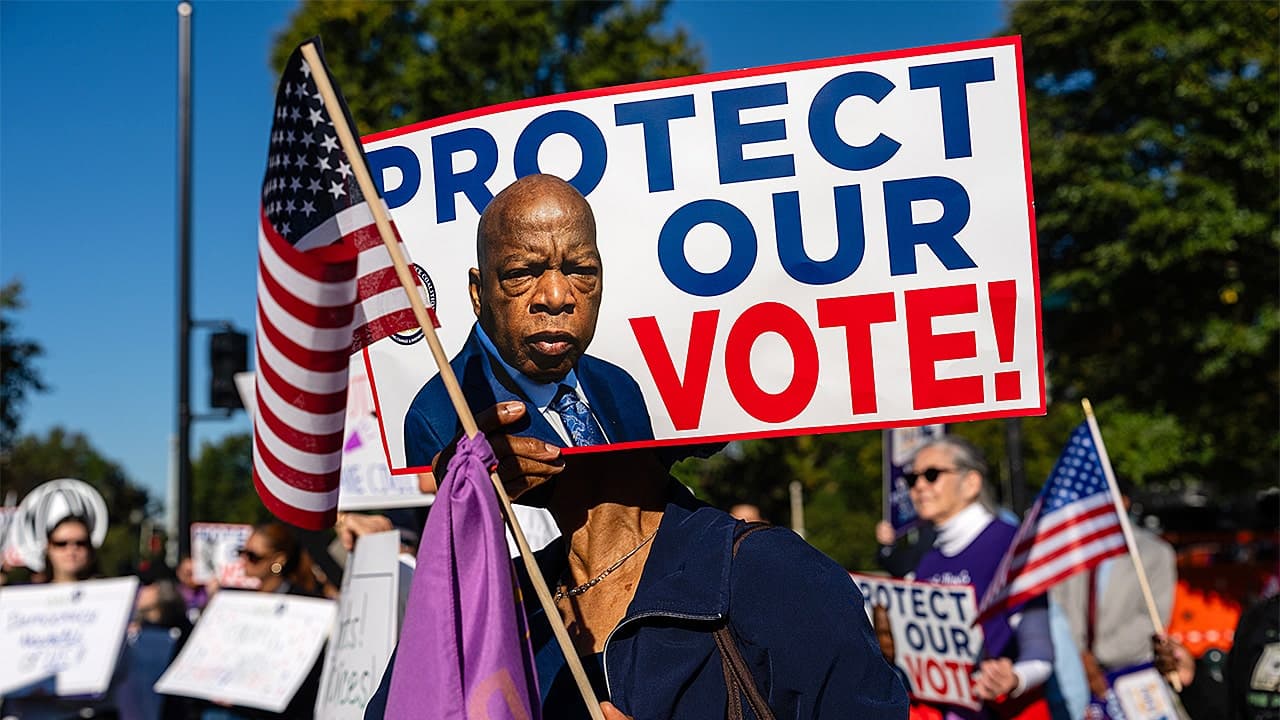
Louisiana suspends elections after Supreme Court strikes down Black district
Left says
- •The Supreme Court ruling significantly weakens the Voting Rights Act and undermines protections for Black voters that helped dismantle Jim Crow laws across the South
- •Suspending elections just days before voting was set to begin creates mass confusion and effectively changes the rules in the middle of the game, rigging the system
- •The new map will likely reduce Louisiana's majority-Black districts from two to one, diluting Black political representation despite the state's significant African American population
- •This decision represents a devastating blow to civil rights and could set a precedent for reducing minority voting power nationwide
Right says
- •The Supreme Court correctly ruled that using race as the primary factor in drawing congressional districts constitutes unconstitutional racial gerrymandering
- •Governor Landry acted responsibly by suspending elections rather than proceeding under an unconstitutional map that would violate voters' rights and undermine electoral integrity
- •The best way to end race-based discrimination is to stop making decisions based on race, creating truly colorblind electoral districts
- •This ruling represents a historic victory for Louisiana and could help Republicans gain additional congressional seats by ensuring fair, legal redistricting
Common Take
High Consensus- The Supreme Court ruled 6-3 that Louisiana's second majority-Black congressional district constituted an unconstitutional racial gerrymander
- Early voting was scheduled to begin Saturday for the May 16 primary, making the timing of the suspension particularly disruptive
- The state legislature must now draw new congressional maps before elections can proceed
- Both the governor and civil rights groups agree the Supreme Court decision will have significant consequences for Louisiana's electoral landscape
The Arguments
Right argues
The Supreme Court correctly ruled that using race as the primary factor in drawing congressional districts violates the Equal Protection Clause, and Governor Landry acted responsibly by suspending elections rather than proceeding under an unconstitutional map that would violate voters' rights.
Left counters
This ruling fundamentally undermines the Voting Rights Act's core purpose of preventing minority vote dilution, and suspending elections just days before voting creates chaos while effectively changing electoral rules mid-game to benefit one party.
Left argues
Louisiana's significant African American population (about 33%) deserves proportional representation, and reducing majority-Black districts from two to one dilutes Black political power in a state with a long history of voter suppression.
Right counters
True equality means creating colorblind districts based on traditional redistricting principles like compactness and communities of interest, not artificially engineering districts based on racial demographics.
Right argues
The decision represents a historic victory for constitutional principles by ending race-based gerrymandering and ensuring all voters are treated equally regardless of their race, which is the true spirit of civil rights.
Left counters
This 'colorblind' approach ignores ongoing racial disparities in political representation and effectively allows the dilution of minority voting strength under the guise of constitutional neutrality.
Left argues
The timing of this suspension creates mass confusion among all voters and undermines electoral integrity by abruptly changing established election procedures when early voting was set to begin in days.
Right counters
Proceeding with elections under a map the Supreme Court declared unconstitutional would have been far more damaging to electoral integrity and would have violated voters' constitutional rights.
Right argues
This ruling could help Republicans gain additional congressional seats by ensuring fair, legal redistricting that doesn't artificially favor one racial group over another in violation of constitutional principles.
Left counters
The real motivation appears to be partisan advantage disguised as constitutional principle, as this decision conveniently benefits Republicans while dismantling protections that helped end Jim Crow-era discrimination.
Challenge Questions
These questions target genuine internal contradictions — meant to provoke honest reflection.
Right asks Left
“If the goal is truly equal representation, how do you reconcile supporting race-conscious redistricting while simultaneously opposing other forms of racial considerations in areas like college admissions or employment, and doesn't this create an inconsistent standard for when race should and shouldn't matter?”
Left asks Right
“If creating truly 'colorblind' districts is the constitutional imperative, why does this principle seem to consistently result in outcomes that benefit white Republican voters at the expense of minority representation, and how do you address the practical reality that ignoring race often perpetuates existing racial disparities in political power?”
Outlier Report
Left Fringe
Progressive activists like those from Black Lives Matter and some Squad members who frame this as a return to Jim Crow represent about 15-20% of the left, using more inflammatory historical comparisons than mainstream Democrats.
Right Fringe
Hard-right figures like Steve Bannon and some America First commentators who celebrate this as completely dismantling minority voting protections represent about 10-15% of the right, going beyond the mainstream conservative position of colorblind redistricting.
Noise Assessment
Moderate noise level - while partisan figures are amplifying their positions, the core debate reflects genuine disagreement about voting rights versus colorblind governance that exists in broader public opinion.
Sources (7)
Gov. Jeff Landry (R-LA) suspended Louisiana's primary elections, scheduled for May 16, on Thursday following a Supreme Court ruling that struck down the state's 2024 congressional map. The Supreme Court ruled 6-3 that the second majority-black district drawn in the 2024 map, the 6th Congressional District represented by Rep. Cleo Fields (D-LA), constituted a racial gerrymander. The justices cited Section 2 of the Voting Rights Act in their decision, which has long been interpreted by courts to prohibit congressional maps drawn on the basis of minority voting strength, regardless of intent. "The State is currently enjoined from carrying out congressional elections under the current map," Landry and Attorney General Liz Murrill said in a statement. "We are working together with the Legislature and the Secretary of State's office to develop a path forward."
<p>Louisiana is suspending its House elections just days before voting was set to begin, Gov. Jeff Landry said Thursday, after the U.S. Supreme Court <a href="https://www.axios.com/local/new-orleans/2026/04/29/louisiana-callais-congressional-map-elections" target="_blank">struck down</a> the state's congressional map.</p><p><strong>Why it matters:</strong> Landry says an "electoral emergency exists," which gives him authority to suspend or delay elections.</p><hr /><p><strong>The big picture:</strong> The governor issued an executive order Thursday afternoon that suspends the <a href="https://www.axios.com/local/new-orleans/2026/04/07/closed-party-primary-deadline-senate-race" target="_blank">closed-party primaries</a> on May 16 and June 27 for the U.S. House races.</p><ul><li>The other races and ballot measures will continue as planned, his statement says.</li><li>Early voting was set to start Saturday. Absentee ballots have already been mailed to overseas voters.</li><li>"Allowing elections to proceed under an unconstitutional map would undermine the integrity of our system and violate the rights of our voters," Landry said in a statement.</li></ul><p><strong>Zoom in: </strong>Landry and Attorney General Liz Murrill are working with the Legislature and the Secretary of State's office to "develop a path forward," they said in a joint statement.</p><ul><li>The delayed election gives the Legislature time to draw a new map, Landry says.</li><li>He did not provide a timeline for next steps, including when House primaries would be rescheduled.</li></ul><p><strong>Zoom out:</strong> <a href="https://truthsocial.com/%40realDonaldTrump/posts/116494895594528861" target="_blank">President Trump praised Landry</a> on Truth Social on Thursday, thanking him for "moving so quickly to fix the Unconstitutionality of Louisiana's Congressional Maps."</p><ul><li>He also <a href="https://truthsocial.com/%40realDonaldTrump/posts/116494706928688681" target="_blank">heralded redistricting efforts in Tennessee</a>, saying they would "give us one extra seat, and help Save our Country from the Radical Left Democrats."</li></ul><p><strong>Catch up quick: </strong>The Supreme Court's 6-3 <a href="https://www.supremecourt.gov/opinions/25pdf/24-109_21o3.pdf?utm_source=newsletter&utm_medium=email&utm_campaign=newsletter_axiospm&stream=top" target="_blank">decision</a> Wednesday found Louisiana's use of race in creating a second majority-Black congressional district was an "unconstitutional racial gerrymander," Justice Samuel Alito wrote for the majority.</p><ul><li>The ruling limits a key provision of the Voting Rights Act, which helped dismantle Jim Crow laws and expand protections for voters of color across the South, writes Axios' Josephine Walker.</li><li>Landry and Murrill welcomed the ruling as a victory for the state, while civil rights leaders said it was devastating for Black voters.</li></ul><p><strong>What he's saying:</strong> "The best way to end race-based discrimination is to stop making decisions based on race," Landry said Thursday.<strong> </strong>"Here in Louisiana, we're proud to lead the nation on this charge."</p><p><strong>The intrigue:</strong> The redrawn map could potentially reduce the state's number of majority-Black districts.</p><ul><li>Louisiana currently has two majority-Black districts, which both elected Black Democrats.</li><li>Rep. <a href="https://www.axios.com/local/new-orleans/2024/11/12/live-results-cleo-fields-wins-louisianas-6th-congressional-district" target="_blank">Cleo Fields</a> was elected last year to represent the new district. Rep. Troy Carter represents the other, which includes New Orleans.</li><li>Alanah Odoms, the executive director of the ACLU of Louisiana, says she expects lawmakers to draw six majority-white districts or five majority-white and one majority-Black district.</li></ul><p><strong>What's next: </strong>State lawmakers are likely to take up the map redistricting during the current session, which ends June 1, <a href="https://www.nola.com/news/politics/elections/louisiana-postpones-primary-elections-supreme-court-ruling/article_6efaf265-024c-4d38-86f5-9ee3c8ce57b1.html#tncms-source=featured-top" target="_blank">NOLA.com's Tyler Bridges reports.</a></p><p><em>Editor's note: This story was updated with comments from President Trump and Gov. Jeff Landry.</em></p>
Louisiana's May congressional primaries were suspended after a U.S. Supreme Court ruling struck down a majority Black congressional district map.
Early voting had been scheduled to begin Saturday in advance of the May 16 primary.
GOP Gov. Jeff Landry issued an executive order Thursday delaying the elections until July 15 at the earliest — though the state’s Senate primary is unaffected.
Louisiana Gov. Jeff Landry (R) on Thursday suspended the May 16 primary elections for the House in his state, a day after the Supreme Court ruled that Louisiana’s addition of a second majority-Black congressional district was an unconstitutional racial gerrymander. Landry signed an executive order suspending the elections, for which early voting was set to…
Gov. Jeff Landry (R) issued an order pausing next month’s primaries until lawmakers can approve a new map, which could help the GOP gain one or two seats in the state this fall.