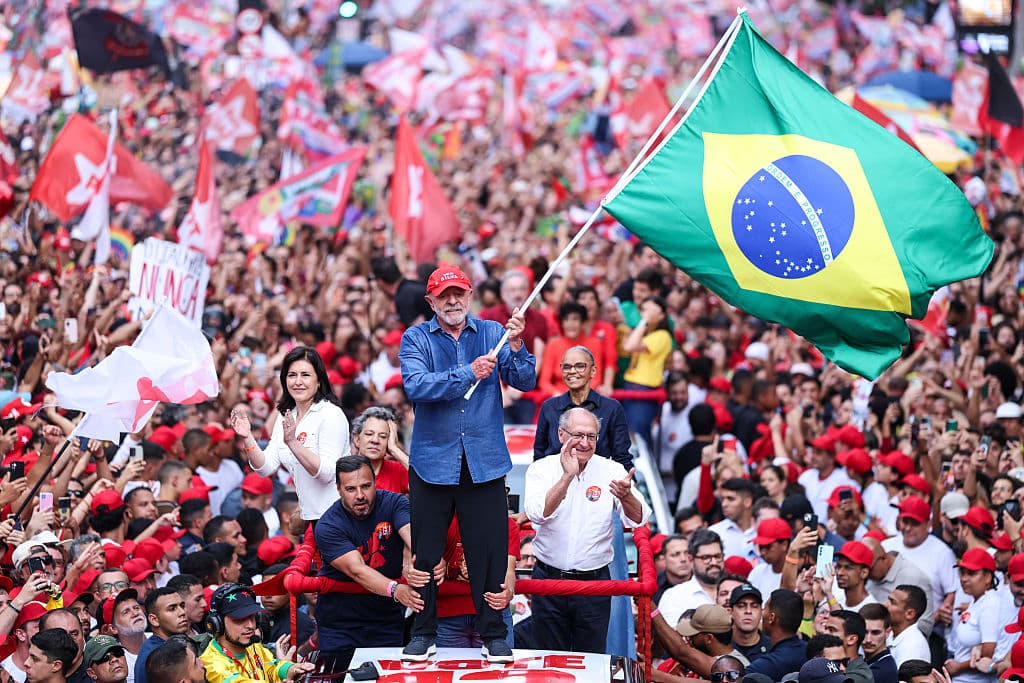
 Lula waves a Brazilian flag before a massive sea of red-clad supporters.
Lula's Comeback Win Halts Trump-Aligned Right-Wing Wave in Latin America
Left says
- •Lula's victory shows that grassroots organizing, student mobilization, and door-to-door campaigning can overcome disinformation and well-funded right-wing political machines.
- •The win is framed as a referendum on democracy itself, given that Flávio Bolsonaro sought to continue the legacy of his father, who was sentenced to prison for plotting a coup after losing in 2022.
- •Lula's expansion of Bolsa Família welfare payments and anti-poverty record are credited with winning back working-class voters who had drifted toward the right.
- •The result is celebrated internationally by progressive leaders as proof that the Trump-aligned right's regional momentum can be stopped and that Brazil will act as a counterweight to U.S. dominance in Latin America.
Right says
- •Flávio Bolsonaro won the first round of voting and came close to a majority in the runoff, reflecting genuine and substantial public support for his platform rather than a decisive rejection of it.
- •Bolsonaro and his allies are refusing to concede and are calling for the result to be annulled, raising concerns about the legitimacy and finality of the vote count.
- •The loss is viewed as a setback for a broader regional movement of seven consecutive conservative election victories across Latin America in the past 18 months, rather than evidence that voters have turned against those policies.
- •Concerns remain that U.S.-based tech platforms and international meddling may have shaped the information environment in ways that disadvantaged the right-leaning candidate, a claim some on the left have also raised in reverse.
Common Take
High Consensus- Lula won the runoff with 51.8% of the vote to Bolsonaro's 48.2%, a margin of roughly 4.4 million votes.
- This marks the first time in Brazil's post-1985 democratic history that a candidate overturned a first-round defeat to win the presidency.
- Jair Bolsonaro, the father of the runoff candidate, remains imprisoned after being sentenced for plotting a coup following his 2022 election loss.
- The election is widely seen as a significant moment for the broader geopolitical contest between left-leaning and right-leaning governments across Latin America.
The Arguments
Left argues
Lula's unprecedented comeback—overturning a first-round deficit for the first time in Brazilian democratic history—demonstrates that grassroots mobilization and a strong anti-poverty record can defeat well-funded right-wing campaigns, even ones aligned with Trump's geopolitical agenda.
Right counters
A 51.8%-to-48.2% margin is razor-thin, not a mandate; nearly half the electorate backed Bolsonaro despite his father's coup conviction, suggesting the 'referendum on democracy' framing overstates how decisively voters rejected the right's platform.
Right argues
Flávio Bolsonaro's strong first-round performance and near-majority in the runoff reflect genuine, substantial public demand for his platform, meaning this was a narrow electoral loss rather than proof that right-wing policies are unpopular or discredited in Brazil.
Left counters
Lula's campaign gained over 10 million votes in three weeks—a historic swing driven by unprecedented grassroots organizing—showing that when mobilized, the electorate decisively preferred protecting democratic institutions and social programs over continuing the Bolsonaro legacy.
Right argues
Bolsonaro's refusal to concede and calls to annul the results raise legitimate questions about the finality and legitimacy of the vote that deserve scrutiny rather than dismissal, especially given the closeness of the race.
Left counters
Brazil's electoral court and the Associated Press have certified the results with 100% of votes counted, and refusing to concede after a certified loss is itself a continuation of the anti-democratic pattern that led to the elder Bolsonaro's coup conviction, not evidence of fraud.
Left argues
Lula's victory interrupts a streak of seven consecutive right-wing victories across Latin America, positioning Brazil as a counterweight to Trump's regional ambitions and proving that the conservative wave is not inevitable or irreversible.
Right counters
A single election in one country does not overturn a broader 18-month regional trend toward conservative governance; Brazil's result may simply reflect Lula's unique incumbency advantages and welfare spending rather than a genuine ideological shift across Latin America.
Right argues
Concerns about U.S.-based tech platforms shaping the information environment cut both ways—if the left can credibly allege algorithmic suppression of Lula's messaging, the same scrutiny should apply to claims that foreign or corporate influence disadvantaged conservative candidates elsewhere in the region.
Left counters
The specific allegation here is that tech companies favored the Trump-aligned candidate, not the reverse, and Lula's win despite this alleged disadvantage only strengthens the case that grassroots organizing overcame a skewed digital playing field.
Challenge Questions
These questions target genuine internal contradictions — meant to provoke honest reflection.
Right asks Left
“If grassroots organizing and welfare spending were truly decisive, why was the race still close enough that nearly half of voters chose Bolsonaro despite his father's coup conviction—and does celebrating this as a sweeping 'referendum on democracy' risk overstating a narrow win?”
Left asks Right
“If Bolsonaro's refusal to concede and calls to annul a certified election result are treated as legitimate concerns rather than anti-democratic behavior, how does the right distinguish this from the same coup-adjacent conduct that landed his father in prison?”
Outlier Report
Left Fringe
Figures like Bernie Sanders and Zohran Mamdani explicitly celebrated Lula's win as a victory against Trump and global authoritarianism; this triumphalist framing represents maybe 15-20% of the left that is highly engaged in international leftist solidarity politics, while most Democratic-leaning Americans are only vaguely aware of the election.
Right Fringe
Commentators sympathetic to Jair Bolsonaro and figures like Steve Bannon or pro-Bolsonaro US conservative media voices have pushed claims of a 'stolen' or 'rigged' election mirroring Flávio Bolsonaro's own rhetoric; this represents maybe 10-15% of the right, with most conservatives only mildly interested in Brazilian electoral specifics.
Noise Assessment
High noise relative to actual public engagement — this story is heavily amplified among politically active social media users and foreign policy commentators, but most ordinary Americans have low awareness of or interest in Brazilian domestic politics beyond its symbolic Trump-related framing.
Sources (19)
Brazil's President Luiz Inácio Lula da Silva has won a fourth term in office in a dramatic comeback over his right-wing challenger Flávio Bolsonaro. Left-wing leader Lula took 51.79% of votes, becoming the first president since the return of democracy in 1988 to win an election after losing the first round of voting. Lula told celebratory crowds this election is a "loss for negativity, lies", later adding "long live democracy".
<p>Brazil President <a href="https://www.axios.com/2025/11/07/trump-un-cop30-climate-summit-brazil" target="_blank">Luiz Inácio Lula da Silva</a> was elected to a fourth, nonconsecutive term in the nation's presidential <a href="https://www.axios.com/politics-policy/election-results-voting" target="_blank">election</a>, according to early results released Sunday evening.</p><p><strong>Why it matters:</strong> Lula's victory deals a setback to Brazil's right-wing populist movement and preserves a major counterweight to President <a href="https://www.axios.com/politics-policy/donald-trump" target="_blank">Trump</a>'s influence in Latin America, with <a href="https://www.axios.com/2026/10/02/brazil-election-lula-flavio-bolsonaro-trump-amazon" target="_blank">tensions over trade</a> and tariffs threatening to persist. </p><hr /><ul><li>Lula, the incumbent candidate, was facing Flávio Bolsonaro, the son of former Brazilian President <a href="https://www.axios.com/2025/11/26/jail-brazil-president-prison-bolsanaro-coup" target="_blank">Jair Bolsonaro</a>. Flávio was widely seen as the heir to the nation's right-wing populist movement.</li></ul><p><strong>The latest: </strong>Lula <a href="https://x.com/LulaOficial/status/2114524774965588077" target="_blank">thanked</a> the Brazilian people after his election win, but Bolsonaro <a href="https://x.com/clashreport/status/2114534970970575114" target="_blank">told</a> reporters he would not accept the results and said they should be annulled, according to <a href="https://www.nytimes.com/live/2026/10/25/world/brazil-election?smid=tw-nytimes&smtyp=cur" target="_blank">translations</a>.</p><p><strong>The big picture:</strong> The election has been shaped by the impact of U.S. tariffs, climate change and the Amazon rainforest, <a href="https://rainforestfoundation.org/our-work/where-we-work/brazil/" target="_blank">60%</a> of which is in Brazil.</p><ul><li>Bolsonaro campaigned on public security and tackling corruption, presenting himself as a continuation of his father's political legacy, while Lula emphasized defending Brazilian sovereignty against U.S. pressure.</li><li>Yet substantive policy debate was limited, with both candidates focusing instead on corruption allegations levied against the opposing camp, <a href="https://www.american.edu/sis/news/2026-brazil-election.cfm" target="_blank">wrote</a> Matthew Taylor, a Brazil politics expert at American University.</li></ul><p><strong>Zoom in:</strong> After the U.S. imposed <a href="https://www.axios.com/2026/07/16/trump-tariffs-brazil" target="_blank">additional 25% tariffs</a> on some Brazilian goods this summer, Lula <a href="https://www.theguardian.com/world/2026/sep/25/lula-says-trump-wants-to-colonise-and-capture-brazils-resources-by-meddling-in-election" target="_blank">accused</a> Bolsonaro of being "Trump's candidate" and the U.S. president of wanting to "colonize" Brazil.</p><ul><li>Lula has enacted climate policies aimed at <a href="https://www.carbonbrief.org/analysis-lula-presidency-saved-at-least-20000km2-of-brazilian-amazon-since-2022" target="_blank">reversing</a> environmental deregulation under the previous administration, while Bolsonaro <a href="https://apnews.com/article/brazil-elections-amazon-lula-flavio-bolsonaro-eacb0832cd11cf40b0b2a24481439d1f" target="_blank">denied climate change</a> and <a href="https://www.reuters.com/business/media-telecom/flavio-bolsonaro-launches-brazil-presidential-campaign-touts-support-milei-2026-07-25/" target="_blank">pledged</a> to continue his father's political legacy.</li><li>Amazon deforestation has <a href="https://www.theguardian.com/environment/2026/oct/16/brazil-amazon-deforestation-lowest-on-record-election" target="_blank">fallen</a> 71% since 2022, the year before Lula returned to office, reaching its lowest annual level on record in 2026. Yet Lula's environmental record is complicated by his support for expanded oil development.</li><li><a href="https://www.axios.com/2022/10/30/brazil-election-lula-wins-bolsonaro-results" target="_blank">Lula defeated</a> Jair Bolsonaro in the previous election. The elder Bolsonaro is now serving a <a href="https://www.axios.com/2025/09/11/brazil-supreme-court-bolsonaro-coup-guilty" target="_blank">27-year prison sentence</a> for plotting a <a href="https://www.axios.com/2025/09/02/bolsonaro-trial-alleged-coup-trump" target="_blank">coup</a> to overturn the 2022 election, though he remains under house arrest due to health problems.</li></ul><p><strong>Go deeper:</strong> <a href="https://www.axios.com/2026/10/06/bolsanaro-brazil-markets-trump" target="_blank">Brazil's markets rally after Flávio Bolsonaro's first-round lead</a></p><p><em>Editor's note: This story has been updated with comment from the presidential candidates.</em></p>
The Trump-Lula relationship may have thawed, but several issues could reignite tensions between the two leaders.
Just as it has throughout Latin America, the Trump administration was openly working to defeat a left-wing government in Brazil and replace it with a far-right one. With Lula’s victory, Trump failed.
Lula’s defeat of the far right in Brazil not only secures the Brazilian president a definitive place in the history of global democracy but also offers valuable lessons for socialists across the planet.
Victory for Flávio Bolsonaro in Brazil’s election would bring mafiosi to power and reward interference by the White House and Miami reactionaries. In the final stretch of the campaign, Bolsonaro no longer looks invincible.
President Luiz Inácio Lula da Silva won another term on Sunday, with the help of a seismic social media campaign that convinced Brazilians to reject his rival.
President Luis Inácio Lula da Silva’s victory ended a string of presidential election wins by right-wing candidates in Latin America. His opponent has refused to accept defeat.
He will begin his fourth presidential term even as the right has gained ground.
Brazilian President Luiz Inácio Lula da Silva bucked prediction market odds with his unlikely win in the Brazilian presidential runoff election this weekend. On Sunday, Lula was rated an underdog in the election, as his odds were at 20.2 percent on Kalshi and 20.5 percent on Polymarket at noon EDT. His opponent, Flávio Bolsonaro, the…
Brazilian President Luiz Inácio Lula da Silva, a critic of President Trump and a champion of the Latin American left, won an unprecedented fourth term on Sunday in a runoff election against Flávio Bolsonaro, the son of Brazil’s former far-right leader Jair Bolsonaro. “We made history in the streets and at the ballot boxes, with…
Luiz Inácio Lula da Silva made history on Sunday, setting a record for Brazil and the rest of Latin America by becoming the first president to win a fourth term – and he did so days before turning 81, an age when many other leaders decide to leave politics behind. The Brazilian president's remarkable comeback against his right-wing rival, Flávio Bolsonaro, also set another record. Since Brazil's return to democracy in 1985, no president has managed to overturn a first-round defeat. The Workers' Party candidate added more than 10 million votes in the three weeks between the two rounds of voting, while his rival gained just 3.6 million.
Incumbent leftist President Luiz Inácio Lula da Silva defeated right-wing challenger Sen. Flávio Bolsonaro in Sunday's presidential second-round runoff, according to Brazil's electoral court and The Associated Press. The deeply polarized nation returned to the polls for a second round of voting on Sunday. With 100% of the vote counted, Lula won 51.8% of the vote, defeating Bolsonaro by nearly 4.4 million votes.
Brazilian President Luiz Inácio Lula da Silva has won a record fourth term in office, defeating far-right challenger Flávio Bolsonaro by 4 million votes in a runoff election on Sunday. Flávio Bolsonaro is the son of former President Jair Bolsonaro, who remains under house arrest for plotting a coup against Lula four years ago. The younger Bolsonaro, who narrowly defeated Lula in the first round of voting earlier this month, is now refusing to concede.</p> <p>Lula’s surprise comeback comes after weeks of student-led organizing and campaigning on his behalf, and amid accusations that U.S.-based tech companies were suppressing Lula’s reach online in favor of his Trump-aligned opponent. “The amount of organizing, the amount of marches and rallies, campaigning, pamphlets that we’ve seen the last three weeks has been something that I have never seen in my entire life, ever, covering elections for decades in so many different countries. It is absolutely unprecedented,” says Brazil-based journalist Michael Fox. “It is an absolute game-changer for the region.”
This article was published in partnership with Agência Pública, Brazil’s largest nonprofit newsroom. Two weeks before the second and decisive round of the Brazilian presidential elections in October, US Health Secretary Robert F. Kennedy Jr. was in Rio de Janeiro for the multi-day celebration of his son Conor’s wedding. The Kennedy scion married singer Giulia […]
Brazilian voters have denied Latin America's resurgent right its ultimate prize. Lula's reelection limits U.S. President Trump's influence in the region and cements Brazil as a counterweight to Washington.
The people united will never be defeated!
<p>After the rejoicing, it will be vital to learn the lessons. The rightward shift is neither inevitable nor irreversible, but progressives cannot rest for a moment</p><p>The impossible happened. President Luiz Inácio Lula da Silva <a href="https://www.theguardian.com/world/2026/oct/26/lula-wins-brazil-election">won a fourth term</a> in Sunday’s runoff election in Brazil, overturning Flávio Bolsonaro’s first-round lead in a historic comeback. No candidate has ever lost the first round and won the second, until now. Grassroots mobilisation, alongside social welfare policies, helped turn the contest into a referendum on Brazilian democracy, rallying voters against a candidate seeking to restore the legacy of his father, Jair Bolsonaro, <a href="https://www.theguardian.com/world/2025/nov/25/jair-bolsonaro-brazil-prison">imprisoned for plotting a coup</a> after his 2022 defeat. Lula’s victory suggests that defending democracy can still be a powerful electoral argument against the ascendant right.</p><p>Having already consolidated most of the leftwing vote, Lula had limited room to attract supporters of other candidates after his first-round defeat. His best chance lay in mobilising abstainers and reconnecting with working-class voters. The Workers’ party intensified its grassroots and digital campaigns, using social media influencers and messaging networks to reach supporters. Nearly 3 million more Brazilians voted in the runoff, and Lula gained ground across the country, particularly in major cities and his north-eastern strongholds. He also appealed to voters’ immediate economic concerns, drawing on a record of reducing poverty and inequality, and <a href="https://www.theguardian.com/world/2026/sep/18/brazil-lula-welfare-payments-weight-loss-jabs-election">increasing benefits under Bolsa Família</a>, the landmark welfare programme he launched in 2003. Lula framed the election as a choice between protecting social gains and democratic institutions, or returning to the Bolsonaro family’s attacks on both, warning that his opponent would compromise Brazil’s sovereignty by aligning himself with Donald Trump.</p><p>Jordana Timerman is a journalist based in Buenos Aires. She is the managing editor of The Ideas Letter and compiles the Latin America Daily Briefing</p><p>The Guardian’s Latin America correspondent Tom Phillips will be answering your questions about the election and the future of Brazil from 1500 GMT on Tuesday 27 October as part of our <a href="https://www.theguardian.com/community/series/conversations">Conversations</a> series. Email questions to <a href="mailto:conversations@theguardian.com">conversations@theguardian.com</a><strong>.</strong></p> <a href="https://www.theguardian.com/commentisfree/2026/oct/26/brazil-lula-far-right-donald-trump-election">Continue reading...</a>
<p>John Nichols</p> <div><img alt="" src="https://www.thenation.com/wp-content/uploads/2026/10/AP26299152729936.jpg" /></div> <div> <div class="wp-block-the-nation-dek article-title__dek"> <p>“The people united will never be defeated!" wrote Zohran Mamdani.</p> </div> </div> <p>The post <a href="https://www.thenation.com/article/world/lula-victory-brazil-election-reaction/">"LULA!" Progressives Hail Brazil's Stunning Election Result</a> appeared first on <a href="https://www.thenation.com">The Nation</a>.</p>