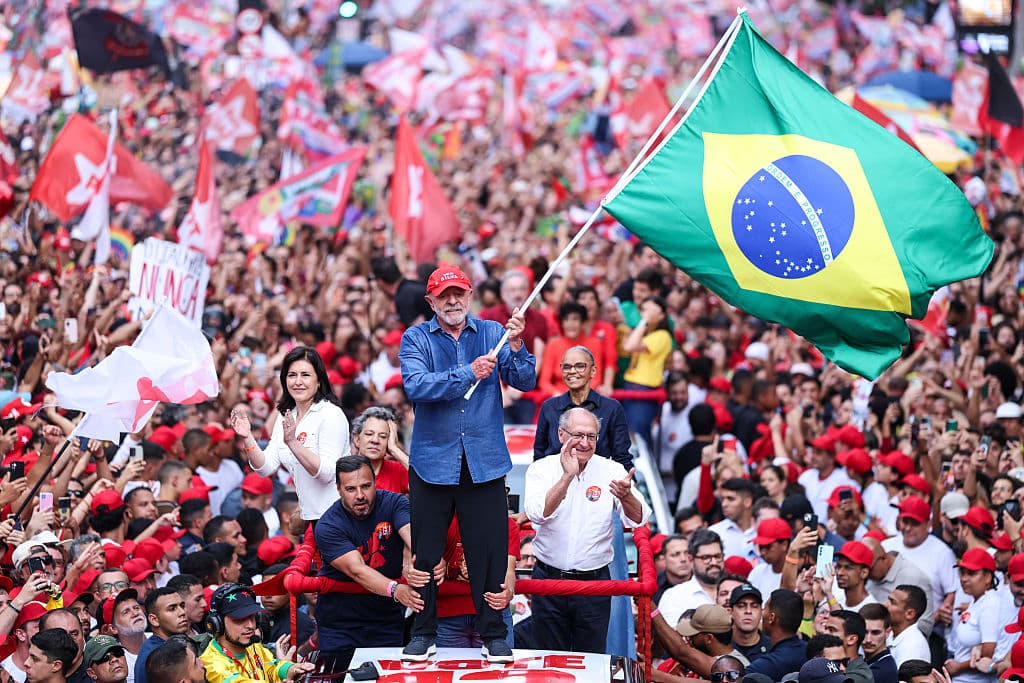
Lula's Comeback Win Halts Trump-Backed Far-Right Wave in Latin America
Left says
- •Lula's victory demonstrates that mass mobilization and grassroots turnout, especially among young voters, can overcome a seemingly unstoppable far-right momentum and well-funded disinformation campaigns.
- •The result is a rebuke of foreign interference, including Big Tech platforms like Meta allegedly favoring far-right candidates and the Trump administration's attempts to shape the outcome.
- •Lula's win, alongside solidarity from leaders like Claudia Sheinbaum and Bernie Sanders, signals a broader international progressive coalition pushing back against authoritarianism and defending democratic institutions.
- •His rhetoric rejecting being 'anyone's backyard' reflects a reassertion of Latin American sovereignty against US political and economic dominance.
Right says
- •Flávio Bolsonaro's strong second-round gains, nearly matching Lula's vote increase, show that right-wing populism retains deep and energized support in Brazil despite the loss.
- •The narrow 52-48 margin undercuts narratives of an overwhelming leftist mandate, suggesting the country remains deeply and evenly divided.
- •Jair Bolsonaro's imprisonment for an alleged coup attempt remains a contested and politically charged issue, with concerns that judicial and institutional actions have been used to sideline right-wing opposition.
- •Characterizing the election as a defeat of a 'Trump-backed' wave oversimplifies a complex national contest driven by domestic economic and social issues rather than foreign influence alone.
Common Take
High Consensus- Lula won the runoff election by a 52-48 margin, a reversal from trailing in the first round.
- Both sides recognize the election was closely contested and reflects deep political polarization within Brazil.
- The outcome has significant implications for the broader political direction of Latin America.
- Both acknowledge the role of youth turnout and late-campaign momentum in shaping the final result.
The Arguments
Left argues
Lula's come-from-behind victory, fueled by mass mobilization and surging youth turnout, shows that organized grassroots politics can overcome a seemingly unstoppable far-right wave and well-funded disinformation efforts.
Right counters
Flávio Bolsonaro also gained millions of votes in the second round, nearly matching Lula's increase, which suggests the result reflects a closely contested, mobilized electorate on both sides rather than a decisive progressive surge.
Right argues
A 52-48 margin indicates Brazil remains deeply and evenly divided, undercutting claims that this election represents a sweeping repudiation of right-wing populism or a broad progressive mandate.
Left counters
Even a narrow margin is decisive in a high-turnout national election, especially after Lula trailed in the first round; the scale of the reversal—ten million new votes—demonstrates real momentum behind his coalition, not just a razor-thin accident.
Right argues
Jair Bolsonaro's imprisonment on coup-related charges remains legally and politically contested, raising legitimate concerns that judicial institutions may have been used to weaken the right's leading figure ahead of the election.
Left counters
Bolsonaro's conviction followed documented evidence of an attempted coup after his 2022 loss, and treating accountability for anti-democratic actions as mere political persecution risks normalizing attacks on electoral institutions.
Right argues
Framing the race primarily as a defeat of a 'Trump-backed' far-right wave oversimplifies a contest shaped largely by domestic economic concerns, inflation, and social issues specific to Brazilian voters.
Left counters
While domestic issues mattered, documented interference—including Big Tech's favorable treatment of far-right content and Trump's public involvement—shows that foreign actors actively tried to shape the outcome, making the international dimension impossible to ignore.
Left argues
Lula's victory, celebrated by leaders like Sheinbaum and Sanders, signals an emerging international progressive solidarity capable of pushing back against authoritarian drift across the Americas.
Right counters
Enthusiastic praise from foreign left-wing leaders doesn't change the fact that Brazil's election was fundamentally about domestic conditions, and treating it as a symbolic win for a global progressive movement overstates its transferability to other countries' politics.
Challenge Questions
These questions target genuine internal contradictions — meant to provoke honest reflection.
Right asks Left
“If foreign interference and Big Tech bias were powerful enough to nearly tip the election toward the far right, how does the left reconcile that with its claim that grassroots mobilization alone was responsible for Lula's comeback?”
Left asks Right
“If the election is being described as evidence of deep national division rather than a mandate, how does the right address the fact that Bolsonaro's movement is anchored by a leader convicted of attempting to overturn a prior democratic election?”
Outlier Report
Left Fringe
Figures like Bernie Sanders and commentators at The Nation (e.g., John Nichols) who frame Lula's win as part of a global progressive movement against authoritarianism represent maybe 15-20% of the left that engages this deeply; most Democratic-leaning Americans have only passing awareness.
Right Fringe
Commentators like Steve Bannon or far-right media figures who portray Lula's win as evidence of a 'stolen' or rigged election akin to claims about Bolsonaro's 2022 loss represent a vocal 10-15% of the right; most Republican-leaning Americans are only mildly engaged with Brazilian politics.
Noise Assessment
Social media discourse (X posts from pundits like Nichols, Sanders staffers, or MAGA accounts) is disproportionately loud relative to the general public's negligible engagement with this story.
Sources (4)
Lula’s defeat of the far right in Brazil not only secures the Brazilian president a definitive place in the history of global democracy but also offers valuable lessons for socialists across the planet.
The Brazilian left has stopped the right-wing wave in Latin America. Now it has four years to work out a succession plan.
His come-from-behind victory in Brazil's presidential election spoils the storyline of right-wing dictators on the march.
<p>John Nichols</p> <div><img alt="" src="https://www.thenation.com/wp-content/uploads/2026/10/AP26299152729936.jpg" /></div> <div> <div class="wp-block-the-nation-dek article-title__dek"> <p>“The people united will never be defeated!” declares Zohran Mamdani.</p> </div> </div> <p>The post <a href="https://www.thenation.com/article/world/lula-victory-brazil-election-reaction/">“LULA!” Progressives Hail Brazil’s Stunning Election Result</a> appeared first on <a href="https://www.thenation.com">The Nation</a>.</p>