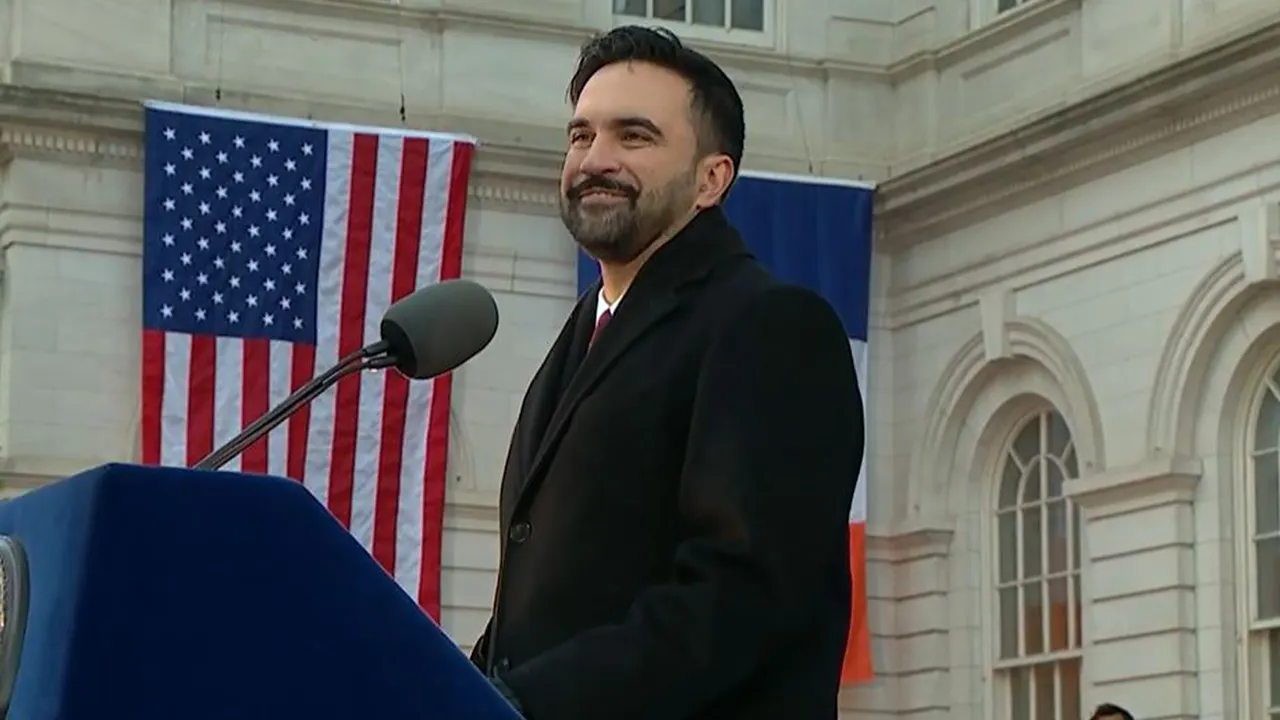
 Speaker at a New York City podium, a secondary figure in the Mamdani story.
Mamdani's Antisemitism Plan Draws Fire From Jewish Groups He Aimed to Protect
Intra-Party Split Detected
Mamdani, a progressive Democrat and Israel critic, faces criticism not only from the right but from mainstream Jewish and liberal organizations (UJA-Federation, AJC, ADL) who argue his anti-Israel rhetoric undermines his own antisemitism strategy, revealing tension between progressive and establishment Jewish Democratic constituencies.
Left says
- •The strategy substantially boosts funding for hate crime prevention and security for Jewish institutions, raising it from $3 million to $29 million, which represents the kind of material investment Jewish community safety advocates have long requested.
- •Mamdani's plan deliberately separates criticism of Israeli government policy from antisemitism, reflecting a view shared by many Jewish New Yorkers that conflating the two unfairly silences legitimate political speech and debate.
- •As the city's first Muslim mayor, Mamdani faces heightened scrutiny and skepticism that may not be applied equally to other officials, and his critics' framing risks suggesting he cannot be trusted to protect Jewish residents regardless of his policy actions.
- •The plan emphasizes concrete deliverables like education initiatives and celebrating Jewish New Yorkers' contributions, an approach meant to address root causes of hatred rather than relying solely on symbolic declarations.
Right says
- •Refusing to adopt any formal definition of antisemitism, including widely used ones, leaves the strategy without a clear standard for identifying and addressing anti-Jewish hate, undermining its practical effectiveness.
- •Major Jewish organizations, including the UJA-Federation, American Jewish Committee, ADL, and New York Board of Rabbis, argue that Mamdani's own rhetoric toward Israel has contributed to the climate of hostility the plan claims to combat.
- •Jewish groups point to specific incidents the administration has allegedly overlooked, such as terror-group flags displayed outside synagogues and sympathizers gathering near houses of worship, as evidence of inadequate moral and practical response.
- •Security funding alone cannot substitute for clear condemnation of antisemitic rhetoric and symbols, and critics see the plan as an attempt to project action without confronting the mayor's own history of harsh anti-Israel statements.
Common Take
High Consensus- Antisemitic hate crimes in New York City have risen significantly, reaching 181 incidents in 2026 with 131 classified as felonies, representing the largest share of all tracked hate crimes in the city.
- Jewish New Yorkers deserve to feel safe walking down the street, attending synagogue, and living openly without fear of harassment or violence.
- Increased funding for hate crime prevention and security measures for Jewish institutions is a necessary and welcome step.
- The timing and content of the mayor's antisemitism strategy carries real political stakes given his prior public statements about Israel.
The Arguments
Left argues
The plan nearly decuples funding for hate crime prevention and security for Jewish institutions, from $3 million to $29 million, representing the kind of material investment Jewish safety advocates have long demanded.
Right counters
Money for cameras and guards does not substitute for moral clarity; critics argue that without naming and confronting the rhetoric that fuels attacks, increased funding treats symptoms while ignoring the disease.
Right argues
By refusing to adopt any formal definition of antisemitism, including widely used ones like the IHRA definition, the strategy lacks a clear standard for identifying anti-Jewish hate, which major Jewish organizations argue undermines its practical enforceability.
Left counters
Forcing adoption of a single definition, particularly one that equates criticism of Israeli government policy with antisemitism, risks chilling legitimate political speech and does not itself prevent a single hate crime.
Right argues
Groups like the UJA-Federation, AJC, ADL, and the Board of Rabbis argue that Mamdani's own history of harsh anti-Israel rhetoric, including recently calling for the Israeli prime minister's arrest, has contributed to the very climate of hostility his plan claims to address.
Left counters
Conflating criticism of a foreign government's policies with hostility toward Jewish New Yorkers is itself a category error that these same critics are accused of making, and it unfairly implies Mamdani cannot separate political advocacy from his governing responsibilities.
Left argues
Deliberately separating criticism of Israeli government policy from antisemitism reflects a position shared by many Jewish New Yorkers who believe conflating the two is used to unfairly silence legitimate political debate.
Right counters
ADL data cited in reporting shows nearly 40% of antisemitic incidents in NYC are Israel-related, suggesting the two are not as cleanly separable in practice as the plan assumes, and ignoring that overlap leaves a major driver of harassment unaddressed.
Left argues
As the city's first Muslim mayor, Mamdani faces a level of scrutiny and presumption of bad faith that may not be applied equally to other officials, and some of his critics' framing implies he cannot be trusted regardless of concrete policy actions he takes.
Right counters
The criticism comes from mainstream, longstanding Jewish communal organizations citing specific documented incidents, like terror-group flags outside synagogues, not vague suspicion, so the concern is about his record and choices rather than his identity.
Challenge Questions
These questions target genuine internal contradictions — meant to provoke honest reflection.
Right asks Left
“If separating criticism of Israel from antisemitism is so straightforward, how do you account for the ADL's finding that nearly 40% of recorded antisemitic incidents in NYC were Israel-related, and what specific mechanism in the plan addresses that overlap?”
Left asks Right
“If adopting a formal definition of antisemitism is essential to a credible plan, which definition should be adopted, and how would you address the concern that definitions like IHRA have been used to characterize ordinary criticism of Israeli government policy as hate speech?”
Outlier Report
Left Fringe
Figures like Rep. Rashida Tlaib, DSA-aligned activists, and groups like Jewish Voice for Peace represent roughly 10-15% of the left who would fully endorse Mamdani's separation of anti-Zionism from antisemitism and view mainstream Jewish organizations' criticism as bad-faith political attacks.
Right Fringe
Commentators like Ben Shapiro and some Republican officials who frame Mamdani's entire mayoralty as an antisemitic threat represent roughly 15-20% of the right pushing a more maximalist narrative beyond the specific policy critique.
Noise Assessment
High noise ratio; much of the loudest commentary comes from highly engaged partisans and advocacy organizations with institutional incentives, while most Americans likely hold a blended view—appreciating funding increases while wanting clearer moral language, without the intensity seen in media coverage.
Sources (5)
'You fan the flames of antisemitism and then shout, "Fire!"'
A report issued by Mayor Zohran Mamdani describes ways that New York City is funding hate crime prevention and celebrating the contributions of Jewish New Yorkers
Jewish leaders welcome funding for education and security, but some say the New York mayor's strategy has glaring omissions
New York Mayor Zohran Mamdani's antisemitism task force boosts funding from $3 million to $29 million but refuses to adopt a formal definition of anti-Jewish hate.
<p>The mayor of New York, Zohran Mamdani, a boycott-Israel activist since his college days who as recently as this month was denouncing the Israeli prime minister as a war criminal who should be arrested and prosecuted, rolled out a "strategy to combat antisemitism" that was immediately met with withering derision from the very Jewish community the strategy was ostensibly intended to protect.</p> <p>The post <a href="https://freebeacon.com/america/mamdani-strategy-on-protecting-jews-is-denounced-by-jews/">Mamdani Strategy on Protecting Jews Is Denounced by Jews</a> appeared first on <a href="https://freebeacon.com"></a>.</p>