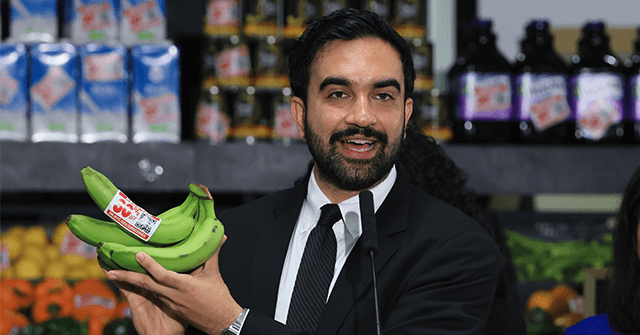
Mamdani's Subsidized Grocery Stores: Affordability Fix or Bodega Killer?
Left says
- •City-run grocery stores are a direct response to soaring food prices and corporate 'surveillance pricing' that squeezes low-income New Yorkers.
- •The stores deliberately avoid competing with bodegas by excluding hot food, alcohol, cigarettes, and lottery tickets, leaving those profit centers to small businesses.
- •Government intervention is framed as necessary because private markets alone have failed to make groceries affordable in a high cost-of-living city.
- •Guaranteed affordability for essential staples like produce, meat, and dairy is a public good worth taxpayer investment, especially in underserved neighborhoods.
Right says
- •Tax-exempt, rent-free government stores create unfair competition against small grocers and bodegas already operating on razor-thin 1-2% profit margins.
- •Immigrant-owned business coalitions argue the mayor has refused to negotiate with them and are pursuing legal action to block the plan.
- •Economists and business leaders warn that subsidizing 30% discounts requires either taxpayer funding, underpaying suppliers/workers, or unsustainable losses.
- •The $70 million project is portrayed as a socialist experiment that echoes failed state-run economic models and risks shortages or empty shelves.
Common Take
High Consensus- The plan involves five city-owned grocery stores, one per borough, offering a 30% discount on staples like produce, meat, dairy, and bread.
- The project carries a $70 million taxpayer-funded price tag.
- The stores will not sell hot food, alcohol, cigarettes, or lottery tickets to avoid directly competing with bodegas' other revenue streams.
- Grocery retail operates on very thin profit margins, making the impact of subsidized competition a legitimate concern for nearby businesses.
The Arguments
Left argues
City-run grocery stores directly address a market failure where corporate consolidation and 'surveillance pricing' have made basic groceries unaffordable for low-income New Yorkers, and government intervention is justified when private markets fail to deliver an essential public good.
Right counters
Even if affordability is a real problem, using tax-exempt, rent-free government entities to undercut prices doesn't fix the underlying market failure — it just shifts the cost onto taxpayers and onto small businesses who face a competitor immune to the pressures they must survive under.
Right argues
Grocery stores already operate on razor-thin 1-2% margins, so a government competitor that pays no rent, no property taxes, and offers a mandatory 30% discount will inevitably siphon customers away from bodegas and small grocers who cannot match those terms.
Left counters
The plan deliberately excludes hot food, alcohol, cigarettes, and lottery tickets — the actual profit centers for most bodegas — meaning the two business models serve different needs and are not in direct competition for survival.
Right argues
A coalition of 50 immigrant-owned business chambers says the mayor has refused to negotiate with them at all, suggesting the policy was designed without input from the very small-business owners it claims not to threaten.
Left counters
Refusing to let a well-funded lobbying coalition — backed by conservative think tanks — dictate policy design isn't the same as ignoring ordinary bodega owners' concerns, and the city can still adjust implementation details like store locations through the normal public process.
Right argues
Economists point out that subsidizing a 30% discount requires one of a few things to be true: underpaying suppliers, underpaying workers, taxpayer-funded losses, or unsustainable operations — all of which are warning signs drawn from historical failures of state-run retail.
Left counters
Government subsidy of essential goods is a common and often successful tool — from SNAP benefits to public transit fares — and a small five-store pilot funded by $70 million in a multi-billion dollar city budget is a modest experiment, not a national economic system.
Left argues
Guaranteeing affordable prices on essential staples like produce, meat, and dairy in underserved neighborhoods is a legitimate public investment, similar to subsidized housing or transit, that puts people's basic needs ahead of pure profit motives.
Right counters
If the goal is helping underserved communities, direct subsidies to residents (like food vouchers) would achieve that without distorting the competitive marketplace or threatening the livelihoods of existing small business owners in those same neighborhoods.
Challenge Questions
These questions target genuine internal contradictions — meant to provoke honest reflection.
Right asks Left
“If the stores are truly designed not to compete with bodegas, why would opening one just blocks away from five existing bodegas in East Harlem be necessary or sensible, rather than placing it in a genuine food desert with no existing grocery access?”
Left asks Right
“If critics believe a handful of tax-subsidized government stores could really trigger Soviet-style shortages and economic collapse, what does that say about how fragile they believe the private grocery market already is — and doesn't that undercut the claim that markets are functioning well without intervention?”
Outlier Report
Left Fringe
Democratic Socialists of America (DSA) activists and figures like Mamdani himself represent an enthusiastic pro-municipal-ownership fringe, likely 10-15% of the left, more radical than mainstream Democrats who tend to prefer subsidies/vouchers over direct government retail operations.
Right Fringe
Commentators like Shaun Maguire and Daily Wire's framing invoking Soviet Union/Cuba/Venezuela comparisons represent an extreme rhetorical fringe, maybe 20-25% of the right, more incendiary than the average conservative who might simply favor free-market skepticism without communist analogies.
Noise Assessment
High noise ratio: much of the coverage from Breitbart/Daily Wire uses maximalist Cold War rhetoric ('Bolsheviks', 'bread lines') that amplifies beyond mainstream public sentiment, while the immigrant business coalition's lawsuit and economists' margin concerns represent more grounded, broadly relatable arguments than the ideological framing suggests.
Sources (9)
<p>New York City Mayor Zohran Mamdani’s plan to open a slate of government-owned grocery stores has begun to take shape.</p> <p>The post <a href="https://www.breitbart.com/economy/2026/07/28/breitbart-business-digest-the-fatal-economics-of-mamdanis-government-grocery-stores/" rel="nofollow">Breitbart Business Digest: The Fatal Economics of Mamdani’s Government Grocery Stores</a> appeared first on <a href="https://www.breitbart.com" rel="nofollow">Breitbart</a>.</p>
<p>A New York City business coalition representing immigrant-owned shops voted this week to sue the city over Mayor Zohran Mamdani's taxpayer-funded grocery stores, alleging the plan will crush nearby competitors, according to a report.</p> <p>The post <a href="https://www.breitbart.com/politics/2026/07/28/immigrant-business-group-votes-to-sue-nyc-over-mamdanis-grocery-stores/" rel="nofollow">Immigrant Business Group Votes to Sue NYC over Mamdani’s Grocery Stores</a> appeared first on <a href="https://www.breitbart.com" rel="nofollow">Breitbart</a>.</p>
Peace, Land, and Bread. That’s the promise of Zohran Mamdani, esteemed leader of the triumphant five sanitation bur — Oh, wait. No. That was the propaganda of Vladimir Lenin and the Bolsheviks in 1917 Russia, sold to workers, soldiers, and peasants who were desperate enough to believe it. Funny. It sure sounds an awful lot ...
Socialist New York City Mayor Zohran Mamdani came under fire Monday after making another promise for his controversial plan for city-run grocery stores, with critics, business leaders, and economists savaging the $70 million taxpayer-funded scheme as an illiterate economic disaster that will drive neighborhood bodegas into bankruptcy. The backlash came swift and furious just hours ...
A business group led by immigrants says it is preparing to sue the city of New York over Mayor Zohran Mamdani's plan to open five taxpayer-funded supermarkets, according to the New York Post.
The first city-run grocery, in East Harlem, will cost $30 million to build a€” and perhaps more.
It should be no surprise that New York City Mayor Zohran Mamdani not only wants to tax the rich but dox them too. On Monday, New York’s Department of Finance published a searchable database of properties that could fall under New York’s new so-called pied-à-terre tax on second homes in the city. The New York...