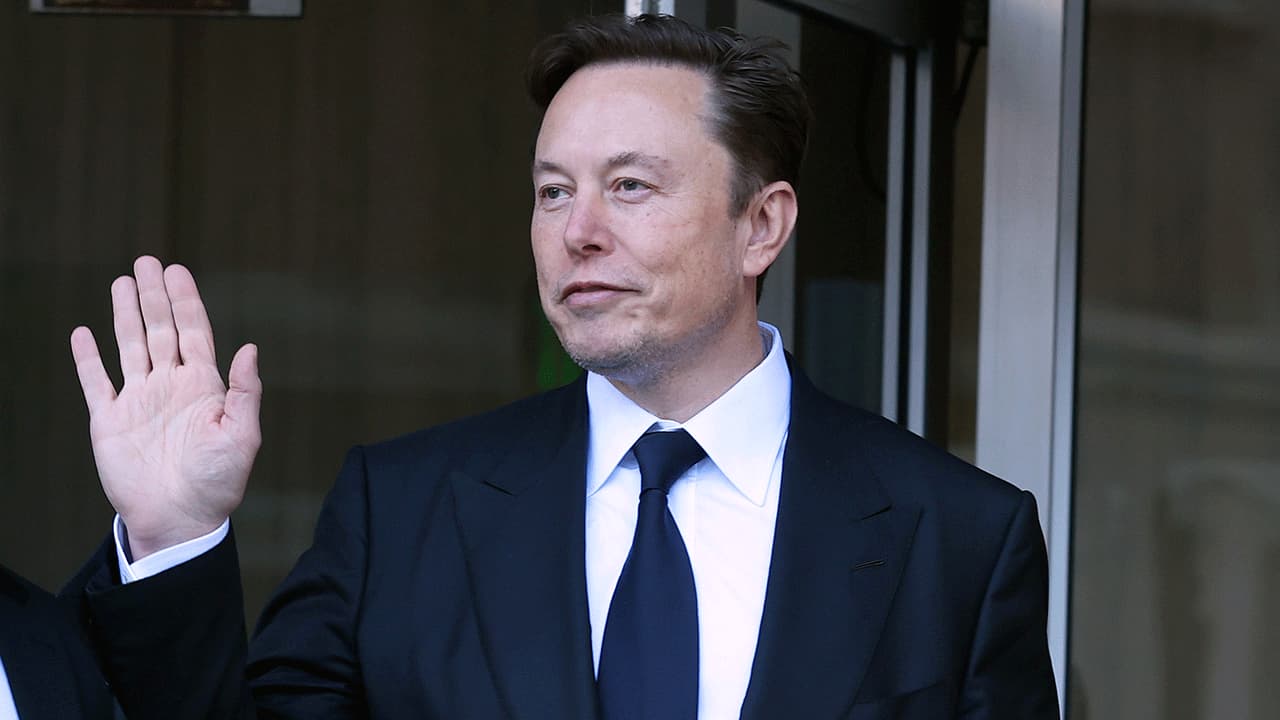
 Elon Musk waves while departing an event, the subject of the midterms story.
Musk, After Trump Rift, Spends Big to Save GOP Senate Bids
Intra-Party Split Detected
Some Republicans remain wary of Musk's involvement given his earlier public falling-out with Trump and concerns his low favorability could be used by Democrats to tie GOP candidates to an unpopular figure, even as others welcome his financial support.
Left says
- •Musk's re-entry into GOP fundraising gives Democrats a fresh line of attack, letting them tie unpopular figures like Talarico's opponents directly to a billionaire with low favorability ratings and a controversial record running DOGE.
- •The scale of spending signals Musk may pour upwards of $100 million into races nationwide, raising questions about how much influence one ultra-wealthy individual should have over dozens of competitive House and Senate contests.
- •This spending resumes despite Musk's public falling-out with Trump, suggesting his political involvement is driven by strategic self-interest and access rather than personal loyalty to the president.
- •Democrats see an opening to frame Republican candidates in states like Texas, Michigan, and Maine as beholden to Musk's money rather than accountable to voters.
Right says
- •Musk's financial backing offers Republicans a much-needed boost in tight races, including traditionally red states like Texas, Alaska, Iowa, and Ohio where the GOP has struggled to build commanding leads.
- •The reconciliation with Trump's political operation, underscored by Musk's meeting with Speaker Mike Johnson, shows Republicans are unifying their resources ahead of a critical midterm fight to keep control of Congress.
- •America PAC's spokesperson frames this as part of a broader, well-organized GOP effort to defy historical midterm trends and retain congressional majorities.
- •Directing major money toward Paxton in Texas addresses concerns about his fundraising shortfalls relative to Democratic challenger James Talarico, helping close a financial gap in a race the GOP must win.
Common Take
High Consensus- America PAC spent roughly $800,000 between August 19 and August 31 supporting Republican candidates and opposing Democrats in battleground races.
- The Texas Senate race between Ken Paxton and James Talarico received the largest share of the spending, at about $248,000.
- The PAC is active in races across more than a dozen states, including Maine, Michigan, Texas, Ohio, and New Hampshire.
- Musk previously spent roughly $260 million supporting Trump and Republicans in the 2024 election before this new midterm push.
The Arguments
Left argues
Musk's willingness to pour up to $100 million into dozens of races raises legitimate concerns about one ultra-wealthy individual exerting outsized influence over congressional elections nationwide, regardless of which party benefits.
Right counters
Musk is simply one of many wealthy donors on both sides of the aisle spending within legal limits through disclosed super PACs; singling him out ignores similar mega-donations from labor unions and progressive billionaires backing Democrats.
Right argues
Republicans face genuine fundraising gaps in critical races like Texas, where Paxton trails Talarico financially, and Musk's infusion of cash provides a much-needed resource to compete and defend the GOP's congressional majority.
Left counters
Relying on a single billionaire to bail out a struggling candidate like Paxton suggests the campaign lacks organic grassroots support and broad voter enthusiasm, which money alone can't manufacture.
Left argues
Musk's resumed spending so soon after his public falling-out with Trump suggests his political engagement is transactional—driven by access and self-interest—rather than principled loyalty, undermining claims that this is simply about strengthening the GOP.
Right counters
Political reconciliations are common and pragmatic; Musk's meeting with Speaker Johnson signals a mature, strategic reunification of resources ahead of the midterms rather than some hidden ulterior motive.
Right argues
The reunification of Musk's money with Trump's political operation demonstrates Republican unity and organizational strength, positioning the GOP to defy historical midterm losses for the president's party.
Left counters
A fragile reconciliation after a public feud is hardly a sign of stability, and voters may see this as opportunistic dealmaking between two powerful figures rather than a genuinely unified movement.
Left argues
Musk's low favorability ratings and the controversy surrounding DOGE give Democrats a potent and credible attack line, allowing them to tie GOP candidates to an unpopular figure rather than let those candidates run on their own merits.
Right counters
Voters ultimately judge candidates on policy and local issues, not on which donors fund their ads; Democrats have their own controversial megadonors that Republicans could just as easily weaponize.
Challenge Questions
These questions target genuine internal contradictions — meant to provoke honest reflection.
Right asks Left
“If large-scale independent spending by wealthy individuals is inherently corrupting when Musk does it for Republicans, does the left apply the same standard to billionaire donors and PACs that fund Democratic campaigns?”
Left asks Right
“If Paxton's campaign requires nearly a quarter-million dollars from a single outside donor just to stay competitive, does that undermine the argument that Republican candidates in red states have strong independent voter support?”
Outlier Report
Left Fringe
Progressive figures like Bernie Sanders and groups such as Public Citizen who argue for banning super PAC spending entirely and see Musk's involvement as emblematic of oligarchic control of elections; roughly 15-20% of the left holds this more radical anti-billionaire-donor stance versus simply using it as a campaign attack line.
Right Fringe
MAGA-aligned commentators who remain suspicious of Musk despite the reconciliation, such as Steve Bannon, who has openly criticized Musk and questioned his loyalty to Trump's movement; this represents perhaps 10-15% of the right that doesn't fully embrace Musk's return to GOP fundraising.
Noise Assessment
High noise ratio on social media (X posts, given Musk owns the platform) with amplified engagement skewing perception; actual public attention to this specific PAC spending story is likely low compared to broader midterm narratives, with most Americans not closely tracking individual FEC filings.
Sources (7)
Elon Musk’s super PAC has funneled about $800,000 into battleground races across the country to boost Republican candidates.
America PAC spent over $800,000 in 12 days backing Republicans, with Ken Paxton's Texas Senate race receiving the largest share of Elon Musk's cash.
Mr. Musk plans to spend at least $100 million in more than a dozen competitive House and Senate races. The tech billionaire helped Donald Trump to victory in 2024.
Disclosure of Musk’s first independent expenditures followed his meeting with Speaker Mike Johnson.
Tech mogul Elon Musk’s super PAC has spent around $800,000 in top House and Senate races this cycle, according to the latest filings. America PAC spent the most in Texas, doling out roughly $248,000 as Republican state Attorney General Ken Paxton fights for the Senate in a toss-up contest against Democrat James Talarico.  The group…
After unleashing $260 million in 2024, America PAC is beginning to spend again.
Elon Musk's political vehicle, America PAC, is aiming nearly $1 million at critical midterm races in its first wave of spending.