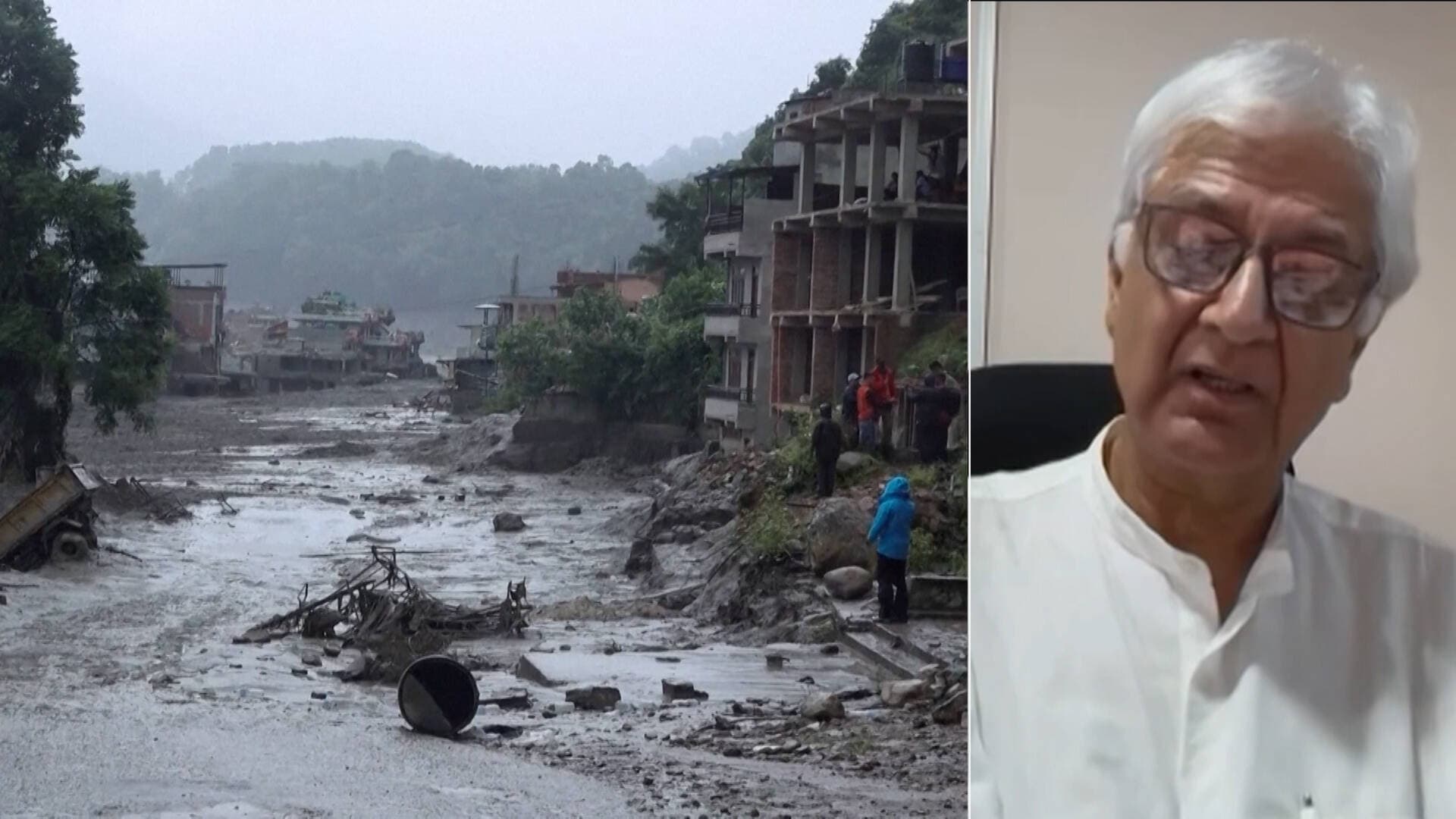
Nepal Flood: Climate Disaster or Politicized Tragedy?
Left says
- •The glacial collapse at Langtang Lirung stemmed from thawing permafrost, a direct consequence of accelerating warming in the Himalayas, a region heating faster than the global average.
- •This disaster fits a broader summer pattern of extreme climate events worldwide, from heatwaves to wildfires, underscoring the urgency of aggressive climate action now.
- •Nepal, a poor nation with minimal historical responsibility for greenhouse gas emissions, bears devastating costs — lost lives, destroyed hydropower, and wiped-out infrastructure — while wealthy nations have failed to deliver adequate climate adaptation funding.
- •Scientists and civil society had long warned such catastrophic glacial events could occur, framing this as a preventable tragedy rooted in delayed global climate action rather than an unforeseeable act of nature.
Right says
- •Attributing this disaster primarily to climate change overlooks tens of millions of years of plate tectonics and well-established mountain-weather dynamics that also explain sudden glacial and rock collapses.
- •Media outlets rushed to brand the tragedy a climate crisis before rescue and death tolls were even finalized, politicizing a natural disaster for ideological narratives.
- •Questions are emerging about whether U.S. foreign aid to Nepal was misdirected toward ideological projects rather than early-warning infrastructure that could have saved lives, especially compared to Bangladesh's more effective monsoon preparedness.
- •With dozens of Americans still unaccounted for, the focus should be on accountability for disaster preparedness and effective use of recovery aid rather than climate messaging.
Common Take
High Consensus- A glacier and mountain collapse at Langtang Lirung on August 26 triggered a massive flash flood along the Nepal-Tibet border with no preceding rainfall or earthquake.
- The disaster killed hundreds and left thousands missing, destroying villages, bridges, roads, and a significant portion of Nepal's hydropower capacity.
- Existing flood warning systems were not designed to detect this kind of high-mountain glacial collapse, leaving communities with virtually no advance notice.
- Rescue operations have been hampered by difficult terrain, weather, and debris, with hundreds of hydropower workers believed trapped in blocked tunnels.
The Arguments
Left argues
The glacial collapse at Langtang Lirung was driven by thawing permafrost in a region warming faster than the global average, and geographer Alton Byers and other scientists point directly to that warming as destabilizing the mountain's ice-rock structure.
Right counters
Even Axios's own reporting notes that researchers have not firmly established climate change as the cause, and Legal Insurrection points out that plate tectonics and well-documented mountain-weather dynamics have produced similar glacial and rock collapses for millions of years without any warming trend.
Right argues
Major outlets declared this a 'climate crisis' before search-and-rescue operations were complete or death tolls finalized, politicizing a disaster whose precise cause was still under investigation by USGS and other agencies.
Left counters
Naming climate change quickly isn't premature opportunism — scientists and civil society groups had been warning for years that thawing Himalayan permafrost made such catastrophic events increasingly likely, so the disaster confirmed a known risk rather than inventing a narrative.
Right argues
Bangladesh's more effective early-warning and evacuation systems kept its death toll at 59, raising legitimate questions about whether Nepal's use of U.S. foreign aid — allegedly including ideological projects rather than disaster-preparedness infrastructure — contributed to a far higher toll of over 900 dead and thousands missing.
Left counters
Axios and ICIMOD reporting shows this was a 'blue-sky flood' triggered by a glacier collapse high in the mountains with no rainfall, earthquake, or river rise — a fundamentally different and far less predictable hazard than the monsoon flooding Bangladesh's rain- and river-based systems are built to catch, making the comparison misleading.
Left argues
Nepal, a poor nation that has contributed minimally to global greenhouse gas emissions, is bearing catastrophic costs — lost lives, destroyed hydropower capacity, and wiped-out infrastructure — while wealthy historically responsible nations have failed to deliver adequate climate adaptation funding, raising a genuine climate justice concern.
Right counters
Framing this primarily as a funding and justice issue diverts attention from concrete, fixable governance failures — like whether Nepal's own disaster-preparedness investments and use of aid money were prioritized correctly — that are within Nepal's control regardless of global emissions politics.
Right argues
With dozens of Americans still unaccounted for and billions in recovery aid anticipated, the immediate priority should be accountability for how existing preparedness resources were used and how future aid will be spent, not abstract climate messaging.
Left counters
Accountability for preparedness and acknowledging the climate-driven nature of the hazard are not mutually exclusive; understanding that permafrost thaw is destabilizing entire mountainsides is precisely what should inform smarter early-warning investment going forward.
Challenge Questions
These questions target genuine internal contradictions — meant to provoke honest reflection.
Right asks Left
“If researchers themselves, including those cited in mainstream climate-friendly outlets, say they have not firmly established that climate change caused this specific glacial collapse, why should politicians and commentators state it as settled fact rather than a leading hypothesis?”
Left asks Right
“If the concern is genuinely about saving lives through better early-warning systems, does dismissing climate change's role in destabilizing Himalayan permafrost risk underinvesting in exactly the mountain-monitoring infrastructure needed to detect future glacial collapses?”
Outlier Report
Left Fringe
Figures like Michael Mann (Guardian op-ed) who explicitly frame the disaster as proof of imminent climate apocalypse and call for immediate dramatic action represent maybe 15-20% of the left, more common among climate activists and academic commentators than average Democratic voters.
Right Fringe
Legal Insurrection and Just The News commentators pushing the 'woke spending on transgender sex workers' angle and framing climate attribution as ideological opportunism represent a vocal 20-25% of the right, more aligned with populist/MAGA media than mainstream conservative or libertarian views on foreign aid.
Noise Assessment
High noise ratio — this is a low-salience foreign disaster story for most Americans; the loudest voices (climate scientists on the left, foreign-aid critics on the right) are amplified by ideological media ecosystems and represent much stronger positions than the average American, who likely just registers sympathy for victims without strong ideological framing.
Sources (9)
<p>Thousands of people are missing and hundreds are dead after a <a href="https://apnews.com/article/nepal-flash-floods-glaciers-climate-change-d8c11c2215ea0792e3612bf791e4299f" target="_blank">flash flood</a> in Nepal that struck with little warning earlier this week.</p><p><strong>Why it matters: </strong>The <a href="https://www.axios.com/2026/08/03/us-climate-change-adaptation-extreme-weather" target="_blank">flood</a> is exposing the gaps in warning systems that are designed to watch out for extreme rain and rivers — not for sudden collapses high in the mountains during good weather.</p><hr /><ul><li>Glacier-driven floods under clear skies — sometimes called "blue-sky floods" — can happen in the U.S. too, especially in Alaska and the Pacific Northwest, where sudden releases of glacial water can send floods and debris racing down mountain valleys.</li><li>This actually happened at <a href="https://www.usgs.gov/publications/glacier-outburst-floods-mount-rainier-washington-state-usa?utm_source=chatgpt.com" target="_blank">Mount Rainier</a> in Washington state in 2001, when debris flow from a glacier-related hazard caught people off guard during fair weather.</li></ul><p><strong>Driving the news: </strong>Nepali officials said Saturday <a href="https://apnews.com/article/nepal-china-flood-rescue-fde34c839b648f93f6aa011f044deb00" target="_blank">nearly 3,000 people</a> are missing from the Nepal-China region impacted by the floods that formed in the Himalayan mountains on Wednesday, per the Associated Press.</p><ul><li>There have been nearly 700 deaths attributed to the disaster, too, AP reports.</li><li>Nepali authorities warned that there could soon be more water rushing through the valleys along the Chinese border, threatening the search for survivors.</li></ul><p><strong>What we're watching: </strong>As investigators assess what happened, researchers are questioning if more floods could hit the area or become more common in the years to come, and what that might mean for the globe at large.</p><h2>How the rare "blue-sky flood" formed with little warning</h2><p><strong>What they found: </strong>The <a href="https://www.usgs.gov/programs/landslide-hazards/science/2026-nepal-debris-avalanche-and-flash-flood" target="_blank">U.S. Geological Survey</a> says that a section of a glacier and mountain debris collapsed on the north side of Lāngtāng Lirung, creating energy comparable to a magnitude-<a href="https://www.usgs.gov/programs/landslide-hazards/science/2026-nepal-debris-avalanche-and-flash-flood" target="_blank">5.2 earthquake</a> (though no earthquake actually triggered it).</p><ul><li><a href="https://www.icimod.org/press-release/major-flash-flood-sweeps-through-nepals-rasuwa-district-raising-fears-of-further-downstream-flooding" target="_blank">Investigators</a> say satellite evidence indicates the ice-rock avalanche may have temporarily dammed the Lhende Khola near the Nepal-China border, forming a lake that subsequently burst.</li><li>The collapsed glacier flow then likely collected additional ice, water, rock and sediment, rapidly amplifying into a stronger mass that caused the widespread flooding, according to USGS.</li><li>The <a href="https://www.icimod.org/press-release/major-flash-flood-sweeps-through-nepals-rasuwa-district-raising-fears-of-further-downstream-flooding/" target="_blank">Trishuli River</a> rose nine meters in 30 minutes during the flooding as well, adding to the disaster, per an analysis from the <a href="https://www.icimod.org/press-release/major-flash-flood-sweeps-through-nepals-rasuwa-district-raising-fears-of-further-downstream-flooding/" target="_blank">International Centre for Integrated Mountain Development</a>.</li></ul><p><strong>Stunning stat: </strong>The flow traveled roughly 100 kilometers (about 62 miles)<strong>.</strong></p><p><strong>The disaster mainly</strong> hit the Tibet region's Gyirong County and the Rasuwa district in northern Nepal, which sits on the Tibetan border.</p><ul><li>Videos posted to social media show widespread flooding and debris tackling villages and homes.</li></ul><img src="https://images.axios.com/88x0CVS92DcrJR6bmXGLGcFEfzw=/2026/08/28/1787934234335.jpeg" /> <div><strong>A graphic maps the glacier collapse and flash flooding that struck Nepal. Photo: Elif Acar/Anadolu</strong></div><p><strong>Reality check: </strong>There were no typical warning signs of the Nepali flood, researchers say. No thunderstorms, no rainfall, no rise in the river, no earthquakes.</p><ul><li>This is considered a "blue-sky flood," where the preceding moments before a dangerous flood is picturesque, according to the <a href="https://www.uottawa.ca/faculty-engineering/news-all/explainer-blue-sky-flood-nepal-no-heavy-rain-no-earthquake-what-happened" target="_blank">University of Ottawa</a>.</li></ul><p><strong>What they're saying: </strong>"The central lesson is that the absence of rain does not mean the absence of flood risk," Hossein Bonakdari, associate professor at the University of Ottawa's Department of Civil Engineering, said about the floods.</p><h2>Why traditional flood alert systems struggled to catch it</h2><p><strong>Context: </strong>Nepal has a flood-warning system that focuses on watching rainfall, river levels and flooding in the larger river systems.</p><ul><li>The <a href="https://lib.icimod.org/records/x8tth-ewj30" target="_blank">ICIMOD</a> says this typically covers major rivers and not the smaller waterways, which can lead to floods hitting with no warnings.</li></ul><p><strong>Yes, but: </strong>Experts told the <a href="https://monorepo-sample1.nyt.net/2026/08/27/climate/nepal-flooding-climate-change.html" target="_blank">New York Times</a> the conventional system wasn't designed to notice flash floods created by a massive mountain or glacier collapse.</p><p><strong>Because the flooding </strong>began high in the mountains under clear blue skies, it rapidly surged downward and avoided the normal trigger system.</p><ul><li>"This suggests an important change in how we think about warning systems in high-mountain regions: we need to monitor the mountain as well as the weather and the river," says Bonakdari, of University of Ottawa.</li></ul><h2>How glacier floods could become more common</h2><p><strong>Between the lines: </strong>Researchers have not firmly established that global warming or climate change caused this flood, but it is a leading theory.</p><ul><li>That's because any warming would have destabilized glaciers, permafrost and surrounding slopes, potentially increasing the threat of sudden collapses and floods, experts say.</li></ul><p><strong>Alton Byers, </strong>a geographer at the University of Colorado, Boulder, told <a href="https://www.nature.com/articles/d41586-026-02716-w" target="_blank">Nature</a> that the glacier breaking off suggests the permafrost on the mountain began thawing thanks to warming temperatures.</p><ul><li>He said this could become more common worldwide. And with more people traveling to various locations with mountain ranges, there needs to be more awareness about how to detect flash flooding.</li><li>"You can't predict these events," he said.</li></ul><p><strong>What's next: </strong>Experts are calling on authorities to invest more in early-detection systems for areas vulnerable to extreme flash flooding. </p>
More than 900 people in Nepal are confirmed dead after a massive wall of water, mud and debris crashed through a Himalayan river valley on the border with Tibet. More than 4,200 people are missing in Nepal and hundreds more in Tibet. Families are searching hospitals for loved ones, and crews have buried hundreds of unidentified bodies in shallow graves. Rescue efforts are also underway for more than 900 hydropower workers, believed to be trapped in more than a dozen underground tunnels blocked by debris. The cause of the flash flooding is believed to have been the collapse of a glacier in the mountains, leading a wave of water, rocks and debris to carve its way through the valley.</p> <p>“This is a catastrophe of unimaginable proportions,” says journalist Kunda Dixit, speaking to <em>Democracy Now!</em> from the Nepalese capital of Kathmandu.</p> <p>“We used to say that the glaciers are melting in the Himalaya. Now it seems like the mountains are cracking up,” says Dixit. “This has sort of redefined what global warming and climate change is doing, not just to Nepal and the Himalaya, but to the planet.”
We get a report from Nepal, where at least 547 people are confirmed to have died and over 1,500 are still missing after a glacial collapse on Wednesday sent a wall of ice, mud and rock into a Himalayan river, triggering catastrophic flooding in the Nepal-Tibet border region that swept away entire communities. Nepali authorities say they have rescued more than 3,700 people so far. Geologists say the flash floods were set off by a landslide and glacial avalanche so powerful it set off its own seismic signal. Climate scientists warn the region is warming much faster than the global average, leading to the rapid retreat of glaciers.</p> <p>“Scientists and civil society have been warning about the very fact that these kind of events might happen in the Himalayas,” says Sunil Acharya, a climate and public policy specialist reporting from Kathmandu, Nepal. “This is the result of the delayed global action to deal with climate change.”</p> <p>“The number of people being killed, the number of properties being damaged has been way beyond what we can adapt to,” says Acharya. The floods have “[washed] away hundreds of villages, a huge number of bridges and road infrastructure and also hydropower stations.”
Eighty Americans are unaccounted for in a disaster that a neighboring country survived with 59 deaths, and the difference appears to come down to whether early-warning systems were built before the water rose.
Last week's flooding has resulted in 903 bodies recovered so far and more than 4,200 people still unaccounted for, according to a spokesperson for Nepal’s Ministry of Foreign Affairs on Sunday.
<p>The political talking point ignores tens of millions of years of plate tectonics and its consequences, and completely dismisses well-established mountain-weather dynamics.</p> The post <a href="https://legalinsurrection.com/2026/09/the-ghoulish-race-to-turn-nepals-flood-victims-into-a-climate-crisis-talking-point/">The Ghoulish Race to Turn Nepal’s Flood Victims Into a ‘Climate Crisis’ Talking Point</a> first appeared on <a href="https://legalinsurrection.com">Le·gal In·sur·rec·tion</a>.
Authorities in Nepal continued mass burials after catastrophic floods roared down high mountain valleys in a vast torrent of destruction. The death toll is now over 1,000 people, with thousands still missing. Across the border in China, which has been less transparent, officials report just 16 deaths, but nearly 550 missing. Neil Connery of ITV News reports from the disaster zone.
<p>The deluge capped a summer of extreme climate events, from deadly heatwaves to wildfires. We must take action now</p><p>For millennia, the high peaks of the Himalayas were held together by an invisible, frozen cement – permafrost and glacial ice that bound ancient rock into seemingly unshakable fortresses. But as the planet continues to warm, this alpine glue is liquefying.</p><p>The glacial collapse and deluge in Nepal and Tibet was <a href="https://www.theguardian.com/commentisfree/2026/aug/28/nepal-tibet-flood-climate-crisis-global-heating">not a freak weather event</a>; it was the structural failure of a mountain itself, nature’s latest commentary on the deadly consequences of human-caused planetary warming. And it was the exclamation point on a summer of extremes, illustrating with a sole <a href="https://thehill.com/opinion/energy-environment/3871118-enjoy-the-weather-worry-about-the-climate/">unnatural disaster</a> the apocalyptic future that lies in store if we fail to take dramatic climate action.</p> <a href="https://www.theguardian.com/commentisfree/2026/sep/01/nepal-flooding-climate-disaster">Continue reading...</a>
<p>Wen Stephenson</p> <div><img alt="" src="https://www.thenation.com/wp-content/uploads/2026/08/nepal-flood-damage-getty.jpg" /></div> <div> <div class="wp-block-the-nation-dek article-title__dek"> <p>An interview with Nepali UN climate expert Manjeet Dhakal on what the massive Himalayan flood will cost Nepal.</p> </div> </div> <p>The post <a href="https://www.thenation.com/article/environment/nepal-flood-manjeet-dhakal-himalaya/">How Will Nepal Pay for the Latest Climate Disaster?</a> appeared first on <a href="https://www.thenation.com">The Nation</a>.</p>