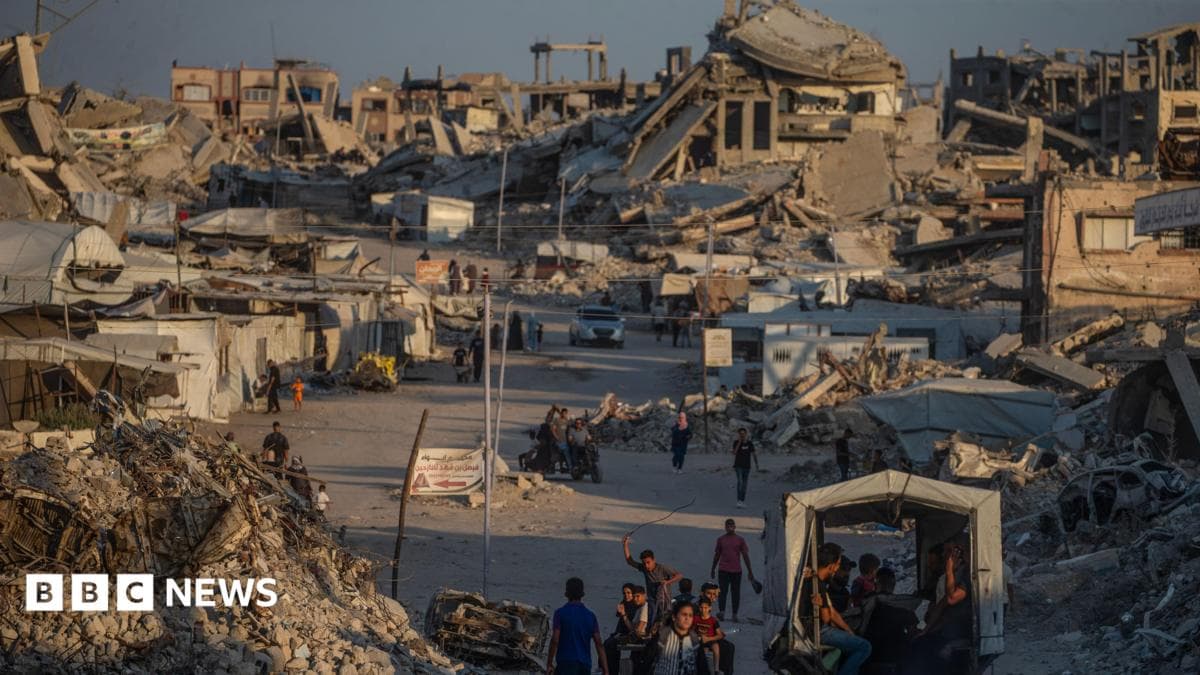
Netanyahu Breaks With Trump, Rejects US Gaza Peace Plan
Intra-Party Split Detected
Netanyahu's rejection of Trump's plan creates tension between the US administration (touting the plan as a diplomatic win) and Israel's right-wing government, while Netanyahu himself is also squeezed by far-right coalition partners pushing him to reject any concessions to Hamas, complicating unified right-leaning support for the deal.
Left says
- •Netanyahu's rejection undercuts a diplomatic breakthrough Trump had personally announced as a historic achievement, exposing tension between the two allies just weeks after it was celebrated.
- •The move comes as Netanyahu faces pressure from far-right coalition partners ahead of October elections, raising questions about whether domestic politics are driving Israel's Gaza strategy rather than security considerations alone.
- •Netanyahu's insistence that Israel will never accept a Palestinian state and will not withdraw troops risks prolonging the conflict and delaying reconstruction and humanitarian relief for Gaza's population.
- •Hamas has publicly reaffirmed its commitment to the negotiated roadmap, suggesting Israel's rejection—not Hamas's noncompliance—is now the primary obstacle to implementation.
Right says
- •Netanyahu's demand for genuine, complete disarmament reflects hard-earned skepticism after decades of Hamas making commitments it later evades or reinterprets.
- •Israel is not rejecting cooperation with Washington outright; Netanyahu says talks continue and some U.S. ideas are acceptable, signaling a negotiating position rather than a full breach with Trump.
- •Withdrawing Israeli troops before Hamas surrenders its arsenal would leave Israeli civilians and soldiers exposed to renewed attacks, a risk Netanyahu says is unacceptable regardless of political pressure.
- •The plan's phased approach, which lets Hamas retain weapons temporarily while transferring governance, understandably concerns a government wary of enabling Hamas to rearm or stall indefinitely.
Common Take
High Consensus- Netanyahu explicitly rejected the Board of Peace's 15-point Gaza plan during a Sunday cabinet meeting, stating the IDF will not withdraw until Hamas is genuinely disarmed.
- Trump's Board of Peace had announced last month what it called a historic agreement for Hamas's complete disarmament.
- Hamas maintains it remains committed to the negotiated roadmap and says it is ready to implement the agreement.
- Netanyahu says Israel and the United States are actively discussing the disagreement, with some American proposals deemed acceptable and others not.
The Arguments
Left argues
Netanyahu's public rejection undercuts a deal Trump personally announced as a 'historic' and 'monumental' achievement, exposing a rift with Israel's closest ally just weeks after it was celebrated as a breakthrough.
Right counters
Netanyahu explicitly said talks with Washington continue and some U.S. ideas are acceptable, which is a negotiating posture over sequencing, not a rupture with Trump or a rejection of the alliance.
Right argues
After two decades of Hamas making commitments it later evades, Netanyahu's insistence on verified, complete disarmament before any troop withdrawal reflects hard-earned skepticism rather than mere obstructionism.
Left counters
Hamas has publicly reaffirmed its commitment to the negotiated roadmap and asked mediators to enforce compliance from all sides, suggesting Israel's rejection—not Hamas's noncompliance—is now the primary obstacle to moving forward.
Left argues
Netanyahu's rejection comes amid pressure from far-right coalition partners ahead of October elections, raising legitimate questions about whether domestic political survival, not security, is shaping Israel's Gaza strategy.
Right counters
Even if politics play some role, the underlying security concern is substantive: withdrawing troops before Hamas surrenders its arsenal would leave Israeli civilians and soldiers exposed to renewed attacks, a risk no government could responsibly accept regardless of the electoral calendar.
Right argues
The plan's phased approach lets Hamas retain weapons temporarily while transferring governance, a sequencing that understandably worries a government wary of enabling Hamas to rearm or stall indefinitely under the guise of 'verification.'
Left counters
Insisting on full disarmament before any withdrawal effectively guarantees indefinite Israeli military presence and stalls reconstruction and humanitarian relief for Gaza's population, since Hamas will not disarm unilaterally while occupation continues.
Left argues
Netanyahu's declaration that Israel will never accept a Palestinian state goes beyond disarmament sequencing and signals a rejection of the plan's core political endpoint, not just its implementation mechanics.
Right counters
Trump's own framework left Gaza's political future and Hamas's disarmament as contentious issues for later negotiation, so Netanyahu restating a longstanding Israeli redline is consistent with, not a departure from, the phased and unresolved nature of the deal.
Challenge Questions
These questions target genuine internal contradictions — meant to provoke honest reflection.
Right asks Left
“If Hamas's disarmament is genuinely contingent on Israeli withdrawal and eventual statehood, as Hamas itself has said, how can the left characterize Hamas's position as full compliance with the roadmap rather than its own conditional rejection of key terms?”
Left asks Right
“If Netanyahu says talks with Washington continue and some U.S. ideas are acceptable, but he has also ruled out the plan's core sequencing mechanism and a Palestinian state outright, at what point does 'negotiating position' become indistinguishable from a substantive rejection of the plan's central bargain?”
Outlier Report
Left Fringe
Figures like Rep. Rashida Tlaib and some progressive commentators (e.g., writers at The Intercept) who view Netanyahu's rejection as proof of Israeli obstruction and oppose continued U.S. military support entirely; roughly 10-15% of the left holds this more absolutist anti-Netanyahu position.
Right Fringe
Some hardline pro-Israel commentators and figures like Mark Levin who back Netanyahu's rejection unconditionally and argue Trump's plan itself was naive or dangerous, representing about 15-20% of the right that prioritizes Israeli security over Trump's diplomatic framing.
Noise Assessment
High noise ratio; much of the online discourse is driven by highly engaged partisan and pro-Israel/pro-Palestinian activist communities, while most Americans pay limited attention to the granular details of ceasefire mechanics and instead hold generalized views about trusting Hamas versus wanting the war to end.
Sources (13)
Israel's PM says its military will not pull out from Gaza until Hamas is "genuinely" disarmed.
Prime Minister Benjamin Netanyahu says Israel has rejected United States President Donald Trump's Board of Peace plan for Gaza and will not withdraw forces until the Palestinian group Hamas fully disarms. "Israel rejects the 15-point document," Netanyahu said at a cabinet meeting on Sunday, referring to the plan endorsed last month by Hamas.
Israeli Prime Minister Benjamin Netanyahu restated his rejection of Donald Trump's latest Gaza plan in televised remarks to his right-wing government on Sunday, even as Israel's military has effectively halted attacks in the territory under pressure from the U.S. President. Netanyahu is in campaign mode as he seeks re-election at a vote due on October 27 but is caught between far-right ministers angered by concessions in Gaza and his key military backer, Trump, who wants progress toward ending the conflict there with a new 15-point peace plan.
President Trump hailed the peace plan as a "historic agreement for the complete disarmament of Hamas and all other groups in Gaza."
Israel is rejecting a 15-point Gaza proposal put forward by the Board of Peace, Israeli Prime Minister Benjamin Netanyahu said Sunday, declaring that Israeli forces will not withdraw from the enclave until Hamas fully gives up its weapons. "Israel rejects the 15-point Gaza document proposed by the Board of Peace," Netanyahu said at Sunday's Cabinet meeting. "The IDF will not carry out any withdrawal until Hamas is genuinely disarmed."
Netanyahu announced the decision during a cabinet meeting
<p>"Israel rejects 15-point Board of Peace plan, the IDF will not withdraw from Gaza until Hamas is disarmed."</p> The post <a href="https://legalinsurrection.com/2026/08/netanyahu-rejects-15-point-gaza-plan-says-no-withdrawal-until-hamas-disarms/">Netanyahu Rejects 15-Point Gaza Plan, Says No Withdrawal Until Hamas Disarms </a> first appeared on <a href="https://legalinsurrection.com">Le·gal In·sur·rec·tion</a>.
Israel will not accept the 15-point plan for Gaza set out by President Donald Trump’s Board of Peace, Prime Minister Benjamin Netanyahu said Sunday.
The Israeli leader ruled out a phased troop withdrawal as Hamas disarms, casting fresh doubt over Gaza’s ceasefire and recovery.
President Trump’s Board of Peace announced an agreement last month that aimed at Hamas giving up its weapons alongside an Israeli withdrawal from Gaza.
Netanyahu's comments come just over a week after President Trump said his Board of Peace had reached a "historic" agreement with Hamas to give up its weapons.
Israeli Prime Minister Benjamin Netanyahu on Sunday rejected President Trump’s plans to disarm Hamas and establish a Palestinian government in Gaza.  “I have heard people saying: ‘You didn’t say it.’ So here I am saying it again: Israel does not accept the 15-point document,” Netanyahu said during a Cabinet meeting Sunday, adding that the Israeli…