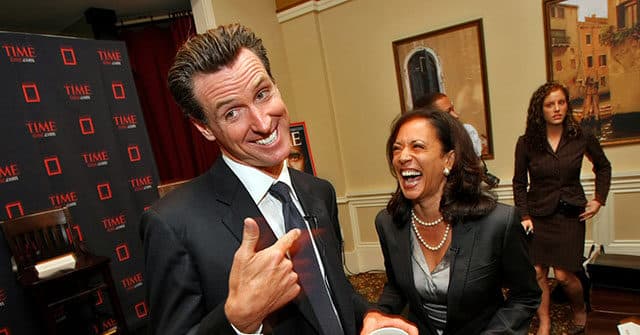
Newsom Says He Won't Challenge Harris for 2028 Nomination
Intra-Party Split Detected
Democratic-aligned coverage and commentary reveal tension between Newsom and Harris supporters over who is the stronger 2028 candidate, with polling showing Harris ahead but Newsom having built a national profile; right-leaning outlets frame Newsom's deference as evidence of weakness or political calculation rather than genuine party unity.
Left says
- •Newsom frames a Harris-Newsom primary matchup as unnecessary infighting that would only help Republicans, reflecting a broader concern about party unity heading into 2028.
- •His deference signals respect for Harris's prior candidacies and standing within the party, rather than a lack of ambition on his part.
- •Newsom emphasizes he would only run if he has a genuine 'why' and the backing of his family, suggesting a values-driven rather than purely opportunistic approach to a potential campaign.
- •He continues to build a national profile through his podcast, social media presence, and redistricting fight against Trump, indicating his 2028 planning continues regardless of Harris's decision.
Right says
- •Critics view Newsom's remarks as calculated positioning rather than genuine deference, noting his simultaneous national fundraising and media efforts suggest he's still angling for a 2028 run.
- •Some commentators highlight the irony that Newsom acknowledges Harris's two failed presidential bids yet still says he'd defer to her, questioning his political judgment or sincerity.
- •Skeptics portray the friendly, staged nature of the interview (fly-fishing with a sympathetic CNN host) as an attempt to soften Newsom's image rather than a substantive policy or political statement.
- •Some see this as evidence that top Democratic contenders lack compelling rationales for their candidacies, reinforcing a broader critique that the party's 2028 field is uninspired.
Common Take
High Consensus- Newsom told CNN's Jake Tapper directly, 'I wouldn't run if she ran,' during a fly-fishing interview in Montana.
- Newsom argued that a primary contest between two California Democrats would be a 'gift' to Republicans and other candidates due to overlapping bases of support.
- Harris has not announced whether she will run in 2028, saying she is focused on the midterms and hasn't made a decision.
- Newsom acknowledged that Harris has run for president twice before while he has not, calling it a fair point against him.
The Arguments
Left argues
Newsom's deference reflects a strategic understanding that a bruising primary between two Californians with overlapping bases would only benefit Republicans and other Democratic contenders, so stepping aside serves the party's larger interest in 2028.
Right counters
If party unity were truly the goal, Newsom wouldn't need to simultaneously build a national fundraising operation and media presence that only makes sense for someone actively preparing a presidential run.
Right argues
Newsom's continued national fundraising, podcast expansion, and travel to early primary states like South Carolina reveal that his stated deference is likely a hedge or PR move rather than a sincere commitment, since his actions still point toward 2028 ambitions.
Left counters
Building a national profile and preparing for a possible future run are not incompatible with genuinely preferring not to run against Harris specifically; Newsom can keep his options open while still meaning what he says about avoiding a divisive intra-party fight.
Right argues
It's a legitimate contradiction that Newsom acknowledges Harris lost two presidential bids, even calling the case against her a 'pretty good' argument, yet still says he'd defer to her purely due to overlapping donor and voter bases, raising doubts about either his political judgment or his sincerity.
Left counters
Recognizing a rival's electoral weaknesses while still avoiding a race against her isn't contradictory — it can reflect pragmatic calculation that a Newsom-Harris primary would cannibalize shared support and damage both, regardless of Harris's track record.
Left argues
Newsom's insistence that he'd only run with a genuine 'why' and family support shows a thoughtful, values-driven approach to candidacy rather than reflexive ambition, distinguishing him from candidates he criticizes as running 'for the wrong reasons.'
Right counters
This 'why' framing conveniently allows Newsom to appear principled while avoiding the tougher admission that he's simply trailing Harris by wide margins in current primary polling, making deference the more strategically sound choice regardless of any deeper rationale.
Right argues
The staged, friendly setting of a fly-fishing interview with a sympathetic CNN host suggests this was an image-softening exercise designed to humanize Newsom nationally rather than a substantive political disclosure.
Left counters
The format of an interview doesn't invalidate the substance of what was said; Newsom made a specific, quotable commitment that reporters immediately treated as newsworthy precisely because it wasn't just soft-focus fluff.
Challenge Questions
These questions target genuine internal contradictions — meant to provoke honest reflection.
Right asks Left
“If party unity is the real motivation for standing aside for Harris, why has Newsom continued building a national fundraising list and media platform that only makes strategic sense for someone still actively positioning for a 2028 run?”
Left asks Right
“If critics believe Newsom's deference is purely calculated positioning, what would a genuinely sincere statement of deference even look like, and why does continuing to build a national profile automatically disqualify his stated preference from being taken at face value?”
Outlier Report
Left Fringe
Progressive commentators and some Harris loyalists (e.g., voices like Symone Sanders-Townsend or MSNBC-aligned pundits) who take Newsom's deference at face value as genuine party unity; likely represents about 15-20% of the left.
Right Fringe
Commentators like RedState's writers and some Breitbart contributors who frame this as evidence of a uniformly weak, uninspired Democratic field with no real ideas; represents roughly 20-25% of the right, as most conservatives simply see it as typical political calculation rather than a broader indictment.
Noise Assessment
Moderate-to-high noise ratio; much of the coverage (fly-fishing optics, 'Venn diagram' quote, CNN staging critique) is being amplified by media and social commentary for entertainment/political value rather than reflecting deep public engagement, as most Americans are not closely tracking 2028 primary positioning this far out.
Sources (11)
<p>California Gov. Gavin Newsom (D) told CNN he will not run for president in 2028 if former Vice President Kamala Harris enters the race.</p> <p>The post <a href="https://www.breitbart.com/politics/2026/09/14/gavin-newsom-wont-run-2028-if-kamala-harris-runs/" rel="nofollow">Newsom Says He Won’t Run in 2028 if Kamala Harris Jumps In: ‘Why Would I?’</a> appeared first on <a href="https://www.breitbart.com" rel="nofollow">Breitbart</a>.</p>
California Democratic Gov. Gavin Newsom said he would not run for president in 2028 if former Vice President Kamala Harris enters the race. “I wouldn’t run if she ran,” Newsom told CNN’s Jake Tapper. Tapper later wrote that he was “stunned” by Newsom’s answer. “Why would I?” Newsom continued. “I wouldn’t waste everyone’s time.” Newsom ...
Newsom claimed that if he did run against Harris, it would be a "gift" to Republicans and other Democratic presidential hopefuls because it would be "mutual assured destruction," and therefore, does not serve a greater purpose.
The California governor said there was too much “crossover” between his base and Harris’, and that it would be an electoral “gift” for everybody else if they both ran.
Newsom said he would not run for president in 2028 if Harris enters the race.
The comments made to CNN, if taken at face value, seemed to fly in the face of the California governor’s presidential ambitions.
<p>In interview, term-limited California governor said running against former VP would ‘waste everybody’s time’</p><p>Gavin Newsom, the California governor, will not run for president if former vice-president Kamala Harris does, he said <a href="https://www.cnn.com/2026/09/14/politics/gavin-newsom-presidential-run-ooo">in a forthcoming interview with CNN</a>.</p><p>Newsom and Harris, both from California, are widely viewed as two of the top establishment frontrunners in the coming Democratic presidential primary. Newsom, who terms out this year as governor, has increasingly portrayed himself as a foil to Trump and is widely viewed as positioning himself for a 2028 presidential bid.</p> <a href="https://www.theguardian.com/us-news/2026/sep/14/gavin-newsom-president-kamala-harris">Continue reading...</a>
California Gov. Gavin Newsom (D) said in an interview on Monday that he wouldn’t run for president in 2028 if former Vice President Kamala Harris ran for a third bid, pointing out that they’d both be fighting over similar bases of supporters. “First of all, electorally, it’s a gift from God for everybody else. They’d…
The pair share deep roots in California politics.
Count out California Gov. Gavin Newsom from the 2028 presidential race if former Vice President Kamala Harris decides to run.