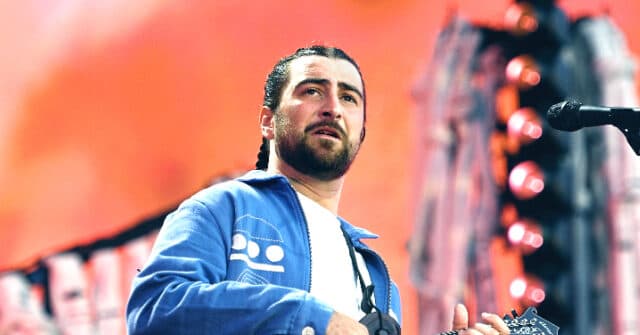
 Noah Kahan performing live on stage, singing into a microphone.
Noah Kahan Blasts White House Over Unapproved Song Use
Left says
- •Kahan joins a growing list of artists — including Sabrina Carpenter, Neil Young, Rihanna, Adele, and the estates of Prince and Tom Petty — who say their music has been used by the Trump administration without consent, pointing to a pattern of disregard for artists' wishes.
- •The White House's dismissive response, accusing Kahan of having 'Trump Derangement Syndrome' rather than addressing his concern, is seen as mocking artists instead of respecting their creative and political boundaries.
- •Musicians argue that even if platform licensing deals technically permit use of a song, that doesn't mean an artist consents to having their work associated with a political administration or its actions.
- •Katy Perry's objection to her song 'Firework' — written as an anthem of hope — being paired with military strike footage illustrates how artists feel their intended message can be twisted into something they find offensive.
Right says
- •Kahan's song 'American Cars' was legally available to the White House through a 2024 licensing deal between Universal Music Group and Meta, meaning its use was technically authorized under existing platform rules.
- •The White House maintains the song was in the 'public Instagram library' and that 'anyone can use it,' framing the complaint as an overreaction rather than a genuine rights violation.
- •Critics view celebrity outrage over song usage as performative and overblown, especially when the White House disabled the sound anyway despite having no legal obligation to do so.
- •The administration frames the backlash as an example of 'Trump Derangement Syndrome,' suggesting entertainers are reflexively hostile to Trump regardless of the actual facts or legality involved.
Common Take
High Consensus- Noah Kahan publicly commented on the White House's Instagram post saying he would 'never approve' of his music being used to support the administration.
- The White House used 'American Cars' in a post about Trump's visit to a General Motors plant in Michigan, and the sound was later disabled on Instagram.
- Kahan is not the first artist to object to the Trump White House using their music, following similar complaints from Katy Perry and others.
- The 2024 Universal Music Group-Meta deal technically allows certain songs, including Kahan's, to be used across social media platforms.
The Arguments
Left argues
Legal permission to use a song via a platform licensing deal is not the same as an artist's consent, and using someone's music to imply their endorsement of a political administration misrepresents the artist's views to the public.
Right counters
Artists who put their work into a licensing pool that authorizes broad platform use accepted the tradeoff of losing granular control over who plays their songs; complaining after the fact doesn't change the terms they agreed to.
Right argues
The White House used a song that was legally and technically available to anyone through an existing UMG-Meta licensing agreement, and voluntarily disabled the sound despite having no legal obligation to do so, showing good faith rather than disregard.
Left counters
Technical legality doesn't erase the reputational harm to an artist whose brand and fanbase may now associate them with a political figure they oppose; 'we were allowed to' is a defense of legality, not of respect for the artist's wishes.
Left argues
The White House's response — mocking Kahan with 'Trump Derangement Syndrome' rather than engaging with his actual objection — reflects a pattern of dismissiveness toward artists' concerns rather than genuine dialogue about consent.
Right counters
When artists repeatedly frame routine, legal platform use as some grave violation, a pointed rhetorical response calling out the overreaction is a reasonable reply to what looks like manufactured outrage.
Right argues
The volume and repetitiveness of celebrity complaints — from Katy Perry to Neil Young to Kahan — suggests a performative pattern where entertainers publicly denounce Trump to appease their fanbase rather than because of a genuine, novel grievance each time.
Left counters
The fact that so many artists across genres and political leanings have independently objected suggests a real, recurring problem with how the administration sources music, not a coordinated publicity stunt.
Left argues
Katy Perry's case shows how songs written with one meaning — hope, healing, unity — can be recontextualized into something like military strike footage that directly contradicts the artist's intended message, which is a real harm beyond mere annoyance.
Right counters
Any song's meaning is inherently open to reinterpretation once released publicly, and artists don't retain veto power over every context in which their already-licensed music might appear online.
Challenge Questions
These questions target genuine internal contradictions — meant to provoke honest reflection.
Right asks Left
“If artists knowingly enrolled their catalogs in broad platform licensing deals that permit use by any account, on what basis should political viewpoint be treated as an exception to terms they otherwise accept for every other user?”
Left asks Right
“If the White House believes disabling the sound was unnecessary because it had no legal obligation, why did it choose to remove it — doesn't that action itself concede that something more than 'anyone can use it' was at stake?”
Outlier Report
Left Fringe
Figures like Noah Levine (co-writer who used profane insults toward Trump) represent a more combative, activist fringe—roughly 15-20% of the left—who treat this as part of active 'resistance' culture rather than a simple rights issue.
Right Fringe
Commentators like those at Breitbart framing Kahan as having 'freaked out,' and White House figures like Kaelan Dorr mocking Kahan with 'Trump Derangement Syndrome' represent a dismissive, mocking fringe—about 20% of the right—that treats any celebrity complaint as inherently illegitimate regardless of merit.
Noise Assessment
High noise ratio; this is largely a social-media-driven celebrity culture war story amplified by both sides' media ecosystems, with most ordinary Americans unlikely to have strong feelings or even awareness of the specific dispute.
Sources (6)
<p>Singer Noah Kahan spoke out against the White House using his song "American Cars," saying he "would never approve" its use.</p> <p>The post <a href="https://www.breitbart.com/entertainment/2026/07/29/noah-kahan-says-he-would-never-approve-of-white-house-using-his-song/" rel="nofollow">Singer Noah Kahan Freaks After Trump White House Uses His Song: ‘Would Never Approve’</a> appeared first on <a href="https://www.breitbart.com" rel="nofollow">Breitbart</a>.</p>
Singer-songwriter Noah Kahan criticized the White House after it used his song “American Cars” in a social media post highlighting President Donald Trump’s visit to a Michigan auto plant. The White House posted a slideshow on TikTok and Instagram featuring photos from Trump’s recent visit to Michigan, using Kahan’s song from his fourth album, “The ...
The White House accused Noah Kahan of having Trump Derangement Syndrome.
“They changed the name of it, but I’m not buying it.”
Trump lapped up the support from the rapper, whose federal weapons charge he pardoned in 2021.
Indie singer Noah Kahan slammed President Trump on Tuesday over the use of his song “American Cars” in a recent Instagram post by the White House. “Would never approve of my music being used in support of you or this administration,” Kahan said in the comments. “Made in America is BACK,” the White House captioned…