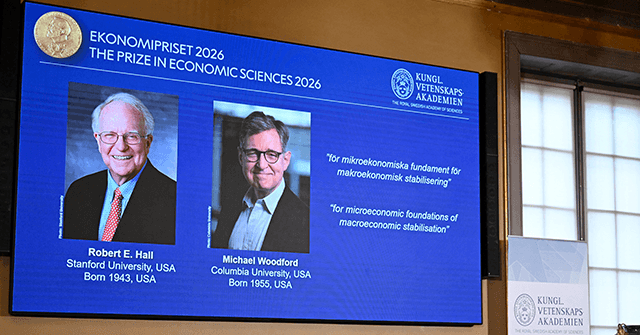
 Screen announcing Robert E. Hall and Michael Woodford as 2026 Nobel Economics Prize winners.
Nobel Honors Forward Guidance Just as Fed Abandons It
Left says
- •Hall and Woodford's research gave central banks rigorous tools to understand how pricing decisions by ordinary businesses translate into inflation and recessions, helping rebuild macroeconomics after the failures of the 1970s stagflation era.
- •Woodford's work on forward guidance proved its worth during the 2008 financial crisis, when interest rates hit zero and central banks needed new tools like communication strategies and asset purchases to support the economy.
- •The timing of the award reflects decades of academic influence rather than a statement on any single Fed chair's current approach, and the prize committee evaluates lifetime contributions to the field, not real-time policy debates.
- •Recognizing scholars whose work shaped how central banks respond to crises underscores the ongoing relevance of evidence-based, technocratic policymaking during a period of renewed inflation and geopolitical instability.
Right says
- •The Nobel committee's choice to honor the intellectual architect of forward guidance arrives just as new Fed Chairman Kevin Warsh moves away from that very framework, creating an awkward and pointed contrast.
- •Some view the award as an implicit rebuke of Warsh's direction at the Fed, even if unintentional, given that Woodford's 2005 Jackson Hole paper essentially defined the forward guidance strategy now being set aside.
- •Forward guidance's practical value may be fading since it was designed primarily for a near-zero interest rate environment, a condition that no longer reflects today's higher-rate, inflation-driven economic landscape.
- •Honoring a framework just as policymakers move past it illustrates a broader pattern in academia of celebrating ideas after their real-world usefulness has already begun to decline.
Common Take
High Consensus- Robert Hall of Stanford and Michael Woodford of Columbia jointly won the 2026 Nobel Prize in economics for work on macroeconomic stabilization.
- Both economists are widely regarded as deserving recipients whose research reshaped modern macroeconomics and central bank policy.
- Woodford's framework, especially forward guidance, became central to how central banks communicated policy following the 2008 financial crisis.
- The prize arrives at a moment of heightened scrutiny over Federal Reserve strategy amid inflation pressures and global economic uncertainty.
The Arguments
Right argues
The timing is strikingly awkward: the Nobel committee honored the intellectual father of forward guidance just months after new Fed Chairman Kevin Warsh began dismantling that exact policy tool, creating an implicit contrast the committee couldn't have missed.
Left counters
Nobel economics prizes recognize decades of cumulative scholarly influence, not real-time monetary policy debates, and the committee's deliberations and research into this year's winners long predate any knowledge of Warsh's specific approach.
Left argues
Woodford and Hall's research gave central banks a rigorous, evidence-based framework linking microeconomic pricing behavior to macroeconomic stability, filling the gap left by the failure of 1970s-era models and proving indispensable during the 2008 crisis when conventional rate cuts were exhausted.
Right counters
Usefulness in 2008's zero-rate environment doesn't guarantee continued relevance in today's higher-rate, inflation-driven landscape, where the very premise that justified forward guidance — stuck-at-zero rates — no longer holds.
Right argues
Forward guidance was explicitly designed as a tool for the zero-lower-bound problem, and with rates now well above zero and inflation the dominant concern, its practical toolkit value has diminished right as it receives academia's highest honor.
Left counters
Woodford's broader contribution extends beyond forward guidance alone to a full New Keynesian framework explaining sticky prices and inflation dynamics, which remains directly applicable to the current inflationary environment the Fed is navigating.
Left argues
Recognizing scholars who built the technocratic infrastructure for modern central banking reaffirms the value of evidence-based policymaking at a moment of geopolitical instability and energy-driven inflation, regardless of any single chair's current preferences.
Right counters
Celebrating a framework just as its chief practical application is being abandoned by the world's most powerful central bank suggests academia may be out of step with the practical realities policymakers now face.
Right argues
The pattern of honoring an idea after its real-world influence has peaked reflects a broader lag in academic recognition, where Nobel committees reward theories at their dusk rather than their dawn, as Breitbart's 'owl of Minerva' framing suggests.
Left counters
This framing assumes forward guidance is actually fading rather than simply being supplemented or adjusted, and dismissing a Nobel-winning framework as obsolete mere months after a single Fed chair's policy shift is premature given how slowly monetary paradigms actually turn over.
Challenge Questions
These questions target genuine internal contradictions — meant to provoke honest reflection.
Right asks Left
“If Nobel recognition is purely about lifetime scholarly contribution rather than current policy relevance, why does the left's synopsis itself lean on forward guidance's 2008 real-world success as a selling point for the award's validity?”
Left asks Right
“If forward guidance's value was always contingent on the zero-lower-bound environment, doesn't declaring it obsolete the moment rates rise simply confirm the theory worked exactly as designed, rather than discrediting it?”
Outlier Report
Left Fringe
Progressive economists like Stephanie Kelly or MMT-aligned commentators (e.g., Stephanie Kelton followers) who are skeptical that New Keynesian forward guidance models deserve such reverence, viewing them as insufficiently attentive to fiscal policy and inequality; roughly 10-15% of left-leaning econ commentary.
Right Fringe
Breitbart Business Digest and hard-money/Austrian-economics commentators who see the award as a direct ideological jab at Fed Chair Kevin Warsh and broader proof of academia's disconnect from real-world policy; represents maybe 15-20% of right-leaning economic commentary, with most mainstream conservatives (e.g., WSJ editorial board) treating it as a minor, non-controversial story.
Noise Assessment
Extremely low actual public engagement; the 'rebuke to Warsh' narrative is largely a Breitbart-specific framing amplified in niche financial media circles rather than a broadly held public sentiment.
Sources (6)
<p>Stanford University's Robert E. Hall and Columbia University's Michael Woodford won the Nobel Prize in economics for research on how policymakers can stabilize <a href="https://www.axios.com/economy" target="_blank">economies</a>, the Royal Swedish Academy of Sciences said on Monday.</p><p><strong>Why it matters:</strong> Their work helped shape how central banks set interest rates and communicate policy. The win comes as those institutions fight energy-driven inflation and risks to economic growth.</p><hr /><p><strong>Zoom out:</strong> For decades, policymakers relied on economic models that linked higher inflation with lower unemployment. But that framework broke down during the 1970s stagflation when both prices and joblessness surged at the same time.</p><ul><li>"The solution by Robert Hall and Michael Woodford was to build a new framework ground up," Timo Boppart, a member of the Nobel economics prize committee, said on Monday.</li></ul><p><strong>What they're saying: </strong>Woodford, who called into Monday's press conference hosted by the committee, said he was "elated" by the win.</p><ul><li><strong>"</strong>It's a tremendous honor. It's a surprise — but I'm feeling very good about it," Woodford said.</li></ul><p><strong>The intrigue</strong>: Asked by a reporter about the threat to the global economy, Woodford said the Middle East conflict has disrupted energy markets and driven price changes with consequences far beyond the region.</p><ul><li>He pointed to the 2008 financial crisis as a key test of his research, when central banks cut interest rates to near zero but struggled to revive economic activity.</li><li>His framework helped explain how other tools, including forward guidance and asset purchases, could support the economy.</li></ul><p><strong>Zoom in:</strong> In research culminating in a landmark 2003 book, Woodford developed a framework linking businesses' pricing decisions to inflation and monetary policy.</p><ul><li>Hall — a Stanford professor who chaired the committee that dates U.S. recessions for 46 years — showed in a 1978 paper how consumers' spending decisions reflect expectations about future income.</li></ul><p><strong>Of note:</strong> The prize comes with an award of 12 million Swedish kronor (about $1.2 million), up from 11 million kronor last year, to be divided between the two winners.</p><p><strong>Flashback:</strong> Recent economics Nobels have recognized research on technological progress, economic prosperity and labor markets.</p><ul><li>Last year's prize went to Joel Mokyr, Philippe Aghion and Peter Howitt <a href="https://www.axios.com/2025/10/13/nobel-prize-economics-growth-innovation" target="_blank">for their work</a> explaining how innovation drives economic growth.</li><li>In 2024, Daron Acemoglu, Simon Johnson and James Robinson <a href="https://www.axios.com/2024/10/14/nobel-prize-economics-winners-2024" target="_blank">won for their research</a> on how institutions shape economic prosperity.</li><li>Harvard economist Claudia Goldin won in 2023 <a href="https://www.axios.com/2023/10/10/claudia-goldin-nobel-women-economics" target="_blank">for research</a> that advanced the world's understanding of women's labor market outcomes.</li></ul>
NPR's Ailsa Chang chats with Michael Woodford of Columbia University, who was one of two Americans awarded the Nobel Prize in Economics.
Prices can get sticky. That helps explain why recessions hurt so much — and what policymakers can do about them.
<p>The Royal Swedish Academy of Sciences has honored the godfather of forward guidance just as central bankers are putting his most famous policy prescription into retirement.</p> <p>The post <a href="https://www.breitbart.com/politics/2026/10/13/breitbart-business-digest-a-nobel-for-an-idea-whose-time-has-come-and-gone/" rel="nofollow">Breitbart Business Digest: A Nobel for an Idea Whose Time Has Come and Gone</a> appeared first on <a href="https://www.breitbart.com" rel="nofollow">Breitbart</a>.</p>
This year’s winner has a long history of blaming Israel for the world’s problems. <img src="https://i0.wp.com/www.nationalreview.com/wp-content/uploads/2026/10/navi-pillay.jpg?fit=617%2C360&ssl=1" />
Instead of promoting peace, this prize risks rewarding Hamas's civilian-shield tactics. More innocents will die, not fewer.