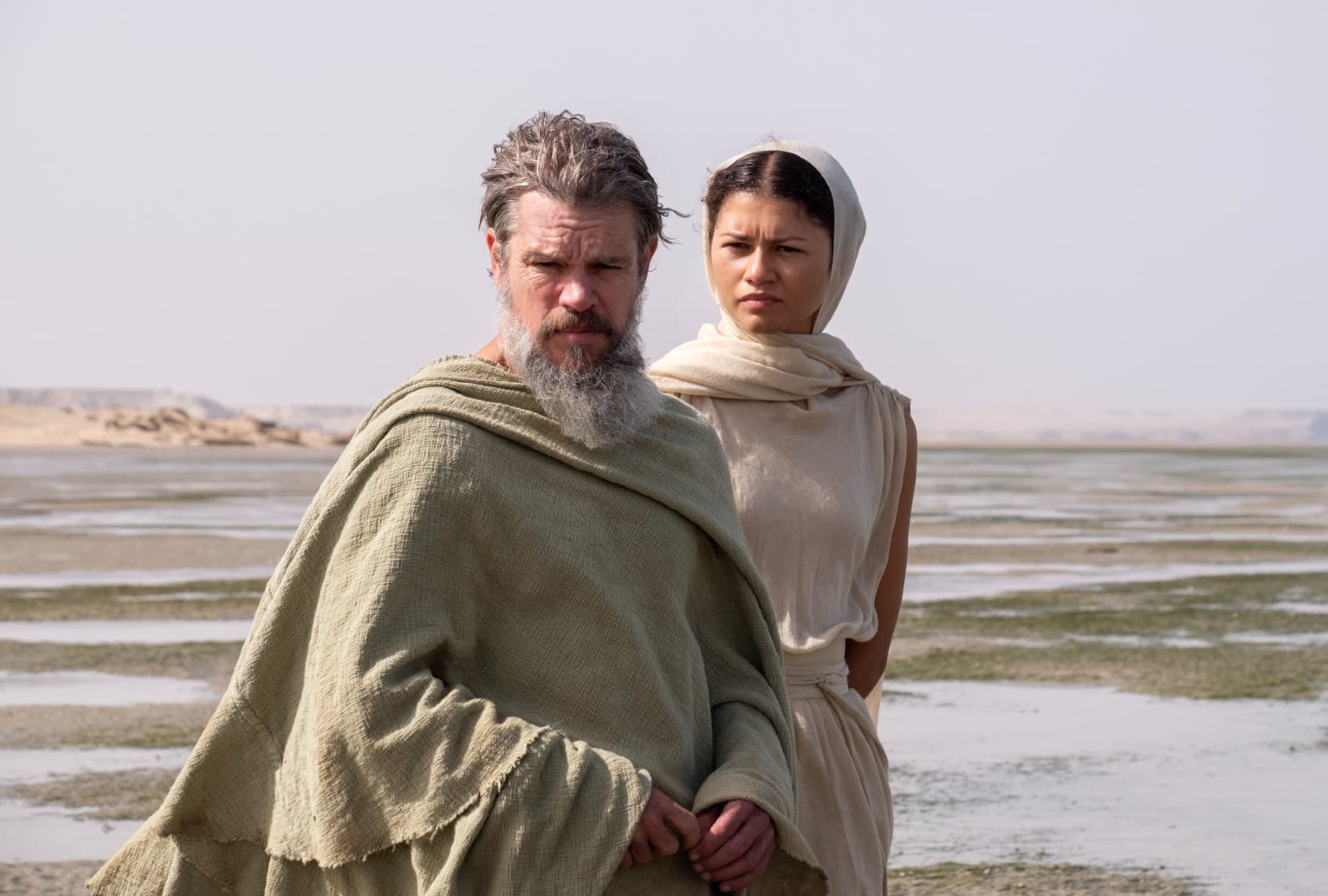
 Matt Damon in costume with co-star in a desert scene from The Odyssey.
Nolan's 'The Odyssey' Becomes Unlikely Culture War Battleground
Left says
- •Nolan's massive $250 million adaptation is scrutinized as spectacle-driven filmmaking that prioritizes scale and technical achievement over narrative substance.
- •Critics question whether an 'unheroic' retelling of Homer's epic actually serves the source material or merely showcases Nolan's directorial ambition and IMAX technique.
- •Even a proven, celebrated director like Nolan experiences genuine vulnerability and fear of audience rejection, humanizing the pressures behind big-budget filmmaking.
- •The film's reception is examined on its artistic and cinematic merits rather than through any political or ideological lens.
Right says
- •Nolan's willingness to present an 'unheroic' version of a foundational Western epic is seen as a bold reworking that challenges audiences and reshapes cinematic tradition.
- •The film is framed as a meaningful cultural moment that alters how audiences engage with classic epics on screen.
- •Attempts to drag a Homer adaptation into the culture war are viewed skeptically, with commentary suggesting the controversy itself reveals more about political overreach than about the film.
- •The scholarly and critical debate over fidelity to Homer's original text is treated as a legitimate, substantive discussion distinct from partisan point-scoring.
Common Take
High Consensus- Christopher Nolan's 'The Odyssey' is a $250 million blockbuster starring Matt Damon adapted from Homer's ancient epic poem.
- Nolan personally described feeling 'petrified' about audience reaction ahead of the film's release.
- The film departs from a traditional, straightforwardly heroic take on the source material.
- Scholars and critics are actively debating the adaptation's fidelity to and interpretation of the original text.
The Arguments
Left argues
Nolan's $250 million adaptation risks prioritizing IMAX spectacle and technical showmanship over the narrative substance of Homer's poem, leaving critics to ask what the film actually accomplishes beyond dazzling audiences.
Right counters
The scale and technical ambition are not empty spectacle but a deliberate tool to make an ancient, foundational epic feel urgent and immersive for modern audiences, which is itself a meaningful artistic achievement.
Right argues
Nolan's willingness to present an 'unheroic' Odyssey is a bold, tradition-challenging choice that forces audiences to reckon with the epic in new ways, reshaping how classic works are adapted for the screen.
Left counters
Boldness alone doesn't guarantee artistic success; subverting heroism without providing compelling narrative substance can leave the story feeling hollow rather than meaningfully reinterpreted.
Right argues
Framing a Homer adaptation as a culture war battleground reveals more about partisan overreach and the desperate search for grievances than about any real controversy in the film itself.
Left counters
Even if the 'culture war' framing is opportunistic, the underlying critique of the film's substance versus spectacle is a legitimate artistic debate that exists independent of politics.
Left argues
Nolan's candid admission of being 'petrified' by audience reaction humanizes him and shows genuine vulnerability that isn't typically associated with directors of massive blockbusters, offering insight into the emotional stakes of the film's reception.
Right counters
Personal vulnerability, however genuine, doesn't excuse or elevate the film if its execution fails to honor the depth of the source material; audiences and critics should judge the work, not the director's feelings.
Right argues
The scholarly debate over fidelity to Homer's text represents a legitimate and substantive discussion about adaptation, translation, and classical scholarship that deserves engagement on its own terms, separate from political point-scoring.
Left counters
Even scholarly debates about fidelity can mask the more fundamental question of whether the film succeeds as cinema, which is the more relevant lens through which most audiences will experience and judge it.
Challenge Questions
These questions target genuine internal contradictions — meant to provoke honest reflection.
Right asks Left
“If the left insists on judging the film purely on artistic merits apart from ideology, why does the critique so heavily emphasize the optics of budget and spectacle rather than engaging deeply with how the 'unheroic' reinterpretation functions as storytelling?”
Left asks Right
“If the right celebrates the film's boldness in reworking a 'foundational Western epic' while simultaneously dismissing the culture war framing as overreach, isn't the very act of calling it 'foundational Western' already a politically loaded framing that invites the controversy it claims to reject?”
Outlier Report
Left Fringe
Culture critics like those at Jacobin or some cinephile Film Twitter accounts who frame big-budget epics like Nolan's as symptomatic of capitalist excess in Hollywood represent maybe 10-15% of the left, pushing harder anti-spectacle takes than the mainstream Salon-style critique.
Right Fringe
Commentators like those associated with Daily Wire or certain classics-focused conservative commentators (e.g., some contributors adjacent to Bronze Age Pervert-style classical revivalism) who take the 'unheroic' retelling as a genuine affront to Western civilizational heritage represent maybe 10-15% of the right, more alarmist than National Review's measured take.
Noise Assessment
Much of the 'culture war' framing appears to be generated by a handful of commentary pieces (like the RCP piece) rather than organic grassroots outrage; most general audiences are engaging with reviews on artistic merit, not political terms.
Sources (5)
Christopher Nolan’s unheroic epic alters the history of movie-watching. <img src="https://i0.wp.com/www.nationalreview.com/wp-content/uploads/2026/07/odyssey-damon-3.jpg?fit=617%2C360&ssl=1" />
It's all Greek to them
The director said he's terrified of audience reaction to his latest blockbuster
The blockbuster director's latest exercise in cinematic spectacle makes Homer feel hollow