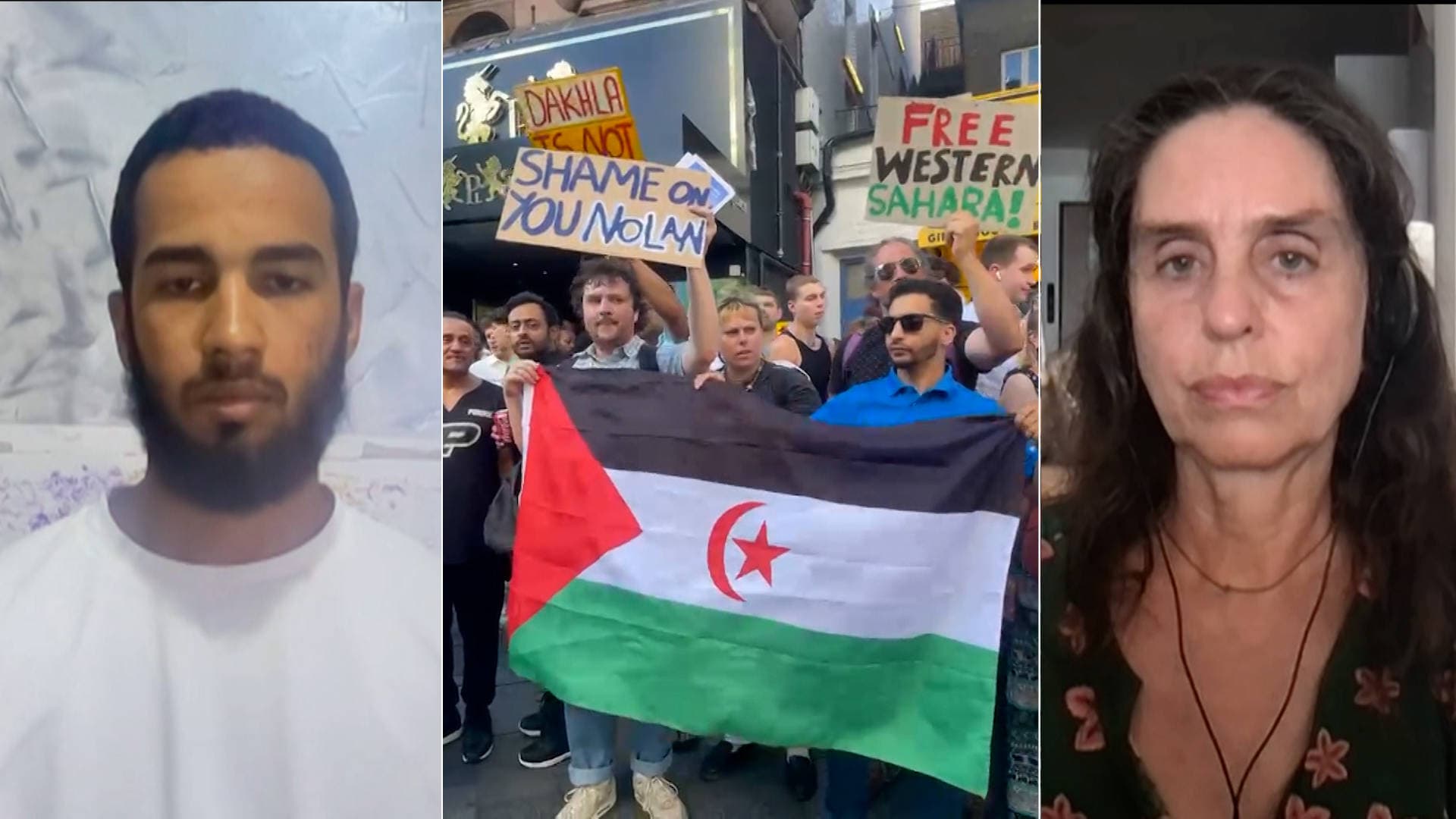
 Protesters in London hold signs opposing filming of Nolan's 'The Odyssey' in Western Sahara.
Nolan's 'The Odyssey' Draws Fire Over Western Sahara Filming
Left says
- •Morocco has occupied Western Sahara for five decades, and shooting a major Hollywood production there with state subsidies helps normalize an illegal occupation regime, according to Sahrawi advocates and film industry figures.
- •Prominent filmmakers including Javier Bardem and Pedro Almodóvar signed an open letter arguing Nolan filmed without the consent of the Sahrawi people, only receiving approval from the occupying Moroccan authorities.
- •Sahrawi filmmakers and human rights campaigners describe the occupation as involving cultural erasure and ethnic cleansing, and see Nolan's use of Dakhla as a filming location as lending international legitimacy to that erasure.
- •The controversy is framed as exposing a broader hypocrisy in how Western institutions selectively invoke human rights and democracy while ignoring occupations that don't fit dominant political narratives.
Right says
- •The film's box office success and critical acclaim, including a 96 percent Rotten Tomatoes score and a massive opening, demonstrate that Christopher Nolan's reputation and artistry override casting or filming location controversies for most audiences.
- •Some commentary treats Nolan as a singular creative force who has earned the benefit of the doubt on controversial choices given his track record, including the acclaimed Oppenheimer.
- •Attention is also drawn to unrelated controversies around the film, including a widely mocked cast rap promotional video and claims from actor John Leguizamo about Hollywood discrimination against Latinos, suggesting the discourse around the film is driven by manufactured or exaggerated outrage as much as substantive concerns.
- •Skepticism exists toward activist-driven boycott campaigns and open letters from celebrities, which are sometimes viewed as performative rather than reflecting the concerns of ordinary moviegoers.
Common Take
- Morocco has controlled Western Sahara for roughly fifty years, a fact acknowledged across the coverage.
- Christopher Nolan's team filmed portions of The Odyssey in the Dakhla region of Western Sahara.
- Prominent actors and cultural figures, including Javier Bardem, publicly objected to the filming location before the movie's release.
- The film has generated significant public attention and debate beyond its box office performance, touching on casting, filming locations, and promotional choices.
The Arguments
Left argues
Filming a major Hollywood production in Dakhla with Moroccan state subsidies, without the consent of the Sahrawi people, lends international legitimacy and tourist-friendly imagery to a five-decade occupation that Sahrawi advocates describe as involving cultural erasure and ethnic cleansing.
Right counters
Nolan is a filmmaker seeking practical logistics and striking landscapes, not a foreign policy actor, and expecting every location shoot to resolve a decades-old geopolitical dispute the UN itself hasn't settled sets an impossible standard for commercial filmmaking.
Right argues
The film's 96 percent Rotten Tomatoes score, record-setting preview numbers, and Nolan's track record following Oppenheimer show that audiences are judging the movie on its artistic merits rather than being swayed by activist boycott campaigns.
Left counters
Box office success and critical acclaim don't erase the ethical question of whether an occupying power should be able to rent out stolen territory as a movie backdrop; commercial popularity has never been a valid defense against complicity in human rights abuses.
Left argues
Sahrawi filmmakers like Abidin Mohamed Hamudi argue the controversy exposes real hypocrisy: Western institutions invoke human rights and democracy selectively, mobilizing outrage over some occupations while filming blockbusters in others without a second thought.
Right counters
Singling out a single film production for geopolitical judgment while ignoring the vast web of global commerce, tourism, and diplomacy that already operates in and around Western Sahara suggests the campaign is more about symbolic celebrity targets than consistent principle.
Right argues
Much of the broader discourse around the film — a widely mocked cast rap video and John Leguizamo's discrimination claims despite a decades-long prolific career — suggests that manufactured or exaggerated outrage, rather than substantive concerns, is driving a significant share of the controversy.
Left counters
Dismissing all criticism as manufactured outrage conveniently lets more serious and specific allegations, like the Western Sahara filming controversy backed by named human rights researchers and filmmakers, get lumped in with unrelated celebrity gaffes and dismissed without engagement.
Left argues
Open letters signed by figures like Javier Bardem and Pedro Almodóvar reflect a genuine, longstanding international solidarity movement with the Sahrawi cause, not a spontaneous or opportunistic pile-on tied to this one film.
Right counters
Celebrity open letters and boycott calls are often performative gestures that generate headlines without changing outcomes, and skepticism is warranted when public statements substitute for engagement with the practical realities of international film production and location permitting.
Challenge Questions
These questions target genuine internal contradictions — meant to provoke honest reflection.
Right asks Left
“If the standard is that no production should film in a territory without the consent of a displaced or occupied population, how should that principle be applied consistently to the many films and productions shot in other disputed or occupied territories worldwide without similar outcry?”
Left asks Right
“If box office success and critical acclaim are sufficient to override concerns about where and how a film was made, does that reasoning also excuse other ethically questionable production practices — like exploitative labor or environmental harm — as long as the finished product performs well commercially?”
Outlier Report
Left Fringe
Figures like María Carrión (FiSahara) and Democracy Now's framing of 'cultural genocide' represent a vocal but narrow pro-Sahrawi activist wing, likely under 10% of the left, as most left-leaning Americans have no strong opinion on Western Sahara specifically.
Right Fringe
Elon Musk's attacks on the film's 'woke' casting represent a fringe culture-war angle distinct from the mainstream right's box-office-focused reaction; this represents perhaps 15-20% of right-leaning commentary, with most conservative outlets like Breitbart focusing on box office and cringe-mockery rather than casting politics.
Noise Assessment
High noise ratio: the Western Sahara controversy is driven by a small international activist and celebrity network with limited American public awareness, while box office/cultural mockery narratives (cast rap video, Leguizamo comments) generate more organic social media engagement among ordinary Americans than the geopolitical boycott angle.
Sources (10)
<p>"The Odyssey" Star John Leguizamo is castigating Hollywood once again, accusing the film industry of discriminating against Latinos.</p> <p>The post <a href="https://www.breitbart.com/entertainment/2026/07/16/watch-the-odyssey-star-john-leguizamo-trashes-hollywood-as-not-an-accepting-place-for-latinos/" rel="nofollow">Watch: ‘The Odyssey’ Star John Leguizamo Trashes Hollywood as Not an ‘Accepting Place’ for Latinos</a> appeared first on <a href="https://www.breitbart.com" rel="nofollow">Breitbart</a>.</p>
<p>Director Christopher Nolan’s The Odyssey is shaping up to become the biggest triumph of an already triumphant career.</p> <p>The post <a href="https://www.breitbart.com/entertainment/2026/07/17/nolte-the-odyssey-opens-to-massive-17-5-million-thursday-night/" rel="nofollow">Nolte: ‘The Odyssey’ Opens to Massive $17.5 Million Thursday Night</a> appeared first on <a href="https://www.breitbart.com" rel="nofollow">Breitbart</a>.</p>
<p>The cast of the 2026 film, "The Odyssey," are being mercilessly mocked on social media over their bizarre rap summarizing the movie in one minute. "Unbelievable Levels of Cringe," one X user said. "Please make it stop."</p> <p>The post <a href="https://www.breitbart.com/entertainment/2026/07/17/the-odyssey-cast-mercilessly-mocked-over-rap-summarizing-the-film-unbelievable-levels-of-cringe/" rel="nofollow">‘The Odyssey’ Cast Mercilessly Mocked Over Rap Summarizing the Film: ‘Unbelievable Levels of Cringe’</a> appeared first on <a href="https://www.breitbart.com" rel="nofollow">Breitbart</a>.</p>
Leftist author Stephen King claimed Utah “banned” one of his books after it was removed from public school libraries under a state law governing sexually explicit material. “They banned DIFFERENT SEASONS in Utah. Contains STAND BY ME and THE SHAWSHANK REDEMPTION, stories of friendship and courage. Readable by teens, too. What’s wrong with these people?” ...
For five decades, Morocco has illegally occupied Western Sahara. The shooting of part of Christopher Nolan’s The Odyssey in the territory, backed by state subsidies, serves a far-reaching effort to normalize Morocco’s colonial rule.
Hollywood’s blockbuster adaptation of the ancient Greek epic <em>The Odyssey</em> premieres around the world today amid growing calls for a boycott. Human rights campaigners are criticizing director Christopher Nolan over his decision to film part of the film in Western Sahara, a vast territory in northwestern Africa that Morocco has occupied for the past half-century.</p> <p>“This occupying force is practicing cultural genocide against the Sahrawi people, ethnic cleansing,” says María Carrión, the executive director of the Western Sahara International Film Festival. “By staying silent for one year and then using this footage, Nolan has basically become an accomplice to Moroccan occupation of Western Sahara.”</p> <p>Abidin Mohamed Hamudi, a Sahrawi filmmaker speaking to <em>Democracy Now!</em> from Algeria, says he cannot return to his home in Western Sahara, but Nolan “can just go there and film and be complicit in the occupation of my homeland.” He calls it “a metaphor of how the Western world uses human rights, democracy narratives whenever they want, and then ignore it in other parts of the world.”
Christopher Nolan’s unheroic epic alters the history of movie-watching. <img src="https://i0.wp.com/www.nationalreview.com/wp-content/uploads/2026/07/odyssey-damon-3.jpg?fit=617%2C360&ssl=1" />
Christopher Nolan’s largely deity-free blockbuster adaptation only highlights the humanity of the original.
Not all viewings are created equal.
<p>Mayor Zohran Mamdani of New York, taking a page from communist predecessors, is moving to assure that he has a pliant, ideologically aligned press corps to serve as props for his policy initiatives.</p> <p>The Trump administration has been targeted with lawsuits for excluding the Associated Press from certain Oval Office pooled coverage opportunities and for restricting some press access in the Pentagon, and he’s taken criticism as an authoritarian for offering access to friendly nontraditional outlets. Mamdani appears to be trying a similar approach but, unlike Trump, he’s so far gotten no apparent pushback about it, demonstrating a double standard.</p> <p>The post <a href="https://freebeacon.com/democrats/were-going-to-go-to-the-jacobin-next-mamdani-handpicks-left-wing-media-for-questions/">‘We’re Going To Go To the Jacobin Next’: Mamdani Handpicks Left-Wing Media for Questions</a> appeared first on <a href="https://freebeacon.com"></a>.</p>