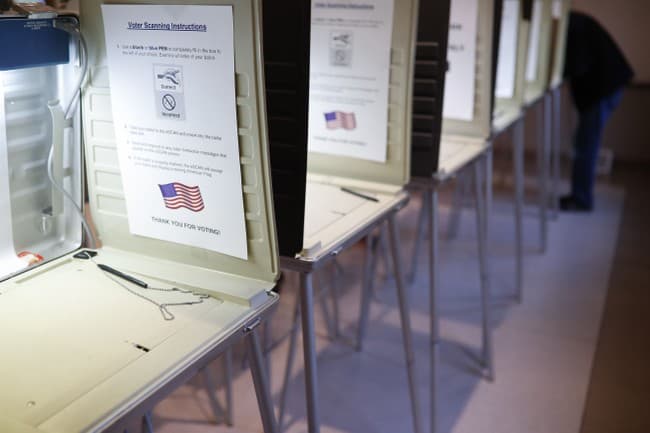
 Voting booths with ballot scanning instructions displayed during election process
Noncitizen Voting Cases Surge as Trump Pushes Election Security Laws
Left says
- •These isolated cases represent an extremely small fraction of total votes cast and do not indicate widespread fraud that would affect election outcomes
- •Existing systems successfully detected and prosecuted these violations, demonstrating that current safeguards are working as intended
- •New voting restrictions would disproportionately burden eligible citizens, particularly minorities and low-income Americans, while addressing a statistically negligible problem
- •The focus on rare noncitizen voting cases distracts from more pressing election administration issues like voter access and poll worker training
Right says
- •These cases prove noncitizen voting occurs more frequently than Democrats acknowledge and justify stronger verification requirements
- •The fact that some individuals voted illegally for decades while evading detection suggests current systems have significant gaps
- •Requiring proof of citizenship and voter ID protects election integrity and ensures every legal vote counts equally
- •Opposition to basic verification measures raises questions about whether some officials are serious about preventing illegal voting
Common Take
High Consensus- Federal prosecutors are actively investigating and charging noncitizens who vote illegally in elections
- Only U.S. citizens have the legal right to vote in federal elections
- Election integrity and ensuring eligible voters can participate are important democratic principles
- These specific cases involved individuals who falsely claimed citizenship to register and vote
The Arguments
Left argues
These cases represent an infinitesimally small fraction of the hundreds of millions of votes cast, and the fact that they were detected and prosecuted proves existing safeguards are working effectively. Implementing new restrictions would disenfranchise far more eligible citizens than the handful of illegal votes they might prevent.
Right counters
The Sacko case shows someone voted illegally for 16 years while under deportation orders, suggesting current systems have serious detection gaps. If these cases are being caught now, how many others went undetected for decades?
Right argues
These prosecutions demonstrate that noncitizen voting occurs more systematically than opponents claim, with individuals like Sacko voting in multiple elections over decades while evading detection. Basic verification requirements like proof of citizenship are reasonable safeguards that protect the fundamental principle that only citizens should choose America's leaders.
Left counters
New voting restrictions would create barriers for millions of eligible citizens, particularly those without easy access to documentation, while addressing a problem that affects a statistically negligible number of votes. The cure would be far worse than the disease.
Left argues
Focusing on these rare cases diverts attention and resources from genuine election administration challenges like ensuring adequate poll worker training, updating voting equipment, and maintaining voter access. The emphasis on noncitizen voting appears designed to justify restrictions that would suppress legitimate voting.
Right counters
Every illegal vote undermines election integrity and cancels out a legal citizen's vote, making even small numbers significant. Opposition to basic verification measures raises legitimate questions about whether some officials prioritize political advantage over election security.
Right argues
The Alabama case shows how easily the system can be circumvented with just a driver's license, while the Pennsylvania case demonstrates that someone can vote illegally for decades while checking in with ICE. These gaps justify requiring proof of citizenship and voter ID to ensure only eligible citizens participate in elections.
Left counters
These isolated cases were ultimately detected and prosecuted, showing that existing systems do catch violations. Creating new bureaucratic hurdles would disproportionately impact elderly citizens, minorities, and low-income Americans who may lack easy access to required documentation.
Challenge Questions
These questions target genuine internal contradictions — meant to provoke honest reflection.
Right asks Left
“If current safeguards are truly working as intended, how do you explain cases like Sacko's where someone voted illegally for 16 years while under active deportation orders, and why shouldn't we strengthen verification to prevent such long-term violations?”
Left asks Right
“Given that these prosecutions represent a tiny fraction of total votes cast and were ultimately detected by existing systems, how do you justify implementing restrictions that could disenfranchise thousands of eligible citizens to prevent a handful of illegal votes?”
Outlier Report
Left Fringe
Progressive activists like Stacey Abrams and some Squad members who have previously called voter ID requirements 'Jim Crow 2.0' may dismiss these cases entirely as manufactured crises, representing roughly 15-20% of the left.
Right Fringe
Figures like Steve Bannon and some MAGA influencers who claim widespread systematic noncitizen voting affecting election outcomes without evidence, representing approximately 25-30% of the right.
Noise Assessment
High noise ratio - these individual cases are being amplified far beyond their statistical significance, with both sides using isolated incidents to support broader narratives about election integrity versus voter suppression.
Sources (3)
An illegal immigrant from Mauritania was charged with fraudulent voting after allegedly casting ballots in Pennsylvania in the last five presidential elections, prosecutors said. Mahady Sacko, a 50-year-old Philadelphia resident who was ordered to be deported from the U.S. in 2000, "allegedly unlawfully voted in person in the 2024 general election for federal office," and, "falsely represented that he was a U.S. citizen in order to vote and register to vote," according to the U.S. Attorney's Office for the Eastern District of Pennsylvania.
A Mexican citizen managed to vote in federal elections in Alabama in 2022 and 2024 just by showing his driver's license and without ever being asked to prove he was an American citizen, federal authorities charged in a new criminal case.