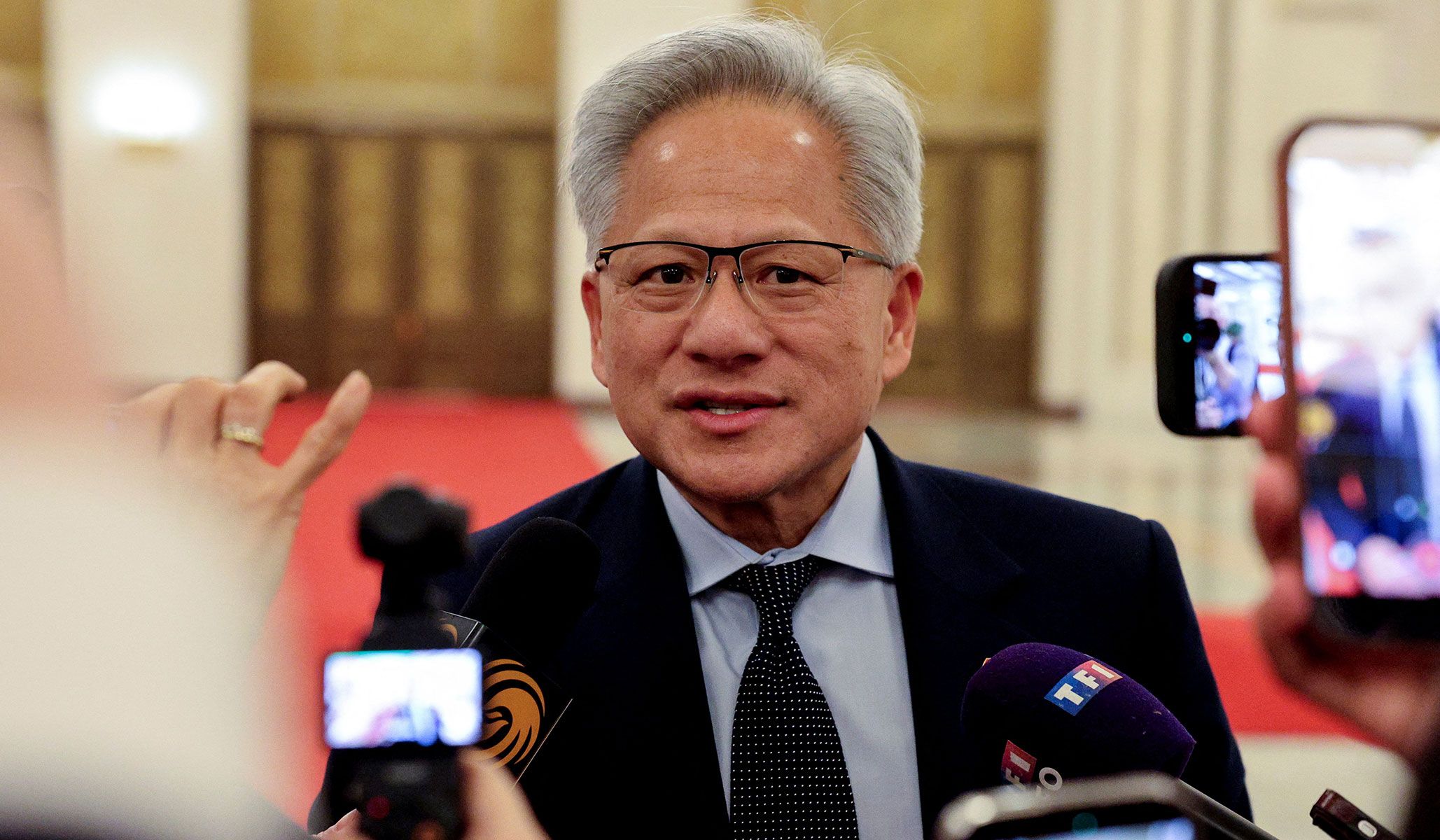
Nvidia CEO's Affair With Alleged Chinese Spy Topples AI Giant
Intra-Party Split Detected
Some on the right (e.g., National Review) emphasize national security risks and call for accountability while cautioning against policies that could cripple Nvidia's competitiveness against China, whereas others (e.g., Trump, as reported) downplayed the affair and Huang's conduct, reflecting tension between hawkish China-policy conservatives and pro-business/pro-Trump allies of Huang.
Left says
- •Huang's departure exposes the danger of American AI infrastructure depending on a single unaccountable executive who deliberately avoided grooming any successor.
- •This episode reveals how Huang leveraged personal political access to the Trump administration to weaken export controls on advanced chips, raising serious questions about whether business-executive influence over national security policy should be allowed to persist unchecked.
- •Nvidia's 'circular financing' model, where it both invests in and sells chips to the same AI startups, created systemic fragility that is now exposed regardless of the scandal's origin.
- •The scandal is an opportunity to reset U.S. policy toward a more cautious, less industry-captured approach to AI development and China chip exports.
Right says
- •The apparent effort by Chinese-linked individuals to infiltrate the personal life of America's top AI executive validates long-standing concerns about Beijing's aggressive espionage tactics targeting critical U.S. technology.
- •Washington must hold Nvidia and relevant officials accountable for any security lapses without overcorrecting in ways that cripple a company vital to maintaining America's lead over China in the AI race.
- •Nvidia's institutional strengths, including its dominant chip supply and favorable regulatory treatment under the Trump administration, remain intact independent of one man's personal misconduct.
- •Commerce Secretary Howard Lutnick and other officials deserve scrutiny for reportedly failing to act on earlier warnings about the China-linked security risks swirling around Huang and Megaspeed.
Common Take
High Consensus- Jensen Huang resigned as Nvidia CEO after revelations of an affair with Alice Huang, a Chinese national tied to a company accused of smuggling restricted chips to China, alongside a separate affair with an Nvidia employee.
- Colette Kress, Nvidia's CFO, has stepped in as interim CEO while the board searches for a permanent replacement.
- Huang's exit raises urgent questions about Nvidia's future, the broader AI industry's reliance on his dealmaking and investments, and U.S. national security given Nvidia's central role in the global chip supply.
- Lawmakers across the spectrum are calling for investigations into the national security implications of Huang's relationships and Nvidia's China-related business dealings.
The Arguments
Left argues
Huang's deliberate failure to cultivate any successor left Nvidia, and by extension much of the AI industry's financial backbone, dangerously dependent on one unaccountable individual whose personal conduct could trigger a crisis with no contingency plan.
Right counters
Nvidia's core advantages—its chip supply dominance, cash reserves, and favorable regulatory treatment—are structural and institutional, not personal to Huang, so the company can adapt its leadership model going forward without the sky falling.
Right argues
The apparent targeting of Huang through a relationship with a suspected Chinese intelligence asset confirms that Beijing is willing to go to extraordinary lengths to compromise the people controlling America's most critical AI technology, which argues for tighter export controls rather than looser ones.
Left counters
The scandal also reveals that Huang himself spent years personally lobbying to loosen those very export controls, meaning the solution isn't just vigilance against spies but structurally removing the ability of any single executive to override national security policy through political access.
Right argues
Commerce Secretary Lutnick and other officials reportedly received warnings about Megaspeed and the China-linked risks surrounding Huang well before the scandal broke, and they deserve direct scrutiny for failing to act, independent of what happens to Nvidia.
Left counters
That officials ignored warnings about a politically connected CEO is itself evidence of the deeper problem the left identifies: when a single executive has enough access to shape policy, institutional safeguards like intelligence warnings get overridden by personal relationships.
Left argues
Nvidia's circular financing model—funding startups that then use that money to buy Nvidia's own chips—created a systemically fragile structure that was always going to be a problem, and the scandal simply exposed a vulnerability that existed regardless of Huang's personal behavior.
Right counters
Circular financing concerns are a separate business-model question from the scandal itself, and conflating the two risks using a personal sex-and-espionage story as a pretext for broader industry overregulation that could hamper America's competitive position against China.
Right argues
Overcorrecting in response to one executive's personal scandal by imposing sweeping new restrictions on Nvidia or the broader AI industry risks handing China the very advantage that tighter chip controls were meant to prevent.
Left counters
Caution now is warranted precisely because the prior approach, driven heavily by one well-connected executive's preferences, already resulted in loosened controls like H200 sales to China, suggesting the industry-captured status quo was the riskier path all along.
Challenge Questions
These questions target genuine internal contradictions — meant to provoke honest reflection.
Right asks Left
“If the goal is reducing concentrated, unaccountable executive power over national security policy, does proposing a broad regulatory reset in reaction to one scandal risk simply transferring that outsized influence to unelected regulators instead of elected oversight bodies?”
Left asks Right
“If Nvidia's institutional strengths are truly independent of Huang, how do you reconcile that with simultaneous warnings that his personal relationship with Trump was central to securing the favorable export policies you credit as part of those institutional strengths?”
Outlier Report
Left Fringe
Figures like Senator Elizabeth Warren or progressive tech critics (e.g., writers at The American Prospect) who argue for aggressively breaking up Nvidia's market power or imposing strict public oversight of AI firms represent maybe 10-15% of the left, as most Democrats focus on the China-espionage angle rather than antitrust-style restructuring.
Right Fringe
China hawks like Senator Tom Cotton or commentators who want blanket, severe export bans on all advanced chips to China regardless of economic cost represent roughly 15-20% of the right; most mainstream Republicans and the Trump administration favor the more moderate 'accountability without crippling the company' stance reflected in the right synopsis.
Noise Assessment
Significant amplification from tabloid-style coverage of the affair itself (Vox's 'movie casting' framing, Newsweek's CEO replacement rankings) that overshadows substantive policy debate, meaning actual public opinion is less polarized than the volume of commentary suggests.
Sources (16)
The efforts that the Chinese appear to be making to get hold of a U.S. product make the case for not selling it to them. <img src="https://cdn.sanity.io/images/yu68q2re/production/6e82ed1f5c13dc6d3d636aec2ee9982bc2a948a8-2057x1200.jpg?w=600" />
Nvidia has says it will consider both internal and external candidates when looking for Huang's permanent replacement.
Mr. Huang championed start-ups, with Nvidia holding $48 billion worth of stakes in 229 private companies, including OpenAI and Anthropic, at the end of July.
The ousted Nvidia chief executive was the consummate dealmaker leading the trillion-dollar A.I. build out.
Jensen Huang was a big reason Nvidia preserved the ability to sell chips to China. His departure from the company might change that.
AI expert Gary Marcus breaks down what's at stake for Nvidia and the mess its new CEO has inherited.
Nvidia CEO Jensen Huang announced his resignation after it was reported that he had an affair with a businesswoman accused of being a Chinese spy and an extramarital relationship with an Nvidia executive. Huang's departure has sparked questions about the future of Nvidia, the AI industry and U.S. national security. Amna Nawaz discussed the latest with Dmitri Alperovitch and Stephen Witt.
Nvidia's ousted leader was a unique rhetorical and financial booster for investments that are driving economic growth.
There are silver linings to the end of the Jensen Huang era at Nvidia.
America needs a new approach to AI.
“This may be the craziest story in the AI era since ChatGPT launched.”
No business executive should have so much political power that they can’t be held to account.
Plus: Trump pulls Vance off Iran diplomacy, the president threatens to double tariffs on Mexico over a migrant caravan, and don’t steal expensive orangutan statues.
The founder’s resignation is a sad moment for American tech, and an important opportunity to reform the company he built.
The first big sex scandal of the AI era has taken down Jensen Huang, Nvidia’s co-founder and longtime CEO. Nvidia’s board of directors announced his resignation on Thursday morning and named CFO Colette Kress as interim CEO. Huang has been making headlines all week after news broke Friday that he had an affair with Alice […]
Editor’s note, November 12, 3:35 pm ET: This story was originally posted on November 9 and is being republished today in light of Jensen Huang’s resignation as Nvidia CEO. The movie version of Jensen Huang’s jaw-dropping affair basically writes itself.  Cast BD Wong as 63-year-old Huang, the CEO of one of the world’s most valuable […]