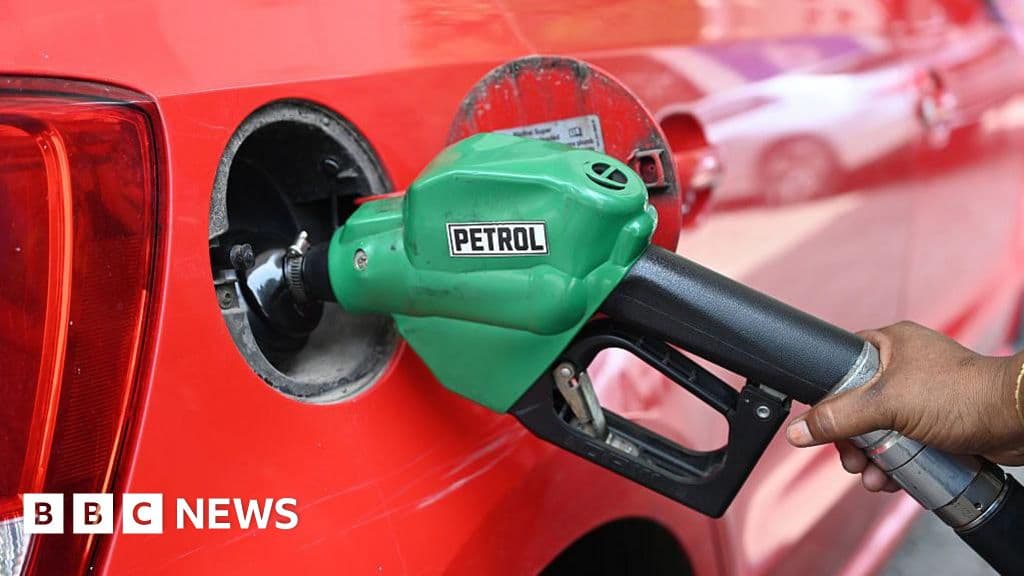
 Hand holding petrol pump nozzle filling red car at gas station
Oil prices plunge on Iran deal hopes, but gas relief may take months
Left says
- •Americans are suffering under crushing fuel costs that have risen 53% since the war began, with all 50 states now paying over $4 per gallon and some exceeding $5
- •The conflict has created a devastating economic burden on working families and small businesses while driving dangerous inflation across the economy
- •Even with a peace deal, the complex process of repairing infrastructure and restoring supply chains means relief for struggling consumers could take months or years
- •The closure of the Strait of Hormuz has blocked 20 million barrels of daily oil production, demonstrating how military conflicts create widespread economic hardship
Right says
- •Market forces are already responding positively to diplomatic progress, with oil prices dropping over 5% as negotiations advance toward reopening critical shipping lanes
- •President Trump's direct engagement with regional leaders shows effective leadership in pursuing peace through strength and strategic diplomacy
- •The administration is working methodically to secure a comprehensive deal rather than rushing into an agreement that might not hold
- •Swift market reactions to peace prospects demonstrate that resolving the conflict through negotiation will restore energy security and economic stability
Common Take
High Consensus- Oil prices dropped approximately $5 per barrel following news of potential US-Iran peace negotiations
- The Strait of Hormuz closure has blocked roughly 20-25% of global maritime oil trade since the conflict began
- All 50 US states now have average gas prices above $4 per gallon, with the national average at approximately $4.55
- Restoring normal oil flows and repairing energy infrastructure will require significant time even after any peace agreement
The Arguments
Left argues
Americans are facing crushing economic hardship with gas prices up 53% since the war began, hitting working families and small businesses while driving dangerous inflation across the entire economy. Even with diplomatic progress, the complex process of repairing damaged infrastructure, de-mining shipping lanes, and restoring supply chains means relief could take months or years to materialize.
Right counters
Market forces are already responding positively to diplomatic progress, with oil prices dropping over 5% as negotiations advance, demonstrating that effective leadership and strategic diplomacy can quickly restore energy security and economic stability.
Right argues
President Trump's direct engagement with regional leaders shows effective leadership in pursuing peace through strength, working methodically to secure a comprehensive deal rather than rushing into an agreement that might not hold. Swift market reactions to peace prospects prove that resolving the conflict through negotiation will restore stability.
Left counters
The closure of the Strait of Hormuz has blocked 20 million barrels of daily oil production, and experts warn that even if peace is declared tomorrow, the complex logistics of restarting production, clearing damaged facilities, and restocking depleted inventories could take multiple calendar quarters to years.
Left argues
All 50 states now pay over $4 per gallon with some exceeding $5, creating devastating economic burden on families who have seen fuel costs rise $1.50 above pre-war levels. The national average could hit record highs above $5.03 if the strait remains closed through summer.
Right counters
The administration is pursuing a strategic approach that prioritizes long-term stability over quick fixes, with oil futures already trading back under $100 per barrel as diplomatic progress demonstrates the effectiveness of negotiating from a position of strength.
Right argues
The reopening of critical shipping lanes through diplomatic engagement will restore the flow of about 25% of global maritime oil trade, with market confidence already reflected in significant price drops as negotiations advance toward a comprehensive solution.
Left counters
Even if an agreement opens the strait, energy markets will remain disrupted for months because it takes 30-60 days just to turn crude oil into usable fuel, and shippers may lack confidence to quickly resume large-scale transport through previously contested waters.
Challenge Questions
These questions target genuine internal contradictions — meant to provoke honest reflection.
Right asks Left
“If market forces are already responding positively to diplomatic progress with oil prices dropping over 5%, doesn't this contradict your argument that relief will take months or years to materialize?”
Left asks Right
“If the administration's methodical approach is truly effective, why have gas prices reached record levels in all 50 states with some exceeding $5 per gallon during this 'strategic diplomacy' process?”
Outlier Report
Left Fringe
Progressive activists like Alexandria Ocasio-Cortez and climate groups like Sunrise Movement who might argue this crisis should accelerate renewable energy transition rather than focus on oil price relief. Represents roughly 15% of the left.
Right Fringe
Hardline foreign policy hawks like John Bolton or Tom Cotton who might oppose any deal with Iran as appeasement, preferring continued military pressure regardless of economic costs. Represents roughly 20% of the right.
Noise Assessment
Moderate noise level - most discourse reflects genuine public concern about gas prices rather than performative outrage, though some partisan amplification exists around Trump's diplomatic effectiveness.
Sources (6)
<p>Crude <a href="https://www.axios.com/energy-climate/oil-companies" target="_blank">oil</a> prices dropped about $5 per barrel Sunday evening in the first major trading since the emergence of rough and tentative outlines of a <a href="https://www.axios.com/2026/05/24/iran-deal-strait-hormuz-sanctions-nuclear" target="_blank">deal</a> to end the U.S.-Iran conflict.</p><p><strong>Why it matters: </strong>The throttling of the Strait of Hormuz is raising <a href="https://www.axios.com/energy-climate" target="_blank">energy</a> costs and weighing down economies worldwide — including the U.S., where average pump prices are about $1.50-per-gallon above pre-war levels.</p><hr /><ul><li>And the crisis is poised to worsen as global crude oil inventories are depleting at a record pace.</li></ul><p><strong>The latest: </strong>Futures prices from the global benchmark Brent crude are back under $100 per barrel, trading around $98.76 Sunday evening, a 4.62% drop from Friday's close. </p><p><strong>Reality check: </strong>Even if an agreement that opens the Strait is reached — a process that <a href="https://www.axios.com/2026/05/24/iran-deal-white-house-delay-days-trump" target="_blank">could take days</a>, per Axios' Barak Ravid — energy markets will remain disrupted for months.</p><ul><li>As of mid-May, the conflict was blocking the flow of around 14 million barrels of oil per day, <a href="https://www.iea.org/reports/oil-market-report-may-2026" target="_blank">according to</a> the International Energy Agency.</li><li>Saudi Arabia and the United Arab Emirates have increased the use of pipelines that bypass the Strait, but those added volumes don't come close to offsetting what normally travels through the narrow waterway.</li></ul><p><strong>The waterway handles</strong> about a fourth of the global maritime oil and a fifth of the liquefied natural gas trade.</p><ul><li>And several Persian Gulf producers have dialed back production as storage space filled up, and that takes time to come back online.</li></ul><p><strong>What they're saying: "</strong>Gas prices are currently falling but until we see an agreement signed & a significant amount of ships transit through the Strait, the national average price of gasoline will likely remain well above $4/gal," Patrick De Haan, head of petroleum analysis for the data and analysis firm GasBuddy, <a href="https://x.com/GasBuddyGuy/status/2058643243043082423" target="_blank">posted on X.</a></p><p><strong>The intrigue:</strong> Even if a deal emerges, it's not clear whether shippers will have confidence to quickly resume large-scale transport of crude oil and petroleum products.</p><ul><li>And some Asian markets with acute fuel needs take weeks to reach from the region.</li></ul><p><strong>What we're watching: </strong>"[D]e-mining the Strait, evacuating trapped tankers and restarting production could take weeks to months," the research firm ClearView Energy Partners said in a client note Sunday.</p><ul><li>"[R]epairing damaged facilities, restoring pre-war output levels, and restocking depleted inventories could take multiple calendar quarters to years," the research firm added in the note sent ahead of markets opening.</li></ul><p><strong>Go deeper... </strong><a href="https://www.axios.com/2026/05/24/iran-deal-strait-hormuz-sanctions-nuclear" target="_blank">Exclusive: What's inside the Iran deal Trump is close to signing</a></p><p><em>Editor's note: This story has been corrected to show the strait handles about a fourth of the maritime oil trade (not a fifth).</em></p>
<p>All 50 states have average <a href="https://www.axios.com/2026/05/07/gas-prices-iran-war-peace-deal" target="_blank">gas prices</a> above $4 a gallon, AAA said Wednesday, with seven now topping $5 a gallon. </p><p><strong>Why it matters: </strong>As the war with Iran approaches the three-month mark, soaring fuel prices are <a href="https://www.axios.com/2026/05/01/gas-inflation-spending-vibecession" target="_blank">costing Americans</a> millions of dollars a day, crushing <a href="https://www.axios.com/2026/05/20/small-business-economy-gas-prices" target="_blank">small business</a> profits, and driving a <a href="https://www.axios.com/2026/05/13/ppi-iran-inflation" target="_blank">surge in inflation</a>. </p><hr /><p><strong>Driving the news: </strong>The national average now stands at $4.56 a gallon, AAA said.</p><ul><li>California is the nation's high, at $6.15 per gallon, while Georgia is the lowest at $4.01 a gallon. </li><li>Some southern states had been holding the line at $3.98 or $3.99 a gallon in recent days.</li></ul><p><strong>Stunning stat: </strong>The average price of a gallon of gas is up 53% since the war started. </p><p><strong>What to watch: </strong>There are signs that things could get much worse. </p><ul><li>Widely watched GasBuddy analyst Patrick De Haan said Wednesday morning that the national average could hit an <a href="https://x.com/GasBuddyGuy/status/2057047934034714633" target="_blank">all-time record</a> north of $5.03 per gallon if the Strait of Hormuz remains closed through mid-summer. </li></ul>
Trump said on Saturday that an agreement would include the reopening of the Strait of Hormuz, without giving further details.
The cost of crude hit a one-month low and S&P 500 futures were up as investors assessed the prospects for a lasting peace deal.
<p>Prewar US gas prices averaged about $3 a gallon nationally – kiss that number goodbye for 2026</p><p>Sorry, US drivers, but don’t expect pump prices to return to prewar levels any time soon, even if the US and Iran agree to a lasting peace deal tomorrow.</p><p>As the war with Iran enters its third month, drivers have become <a href="https://www.theguardian.com/us-news/2026/mar/13/detroit-michigan-gas-prices">infuriated </a>by rising gas prices – <a href="https://www.theguardian.com/business/2026/may/12/us-inflation-april-iran-war">and inflation</a> – and Donald Trump is facing a historic backlash in <a href="https://www.usatoday.com/story/news/politics/2026/05/17/americans-economy-trump-poll/90133566007/">the polls. </a>The president <a href="https://www.usatoday.com/story/news/politics/2026/05/05/trump-gas-prices-substantial-drop-iran-war/89943271007/">promised recently</a> that relief will be swift once the war ends. “I see it going down very substantially when this is over, I think very rapidly too, at levels that you’ve never seen,” he said.</p> <a href="https://www.theguardian.com/business/2026/may/23/iran-war-us-gas-prices-oil-fuel">Continue reading...</a>
Oil prices decreased early Monday amid negotiations between the Trump administration and Iran on reopening the Strait of Hormuz and ending the Middle East conflict. West Texas Intermediate crude futures, the benchmark for North American markets, dipped by more than 6.1 percent to $90.68 as of early Monday. Brent crude futures, the global benchmark, dropped…