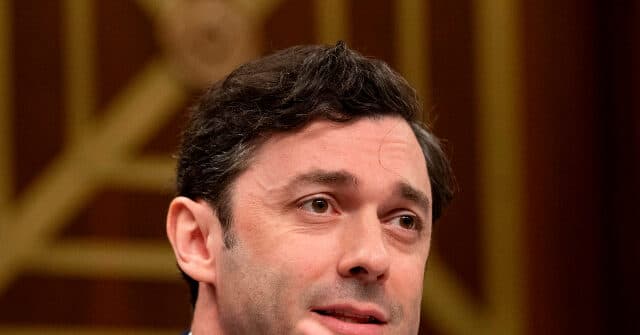
 Senator Jon Ossoff speaking during a Senate hearing.
Ossoff Rules Out 2028 Run, Won't Rule Out Trump Impeachment
Left says
- •Ossoff is making a clear commitment to Georgia voters that he will serve a full six-year term rather than using the Senate seat as a stepping stone to higher office, directly countering Republican attacks that he is more focused on national ambitions than constituent service.
- •On impeachment, Ossoff is responding honestly to a direct hypothetical rather than dodging the question, stating that evidence of misconduct already exceeds prior impeachment standards while still respecting his future role as an impartial juror if articles reach the Senate.
- •His sharpest attacks on Collins focus on documented ties to white nationalist content shared by Collins' son-in-law, which Ossoff frames as a legitimate character and judgment issue voters deserve to understand.
- •Emphasizing that his focus is on reelection to the Senate, not a future presidential bid, reflects an effort to stay grounded in the issues most relevant to Georgians, like tariffs and economic costs.
Right says
- •Ossoff's willingness to entertain impeachment reveals that despite his denial of presidential ambitions, he remains aligned with the most aggressive anti-Trump instincts within the Democratic Party.
- •Collins and his allies see Ossoff's polished answer on 2028 as a calculated move to blunt a damaging narrative rather than a genuine shift away from national political ambitions.
- •Collins frames the race as a contest between a Georgia-rooted job creator and a well-connected, nationally ambitious figure who has used the Senate seat to build a bigger platform.
- •Raising Ossoff's financial ties to donors like Reid Hoffman, who has been connected to the Epstein files, is viewed as a fair examination of the company Ossoff keeps and who funds his campaigns.
Common Take
High Consensus- Both candidates appeared together Tuesday night in the second and final debate hosted by the Atlanta Press Club ahead of the November election.
- Ossoff explicitly stated he has 'zero interest' in running for president in 2028 and committed to serving a full six-year Senate term if reelected.
- Both sides recognize the Georgia Senate race is considered pivotal to which party controls the chamber going forward.
- Impeachment would require a House majority and a two-thirds Senate majority, both currently held by Republicans, making the scenario largely hypothetical under current conditions.
The Arguments
Left argues
Ossoff's pledge to serve a full six-year term is a direct, specific commitment that gives voters a concrete standard to hold him accountable to, rather than a vague denial.
Right counters
Politicians routinely make such pledges and abandon them when opportunity knocks; without a binding mechanism, this is simply a convenient talking point timed to neutralize a damaging narrative before an election.
Right argues
Ossoff's statement that Trump's conduct 'already exceeds any prior standard for impeachment' shows he has prejudged the matter despite claiming he would act as an impartial Senate juror, undermining his credibility on that promise.
Left counters
Expressing a current view based on public evidence is not the same as refusing to consider formal articles of impeachment on their specific merits should they arrive; honesty about one's current assessment is different from a closed mind.
Right argues
Collins' framing of the race as 'Georgia versus Georgetown' taps into a legitimate concern that Ossoff's national media profile and 2028 speculation suggest his ambitions extend beyond representing Georgia's interests.
Left counters
Ossoff directly and repeatedly denied presidential ambitions and committed to a full term, while Collins offers no comparable evidence beyond speculation that Ossoff's public visibility equals disloyalty to constituents.
Left argues
Raising Collins' son-in-law's white nationalist social media activity is a legitimate character question, since voters deserve to know about judgment and associations connected to a candidate's inner circle.
Right counters
Holding a candidate responsible for a relative's independent social media posts, which Collins explicitly condemned, is a guilt-by-association tactic that distracts from substantive policy debate.
Right argues
Questioning Ossoff's ties to donors like Reid Hoffman, whose name appears in the Epstein files, is a fair line of inquiry into who funds a candidate's campaign and what influence that may carry.
Left counters
Appearing in released files associated with a third party is not evidence of wrongdoing by either Hoffman or Ossoff, and the attack functions mainly as a deflection from Collins' own documented associations.
Challenge Questions
These questions target genuine internal contradictions — meant to provoke honest reflection.
Right asks Left
“If Ossoff says his 2028 denial should be taken as sincere and binding, why should his impeachment answer—given as a direct, evidence-based judgment before any formal process has begun—not also be read as a sincere, prejudged position rather than neutral fence-sitting?”
Left asks Right
“If Collins condemns hate speech and distances himself from his son-in-law's posts, why does his campaign continue invoking guilt-by-association attacks on Ossoff's donors rather than engaging with Ossoff's own voting record and policy positions?”
Outlier Report
Left Fringe
Progressive commentators and groups like Indivisible or figures such as Rep. Al Green, who have pushed for impeachment proceedings more aggressively than mainstream Democratic leadership, represent perhaps 15-20% of the left and would want Ossoff to be even more forceful rather than measured.
Right Fringe
Figures like Charlie Kirk or Breitbart commentators who frame any openness to impeachment as proof of 'far-left' extremism represent a vocal 20-25% of the right that pushes maximalist rhetoric beyond what most Republican voters, who are more focused on economic issues, actually prioritize.
Noise Assessment
High noise ratio — national media and partisan outlets amplify the impeachment hypothetical and white nationalist allegations far more than average Georgia voters likely weigh them, with actual vote decisions probably driven more by economic concerns, tariffs, and incumbency evaluation than these flashpoints.
Sources (6)
<p>Far-left incumbent Sen. Jon Ossoff (D-GA) indicated on Tuesday that he would support efforts to impeach President Donald Trump if Democrats take the House majority in November.</p> <p>The post <a href="https://www.breitbart.com/politics/2026/10/13/georgia-u-s-senate-debate-jon-ossoff-signals-support-trump-impeachment/" rel="nofollow">Georgia U.S. Senate Debate: Jon Ossoff Signals Support for Trump Impeachment Efforts if Democrats Win House Majority</a> appeared first on <a href="https://www.breitbart.com" rel="nofollow">Breitbart</a>.</p>
Sen. Jon Ossoff and Republican challenger Mike Collins traded attacks over the 2020 election and alleged connections to white nationalists. Ossoff also pushed back on speculation that he could run for president in 2028.
The Democratic incumbent pledged to serve a full term as he and challenger Rep. Mike Collins hit on similar themes as in their first debate last week.
Representative Mike Collins, who lags Senator Jon Ossoff in public polls, hit his opponent harder in a second and final debate on Tuesday.
The Georgia senator committed to serving out a full six-year term should he win in November — his most forceful rejection of 2028 rumors yet.
Sen. Jon Ossoff (D-Ga.), who has been floated as a potential 2028 presidential candidate, committed on Tuesday to serving a full Senate term as he reiterated “zero interest” in a White House campaign. “Yes, I will,” Ossoff said during a Tuesday debate as he runs for Senate reelection, when asked to pledge his commitment to…