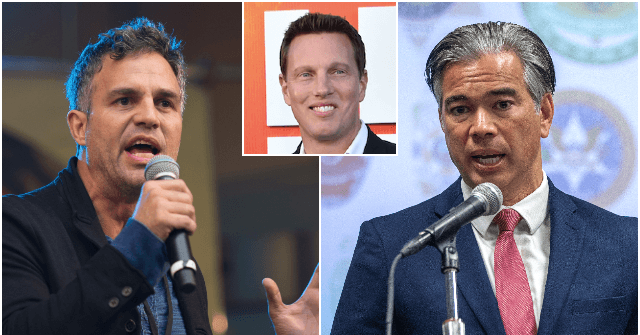
 Mark Ruffalo, AG Rob Bonta, and an inset figure react to the Paramount-Warner Bros. deal.
Paramount Settles With States, Averting Warner Bros. Merger Block
Intra-Party Split Detected
Some Democratic state AGs (e.g., Massachusetts, New York, Connecticut, Minnesota) held out longer than others, pushing harder for stronger editorial independence protections for CBS/CNN before settling, while California's Bonta emphasized the settlement is not an endorsement of the merger, reflecting internal disagreement over how aggressively to challenge corporate consolidation.
Left says
- •The settlement forces a private merger of this scale to accept enforceable public-interest conditions, including new editorial independence boards for CBS and CNN to guard against corporate interference in newsrooms.
- •California Attorney General Bonta emphasized the deal is 'not a vote of support' for the merger itself, preserving the states' underlying concern that consolidating two of Hollywood's last major studios could reduce competition and consumer choice.
- •The agreement secures concrete commitments to domestic film production, additional investment, and financial penalties if Paramount falls short, framed as protecting jobs and livelihoods tied to the entertainment industry in states like California.
- •A trustee will monitor compliance, and states have signaled they will return to court if Paramount fails to meet its obligations, showing continued oversight rather than unconditional approval.
Right says
- •The settlement is portrayed as validating that Democratic state attorneys general had a weak legal case and were using the lawsuit to extract political concessions rather than address genuine antitrust harm.
- •Requiring oversight of CBS and CNN editorial decisions as a condition of a private business deal is criticized as government overreach into newsroom independence and an improper politicization of media regulation.
- •The deal is seen as a win for Paramount CEO David Ellison, who avoided a costly $7 million-per-day penalty and secured merger approval from nearly 70 jurisdictions worldwide without being forced into major divestitures.
- •The lawsuit and delays are viewed as symptomatic of California's broader hostility toward business, contributing to productions leaving the state for lower-cost locations like Texas, Georgia, and Canada.
Common Take
High Consensus- Paramount reached a settlement with a coalition of state attorneys general, led by California's Rob Bonta, clearing a major obstacle to its acquisition of Warner Bros. Discovery.
- The deal includes commitments to increase U.S. film production, invest $300 million annually in domestic productions, and release at least 30 films per year with financial penalties for shortfalls.
- Paramount agreed to establish independent editorial oversight boards for CBS News and CNN as part of the settlement.
- The agreement still requires final approval from a judge and includes a trustee to monitor Paramount's compliance with its commitments.
The Arguments
Left argues
The settlement secures enforceable, court-monitored commitments — editorial independence boards for CBS and CNN, $1.5 billion in new domestic production spending, and financial penalties for shortfalls — that protect jobs and journalistic integrity in ways that would not exist absent the lawsuit.
Right counters
These 'concessions' were extracted through litigation leverage rather than proven antitrust harm, and imposing government-monitored oversight boards on newsroom editorial decisions sets a troubling precedent of state officials inserting themselves into how private media companies run their journalism.
Right argues
The fact that Paramount avoided any major divestitures and secured approval from nearly 70 global jurisdictions suggests the states' antitrust case was legally thin, and the settlement mainly extracted political wins — like editorial oversight boards — rather than addressing genuine competitive harm.
Left counters
Bonta explicitly stated the settlement is 'not a vote of support' for the merger and that consolidation still concerns the states; settling to secure enforceable protections now is not the same as conceding the underlying antitrust case lacked merit.
Right argues
Ellison avoided a ticking $7 million-per-day penalty by settling before October 1, meaning the deal's timing and terms reflect his negotiating leverage and the state AGs' desire to avoid a costly, uncertain trial rather than any true policy victory for consumers.
Left counters
Even under time pressure, the states used that leverage to lock in concrete enforceable protections — production quotas, penalties, and editorial safeguards — that consumers and workers would not have gotten if the states had simply capitulated without a fight.
Left argues
The ongoing role of a compliance trustee and the states' stated willingness to return to court if Paramount fails to meet its obligations shows this is active, continued oversight of a massive merger — not a rubber stamp — preserving public accountability over a company controlling CBS, CNN, and major studios.
Right counters
Trustee oversight and penalty clauses do not change the fact that the merger is now virtually guaranteed to close, and the editorial oversight requirement in particular represents an unprecedented and problematic expansion of state authority into the internal decisions of news organizations.
Right argues
The prolonged legal fight and California's broader regulatory hostility toward business are part of a pattern driving film and TV productions to cheaper states like Texas and Georgia or abroad to Canada, undermining the very California jobs the lawsuit claimed to protect.
Left counters
The settlement directly counters that trend by legally binding Paramount to increase domestic production spending by $300 million annually and to keep the Los Angeles studio lots open for at least five years, concrete commitments that outweigh vague claims about business climate.
Challenge Questions
These questions target genuine internal contradictions — meant to provoke honest reflection.
Right asks Left
“If the settlement is genuinely 'not a vote of support' for the merger and the states still believe further consolidation harms competition, why did they agree to let the $111 billion merger proceed rather than continue fighting it in court?”
Left asks Right
“If the antitrust case was truly as legally weak as claimed, why did Paramount agree to costly, enforceable commitments — including editorial oversight boards, production quotas, and financial penalties — rather than simply litigating and winning outright?”
Outlier Report
Left Fringe
Figures like Mark Ruffalo and vocal Hollywood industry voices who see the settlement as insufficient and wanted the merger blocked outright represent maybe 15-20% of the left, pushing a more aggressive anti-consolidation, anti-corporate-media stance than the mainstream Democratic position reflected by Bonta's cautious 'not an endorsement' framing.
Right Fringe
Commentators like John Nolte at Breitbart who frame the state AGs as 'fascist' and depict any editorial oversight requirement as authoritarian overreach represent a vocal but likely minority (20-25%) of the right; most center-right observers likely see the deal as a reasonable business outcome rather than a dramatic political battle.
Noise Assessment
High noise relative to actual public attention—this story is largely inside-baseball for media/entertainment industry watchers and business press, with only a small slice of ideologically engaged commentators (like Nolte and Ruffalo) driving outsized rhetoric that doesn't reflect broader public sentiment, which is likely largely indifferent or only mildly informed on the specifics.
Sources (10)
<p>Hollywood elites like Mark Ruffalo and media elites are melting down upon the breaking news that Paramount has reached an agreement to settle a lawsuit aimed at scuttling its merger with Warner Bros. Discovery, headed up by radical California Attorney General Rob Bonta (D). </p> <p>The post <a href="https://www.breitbart.com/entertainment/2026/09/21/hollywood-elites-melt-down-over-paramount-warner-bros-deal-ag-bonta-a-fking-coward/" rel="nofollow">Hollywood Elites Melt Down over Paramount Warner Bros. Deal: ‘AG Bonta a F**king Coward’</a> appeared first on <a href="https://www.breitbart.com" rel="nofollow">Breitbart</a>.</p>
<p>To the surprise of no one who knew Paramount Skydance chief David Ellison held all the cards and these 12 fascist Democrat state attorneys general had no legal grounds to stand on, a settlement has been reached between the two parties, which makes it almost certain the merger between Paramount and Warner Bros. Discovery (WBD) will be finalized.</p> <p>The post <a href="https://www.breitbart.com/entertainment/2026/09/21/nolte-paramount-and-12-state-ags-settle-clearing-path-for-warner-bros-merger/" rel="nofollow">Nolte: Paramount and 12 State AGs Settle, Clearing Path for Warner Bros. Merger</a> appeared first on <a href="https://www.breitbart.com" rel="nofollow">Breitbart</a>.</p>
Paramount's agreement with 12 state attorneys general paves the way for the company to complete its $110 billion acquisition of Warner Bros. Discovery.
Paramount-Skydance has now settled two major lawsuits that were holding up the company's $111 billion buyout of Warner Bros. Discovery. One lawsuit was filed by the Writers Guild of America; the other by a dozen states. Paramount is the parent company of CBS News. Jo Ling Kent has the details.
Paramount Skydance's $110 billion merger with Warner Bros. Discovery is now set to move ahead as the company settled with a group of state attorneys general. NBC News' Allie Canal reports more on the latest details and the future of the film industry.
Paramount's owners have made concessions to 12 Democratic state attorneys general to settle a lawsuit that endangered the media company's bid for its larger Hollywood rival, Warner Bros. Discovery.
The agreement calls for Paramount to increase domestic production and establish monitoring of editorial independence of the company's news operations.
<p>States including California and New York sued over concerns of ‘extinguishing competition’ with $81bn merger</p><p><a href="https://www.theguardian.com/tv-and-radio/paramount-plus">Paramount</a> has reached a settlement with <a href="https://www.theguardian.com/us-news/california">California</a> and several other states that sued over a proposed $81bn merger with Warner Bros Discovery (<a href="https://www.theguardian.com/film/warner-bros">WBD</a>), the California attorney general announced Monday, clearing the way to consolidate some of Hollywood’s most recognizable TV networks and studios under one owner.</p><p>Though the merger was <a href="https://www.theguardian.com/us-news/2026/jun/12/paramount-warner-bros-merger">approved</a> by the justice department in June, a coalition of 12 states, led by California, had <a href="https://www.theguardian.com/media/2026/jul/13/paramount-warner-bros-merger-lawsuit">sued</a> over <a href="https://www.theguardian.com/commentisfree/ng-interactive/2026/jul/27/tv-cinema-paramount-warner-bros-merger-benedict-cumberbatch-alan-cumming-benedict-wong">concerns</a> that combining two of the five last legacy studios in Hollywood would “extinguish competition” and <a href="https://www.theguardian.com/film/2026/mar/17/paramount-buying-warner-bros-change-hollywood">lead to</a> fewer movies in theaters and on streaming platforms.</p> <a href="https://www.theguardian.com/business/2026/sep/21/paramount-settles-lawsuits-warner-bros-merger">Continue reading...</a>
Paramount Skydance reached an agreement to settle with 12 states that sued the media conglomerate earlier this year over its planned purchase of Warner Bros. Discovery, the two sides announced Monday. During a press conference in Los Angeles, California Attorney General Rob Bonta — who led the coalition of state attorneys general suing to block…