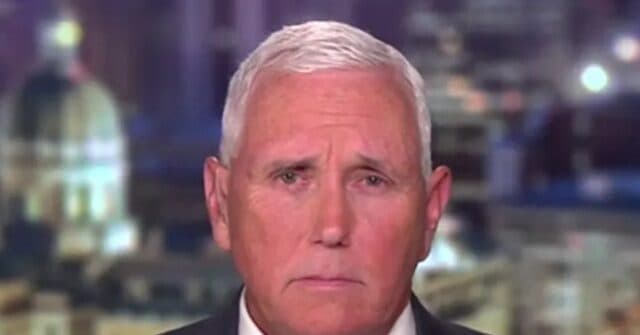
 Mike Pence speaks out, breaking with Trump over Canada trade war impact.
Pence Breaks with Trump: Canada Trade War Hurts Americans
Intra-Party Split Detected
Pence criticizes Trump administration's tariff approach and trade war with Canada, warning it hurts American consumers, while other Trump officials like Sean Duffy defend the tariff strategy as necessary pressure on Canada.
Left says
- •American consumers and businesses ultimately bear the cost of tariffs, not foreign governments, making trade wars a hidden tax on households already struggling with affordability.
- •Canada's prime minister frames the U.S. as effectively initiating a trade war through last-minute, unreasonable demands, suggesting the breakdown in talks stems from U.S. negotiating tactics rather than Canadian intransigence.
- •A prominent Republican breaking with Trump on tariffs validates longstanding warnings that protectionist trade policy undermines economic recovery and burdens ordinary Americans.
- •The Supreme Court's intervention on Liberation Day tariffs signals judicial pushback against unchecked executive trade authority, reinforcing concerns about the wisdom of aggressive unilateral tariff actions.
Right says
- •Pence's tariff skepticism reflects a consistent, longstanding free-trade position he has held since the Liberation Day tariffs, not a sudden political calculation against Trump.
- •Cabinet officials like Transportation Secretary Sean Duffy remain confident tariffs will pressure Canada to negotiate, framing the standoff as a tough but ultimately winnable negotiation rather than a reckless war.
- •Trump administration allies view escalating tariffs as necessary leverage to secure a better trade deal, expecting Canada to fold once the economic costs become too painful to bear.
- •Pence expresses hope that the current friction represents tough negotiation rather than genuine confrontation, leaving room for a favorable resolution that still benefits American interests.
Common Take
High Consensus- Trade talks between the U.S. and Canada collapsed on Friday night, leading to dueling 50% tariffs.
- Both sides agree the American economy is still in a fragile, recovering state that makes economic disruptions particularly risky right now.
- Affordability for American families is a shared concern driving reactions to the tariff standoff.
- There is agreement that a negotiated resolution would be preferable to prolonged confrontation between the two countries.
The Arguments
Left argues
Tariffs function as a hidden tax on American consumers and businesses, since it is domestic importers—not Canada—who pay the tariff, meaning a trade war with Canada directly worsens affordability at a fragile economic moment.
Right counters
Short-term price pressure is the acknowledged cost of leverage; the administration argues that sustained tariffs will force Canada to negotiate a fairer deal that pays off for American industries and workers over time.
Right argues
Cabinet officials like Sean Duffy argue Canada cannot win a prolonged tariff standoff with the much larger U.S. economy, so maintaining pressure is a rational strategy to secure concessions rather than reckless escalation.
Left counters
Betting that Canada will simply 'fold' ignores that Carney has already framed the U.S. as the aggressor with unreasonable last-minute demands, meaning entrenched positions could prolong economic harm rather than produce a quick capitulation.
Left argues
Pence, a lifelong conservative and Trump's own former VP, breaking publicly with the administration on tariffs lends unusual credibility to warnings that protectionism undermines economic recovery.
Right counters
Pence's position isn't new or opportunistic—he's held this free-trade view consistently since the Liberation Day tariffs, so his comments reflect principled continuity rather than a fresh political rebuke of Trump.
Left argues
The Supreme Court's willingness to check the Liberation Day tariffs suggests real legal and institutional skepticism about unilateral executive trade power, reinforcing doubts about the wisdom of this approach.
Right counters
A judicial ruling on process or authority doesn't settle the underlying policy debate; the administration can still argue tariffs are the right tool even while adjusting how they're legally implemented.
Right argues
Pence himself leaves the door open, expressing hope this is tough negotiation rather than a genuine trade war, suggesting the current friction could still yield a deal that benefits American interests.
Left counters
Hoping for a negotiated outcome doesn't erase the immediate, tangible costs to consumers and businesses that are already accruing while the two sides posture and escalate tariffs dollar-for-dollar.
Challenge Questions
These questions target genuine internal contradictions — meant to provoke honest reflection.
Right asks Left
“If tariffs are purely a tax on American consumers with no strategic value, why does the left generally support targeted tariffs or trade restrictions in other contexts, such as on Chinese goods or in defense of domestic manufacturing?”
Left asks Right
“If the administration is confident tariffs will simply force Canada to 'come to the table,' how does that square with Canada's own framing that U.S. demands were unreasonable and last-minute—doesn't that suggest the standoff could just as easily entrench rather than resolve?”
Outlier Report
Left Fringe
Progressive free-trade skeptics and labor-aligned figures like Bernie Sanders occasionally support tariffs for different reasons (protecting union jobs), diverging from the standard anti-tariff left consensus; this represents maybe 10-15% of the left.
Right Fringe
Hardline economic nationalists like Peter Navarro and some MAGA commentators (e.g., Steve Bannon) view any tariff skepticism, including Pence's, as near-treasonous globalist thinking; this represents roughly 20-25% of the right.
Noise Assessment
Moderate-to-high noise: cable news framing and partisan pundits amplify the Pence-vs-Trump split more than ordinary voters are tracking day-to-day, though affordability concerns are a genuine, widely-felt sentiment beneath the political theater.
Sources (7)
<p>Sunday on CNN’s “State of the Union,” former Vice President Mike Pence said “the last thing we need right now, as our economy is getting back on its feet, is a trade war with Canada.” Host Dana Bash said, “I</p> <p>The post <a href="https://www.breitbart.com/clips/2026/08/23/pence-last-thing-our-economy-needs-is-a-trade-war-with-canada/" rel="nofollow">Pence: ‘Last Thing’ Our Economy Needs Is a Trade War with Canada</a> appeared first on <a href="https://www.breitbart.com" rel="nofollow">Breitbart</a>.</p>
Former Vice President Mike Pence and Ukrainian President Volodymyr Zelensky on Sunday stressed the importance of Ukraine having the capabilities to deter Russian ballistic missile strikes. During an interview on NewsNation’s “The Hill Sunday,” Pence said Russian forces have “shifted” to using high-arc ballistic missiles and cruise missiles to strike Ukraine. Those weapons require Patriot…
Former Vice President Mike Pence denied Sunday that the U.S. military depleting its weapons stockpiles in the Iran war is hurting Ukraine in its ongoing fight against Russia. “I don’t see it that way, and I don’t think… the Ukrainians do either,” Pence told host Dana Bash on CNN’s “State of the Union,” while in…
Transportation Secretary Sean Duffy said Sunday that Canadian Prime Minister Mark Carney is going to “come to the table” on trade because tariffs against the U.S.’s northern neighbor will be “devastating.” “To think that they’re going to go to war with Donald Trump and actually win that war with the U.S., I think it’s foolish…
Former Vice President Mike Pence argued Sunday the U.S. military should prepare for further strikes against Iran, action he deemed “inevitable.” “It’s going to be absolutely imperative that we keep the pressure on, and that we keep the military assets in the region to be able to take the action that I believe is going…
Former Vice President Mike Pence said Sunday the trade war between the U.S. and Canada could damage the American economy.  “American businesses and American consumers pay American tariffs, and I think the last thing we need right now, as our economy is getting back on its feet, is a trade war with Canada,” Pence told…
“I think the last thing we need right now, as our economy is getting back on its feet, is a trade war with Canada,” the former vice president told CNN.