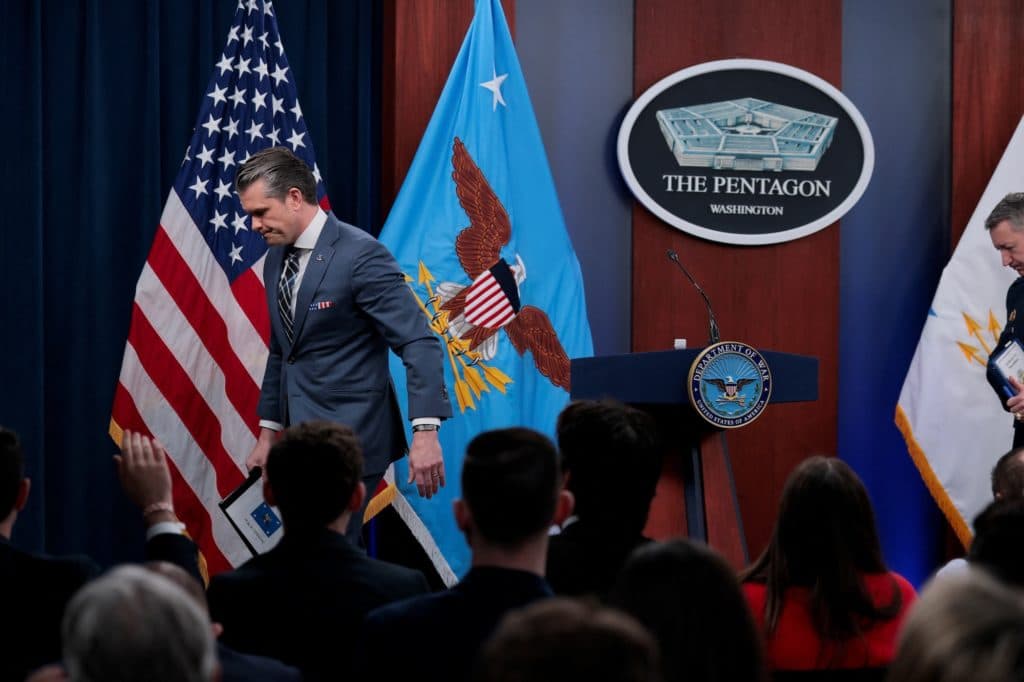
 Pentagon press briefing room with official speaking at podium to assembled reporters
Pentagon Closes Press Offices After Losing Court Battle Over Media Access
Left says
- •The Pentagon is deliberately circumventing a federal judge's constitutional ruling by shutting down press offices rather than allowing proper media access
- •This represents an unprecedented attack on press freedom at a critical time when the U.S. is engaged in military conflicts and public oversight is essential
- •The new restrictions requiring escorts and moving journalists outside the building will severely hamper reporters' ability to build sources and hold the military accountable
- •The policy is designed to exclude independent journalists while favoring pro-administration outlets, undermining democratic transparency
Right says
- •The Pentagon has legitimate security concerns about unescorted access following a pattern of national security leaks that have compromised military operations
- •The Defense Department is complying with the court ruling while still maintaining necessary security protocols to protect sensitive information
- •Journalists will still have access to scheduled briefings, press conferences, and interviews through proper channels with appropriate oversight
- •The administration has the right to appeal the judge's decision and implement interim security measures while the legal process continues
Common Take
High Consensus- A federal judge ruled that the Pentagon's previous press credentialing policy violated the First Amendment
- The Pentagon is appealing the court's decision while implementing new interim policies
- Journalists will continue to have access to scheduled press briefings and official Pentagon events
- The dispute centers on balancing press freedom with national security concerns
The Arguments
Right argues
The Pentagon has legitimate security concerns about unescorted access following documented national security leaks that have compromised military operations, and the Defense Department is implementing necessary interim security measures while appealing the court decision through proper legal channels.
Left counters
The Pentagon is deliberately circumventing a federal judge's constitutional ruling by shutting down press offices rather than complying with the order, representing an unprecedented attack on press freedom when public oversight of military conflicts is most essential.
Left argues
Judge Paul Friedman found 'undisputed evidence' that the policy is designed to weed out 'disfavored journalists' and replace them with those 'willing to serve' the government, constituting illegal viewpoint discrimination that undermines democratic transparency.
Right counters
The administration has the constitutional right to appeal judicial decisions and implement reasonable security protocols during the legal process, while still providing journalists access to scheduled briefings, press conferences, and interviews through appropriate oversight channels.
Left argues
The new restrictions requiring escorts and moving journalists outside the building will severely hamper reporters' ability to build sources and hold the military accountable, effectively ending decades of established press access that has been crucial for government oversight.
Right counters
Journalists will still have meaningful access to Pentagon officials and information through structured channels that balance press freedom with legitimate security needs, ensuring both transparency and protection of sensitive military operations.
Right argues
The Defense Department determined through security assessment that 'unescorted access to the Pentagon cannot be responsibly maintained without the ability to screen credential holders for security risks,' making these protective measures necessary for national security.
Left counters
This rationale conveniently emerged only after losing the court case, suggesting the security concerns are pretextual and designed to maintain restrictions on independent journalism that the court already ruled unconstitutional.
Challenge Questions
These questions target genuine internal contradictions — meant to provoke honest reflection.
Right asks Left
“If press freedom and government accountability are truly the primary concerns, why didn't major news outlets challenge these restrictions through legal channels earlier, and how do you reconcile demanding unfettered access with the reality that some military information genuinely requires security protection?”
Left asks Right
“If legitimate security concerns justify these restrictions, why did the Pentagon only discover these supposedly critical security vulnerabilities immediately after losing a court case, and how does closing press offices actually address the specific security risks you claim exist?”
Outlier Report
Left Fringe
Progressive activists like Glenn Greenwald and some Squad members who frame this as part of broader authoritarian overreach, representing about 15% of the left coalition.
Right Fringe
Trump loyalists like Steve Bannon and some House Freedom Caucus members who view all mainstream media as 'enemies of the people' deserving no access, representing about 20% of the right coalition.
Noise Assessment
Moderate noise level - while press freedom advocates and Trump supporters are vocal, most Americans view this as a procedural dispute rather than a fundamental crisis, with limited viral social media engagement beyond political activists.
Sources (8)
The Defense Department has announced plans to remove media offices from the Pentagon after a Clinton-appointed federal judge sided with The New York Times in a lawsuit challenging limits on reporters' access to the building. The action is seen as a "loophole" strategy to bypass the ruling against restrictions which the Trump Administration has struggled to enforce in the wake of a hailstorm of national security leaks.
The Defense Department will issue new press credentials but is still looking to keep some reporters out of the building by closing its media offices after a federal judge ruled last week that the Pentagon's restrictive press policy was unconstitutional.
The Defense Department said on Monday that it was taking a new approach to limiting access to media organizations, after a federal judge ruled on Friday that major parts of its current policy were unconstitutional, in a case brought by The New York Times.
<p>The Department of Defense announced a new media policy on Monday, three days after a <a href="https://www.axios.com/2026/03/21/judge-blocks-pentagons-press-policy" target="_blank">federal judge ruled</a> Trump administration restrictions on Pentagon journalists were a First Amendment violation. </p><p><strong>The big picture: </strong>The Pentagon said in a <a href="https://media.defense.gov/2026/Mar/23/2003902148/-1/-1/1/IMPLEMENTATION-OF-REVISED-MEDIA-IN-BRIEF.PDF" target="_blank">memorandum</a> announcing the changes that it's complying with the ruling in the New York Times lawsuit, but press groups accused the administration of placing fresh restrictions on journalists with the new policy.</p><hr /><p><strong>Zoom in: </strong>Chief Pentagon spokesperson Sean Parnell announced three new changes to the press policy in a <a href="https://www.war.gov/News/Releases/Release/Article/4441831/statement-by-chief-pentagon-spokesman-sean-parnell-on-implementation-of-revised/" target="_blank">statement</a> saying the Defense Department "disagrees with the decision and is pursuing an appeal."</p><ul><li>The Pentagon Press Association said in a Monday evening <a href="https://www.documentcloud.org/documents/27901059-ppa-statement-march-23/" target="_blank">statement</a> the new Pentagon rules are "a clear violation of the letter and spirit" of the court ruling and it's "consulting with our legal counsel and will advise members once this process is complete."</li></ul><p><em>Here's what to know about the Pentagon's new press policy:</em></p><h2> "Correspondents Corridor" shut</h2><p>The Pentagon closed the area known as the "Correspondents' Corridor" with immediate effect.</p><ul><li>The Defense Department determined following an assessment "that unescorted access to the Pentagon cannot be responsibly maintained without the ability to screen credential holders for security risks," Parnell said.</li></ul><h2>Pentagon to move press to new annex</h2><p>A "new press workspace will be established in an annex facility outside the Pentagon and will be available when ready," per the memo.</p><ul><li>The Pentagon said it would notify all Pentagon Facility Access Credential holders when the new workspace is operational.</li></ul><h2>New "escorted access only" rule</h2><p>All journalists will be required to have an "escort by authorized Department personnel" to access the Pentagon, per Parnell's statement.</p><ul><li>"Credential holders will continue to have access to the Pentagon for scheduled press briefings, press conferences, and interviews arranged through public affairs offices."</li></ul><p><strong>What they're saying: </strong>The National Press Club referred to the <a href="https://www.axios.com/world/iran" target="_blank">Iran</a> war in a <a href="https://x.com/PressClubDC/status/2036210263653798274" target="_blank">statement</a> posted to X that noted at a time when the U.S. "is engaged in active military conflict, the public depends on journalists being able to observe, report and ask questions freely."</p><ul><li>Eliminating the Correspondents Corridor and "requiring escorted access would sharply limit how journalists gather news, build sources and cover one of the most powerful institutions in government — reducing what the public is able to see and understand about decisions made in its name," the statement added.</li><li>"Independent reporting on the U.S. military is not optional. It is essential to accountability, transparency and public trust. Any policy that curtails that access should concern everyone who values a free and informed society."</li><li>Representatives for the Pentagon referred Axios to Parnell's statement when contacted for comment on the press groups' statements.</li></ul><p><strong>Background: </strong>Last week's court ruling blocked the Pentagon from imposing a <a href="https://www.axios.com/2025/10/16/pentagon-press-reporting-rules-restrictions-hegseth" target="_blank">policy</a> that required reporters to sign a pledge committing to its rules to maintain their press credentials, which greatly reduced the number of journalists from major news outlets participating in press briefings.</p><ul><li>Most outlets, including the conservative-leaning Fox News and Newsmax, <a href="https://www.axios.com/2025/10/14/pentagon-press-restrictions-trump-journalists-news-outlets" target="_self">refused to sign</a> the pledge.</li></ul><p><strong>Thought bubble, </strong>via Axios' <a href="https://www.axios.com/authors/sara" target="_blank">Sara Fischer</a>: The Pentagon's move to adhere to the law while still restricting journalists is reminiscent of similar actions the <a href="https://www.axios.com/2025/02/25/white-house-trump-press-pool" target="_blank">White House took</a> in response to AP refusing to change its style guide to align with President Trump's executive order on the Gulf of America (renamed from the Gulf of Mexico).</p><ul><li>The White House <a href="https://www.axios.com/2025/02/25/white-house-trump-press-pool" target="_blank">removed wire services</a> from the rotation altogether, though it later <a href="https://www.axios.com/2025/04/15/ap-reporter-allowed-into-white-house-event" target="_blank">allowed AP to return</a> to cover the president. In this case, the Pentagon is shuttering office space.</li></ul>
The Pentagon Press Association said the announcement "is a clear violation of the letter and spirit of last week’s ruling."
The Pentagon issued a revised policy for credentialing media after a judge struck down the Defense Department's previous rules that determined access to its headquarters. But a spokesperson for The New York Times, which sued the Defense Department, said the new policy does not comply with the judge's order, and they will be going back to court. Liz Landers discussed more with lawyer Ted Boutrous.
<p>DoD announces ‘interim’ policy for journalists decried by newspaper as ‘end-run around the court’s ruling’</p><ul><li><p><a href="https://www.theguardian.com/news/2026/feb/17/sign-up-for-the-breaking-news-us-email-to-get-newsletter-alerts-direct-to-your-inbox?utm_medium=ACQUISITIONS_STANDFIRST&utm_campaign=BN22326&utm_content=signup&utm_term=standfirst&utm_source=GUARDIAN_WEB">Sign up for the Breaking News US email to get newsletter alerts in your inbox</a></p></li></ul><p>The New York Times on Tuesday accused the Pentagon of disobeying a judge’s ruling that undid much of the restrictive agreement journalists were forced to sign or lose access to the building.</p><p>The judge, Paul Friedman, granted an injunction on Friday that overturned much of the language in the “media in-brief” document that had so concerned many news organizations that cover the Pentagon that almost all journalists chose instead to give back their press badges. He also ordered that seven journalists from the Times be returned their badges.</p> <a href="https://www.theguardian.com/media/2026/mar/24/pentagon-correspondents-press-restrictions">Continue reading...</a>
The New York Times is seeking a new order to force the Pentagon to lift new media restrictions following a federal court ruling last week that found similar rules unconstitutional. A motion filed Tuesday on behalf of the outlet lambastes the Pentagon’s latest rules as “contemptuously defying” the court’s ruling, which struck down a requirement that journalists…