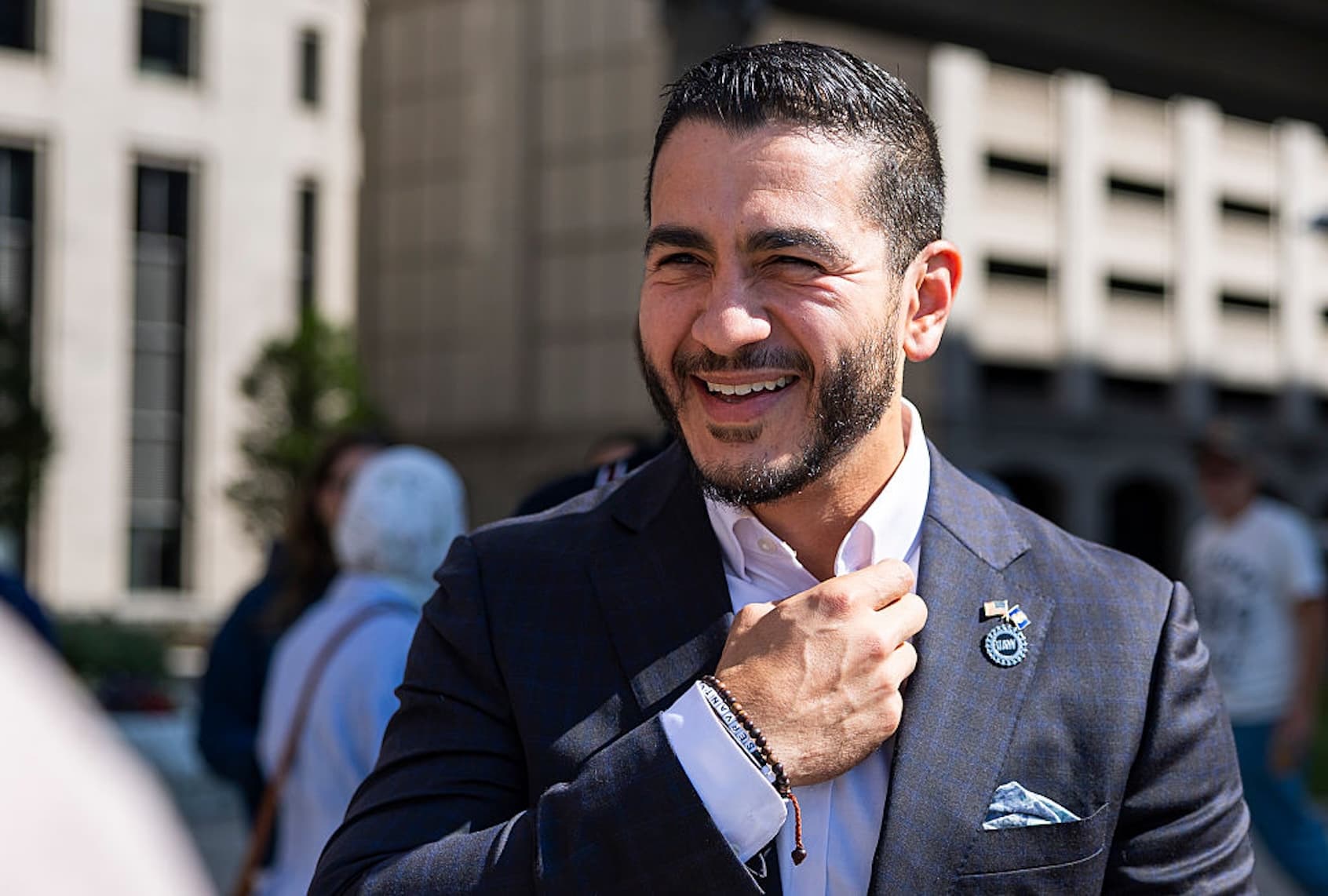
 Abdul El-Sayed smiles during a public appearance in Michigan.
Progressive Beats AIPAC-Backed Democrat in Michigan Senate Upset
Intra-Party Split Detected
El-Sayed's narrow win exposes a deep divide between the Democratic establishment/moderate wing (backing Stevens, supported by AIPAC and pro-Israel groups) and the progressive/left wing (backing El-Sayed, supported by Sanders, AOC, and DSA-aligned activists), particularly over Israel policy and economic populism.
Left says
- •El-Sayed's win demonstrates that a grassroots, door-knocking campaign can overcome a record-breaking $30-60 million spending disadvantage from pro-Israel and corporate super PACs.
- •The victory reflects growing rejection within the Democratic base of unconditional support for Israel amid the war in Gaza, and of AIPAC's outsized influence over Democratic primaries.
- •El-Sayed's populist platform of Medicare for All, getting money out of politics, and cost-of-living relief resonated with voters frustrated by establishment politics-as-usual.
- •The win, alongside other DSA-aligned victories, signals that the party's energy and future may lie with its progressive wing rather than its cautious establishment leadership.
Right says
- •El-Sayed's record includes past comments supporting defunding the police, embracing abolishing ICE, and expressing ambivalence about Israel's existence as a Jewish state, positions seen as far outside the mainstream.
- •His association with far-left streamer Hasan Piker, who made comments suggesting America 'deserved' 9/11, and his refusal to directly condemn the Ayatollah raise serious concerns about his judgment and values.
- •Republicans view his win as an opportunity to paint the entire Democratic Party as captured by socialist and anti-Israel extremism heading into a critical midterm election.
- •His narrow margin and underperformance relative to earlier double-digit polling leads suggest vulnerability in a general election, especially given the loss of traditional coalition voters including Jewish and Black constituencies.
Common Take
High Consensus- El-Sayed defeated Rep. Haley Stevens by a narrow margin, roughly 48.5% to 47.5%.
- The primary became the most expensive Democratic Senate primary in U.S. history, with tens of millions in outside spending, largely from AIPAC-aligned super PACs opposing El-Sayed.
- The race is widely seen as a bellwether for the direction of the Democratic Party and the influence of its progressive wing.
- The November general election against Republican Mike Rogers is viewed by both sides as a critical, closely watched contest that could help determine Senate control.
The Arguments
Left argues
El-Sayed's win proves that a grassroots, door-knocking campaign with 12,000 volunteers can overcome a record-shattering $30-60 million spending disadvantage from AIPAC-aligned and corporate super PACs, showing that money doesn't automatically buy elections.
Right counters
A 1-point margin after leading by double digits in earlier polls suggests the massive spending did move votes substantially and nearly worked, and it exposed real vulnerabilities that could sink El-Sayed in the general election against Rogers.
Right argues
El-Sayed's past support for defunding the police, abolishing ICE, ambivalence about Israel's existence as a Jewish state, and refusal to condemn the Ayatollah reflect a pattern of judgment and positions far outside the mainstream that Republicans can and will use to paint the entire Democratic Party as captured by socialist extremism.
Left counters
Attacking El-Sayed's full name and linking him to unrelated remarks by a podcaster he merely campaigned alongside is a deliberate othering tactic reminiscent of attacks on Barack Hussein Obama, designed to smear rather than engage with his actual Medicare for All and anti-corruption platform.
Left argues
The win signals a genuine shift in the Democratic base's rejection of unconditional support for Israel amid the Gaza war, with El-Sayed's condemnation of the war and pledge to end military aid resonating with voters despite the establishment and AIPAC spending unprecedented sums to stop him.
Right counters
NPR notes El-Sayed will need to win over the traditional coalition of Black, working-class, and Jewish voters that Stevens relied on, and his weaker-than-expected performance in Detroit suggests his Israel stance may be a general-election liability rather than a broadly popular position.
Right argues
El-Sayed's narrow 1-point victory despite once polling with a double-digit lead, combined with Stevens' surprisingly strong rural showing, indicates real fragility in his coalition that Rogers and the GOP can exploit in a race Democrats consider must-win to retake the Senate.
Left counters
Michigan Democrats haven't lost a Senate race since the 1990s, and El-Sayed's strength in college towns and dominance in Grand Rapids shows an expanding, energized coalition that can still be built out further before November.
Left argues
El-Sayed's victory alongside other DSA-aligned wins in Colorado and New York shows the party's future energy lies with its progressive wing, and establishment Democrats ignoring this trend do so at their own peril heading into future elections.
Right counters
A single point in one primary is a thin reed on which to declare an ideological realignment, and if El-Sayed loses a winnable Michigan Senate seat in November, it will be Exhibit A that the socialist label is a general-election liability, not an asset.
Challenge Questions
These questions target genuine internal contradictions — meant to provoke honest reflection.
Right asks Left
“If El-Sayed's win is proof that grassroots organizing beats big money, how do you reconcile that with the fact that his lead collapsed from double digits to a single point after the spending onslaught — doesn't that suggest the money worked, just not quite enough?”
Left asks Right
“If Republicans plan to brand the entire Democratic Party as extremist based on one candidate's past comments, how do you square that strategy with your own party's continued embrace of figures who've made comments about January 6th, election denial, or other fringe positions without treating those as disqualifying for the whole GOP?”
Outlier Report
Left Fringe
Figures like Hasan Piker (with his 9/11 comments) and the more radical DSA wing represent perhaps 10-15% of the left that embraces the most extreme rhetoric; most mainstream progressives (AOC, Bernie Sanders supporters) distance themselves from the harshest statements while still backing El-Sayed's economic populism.
Right Fringe
Figures like Tommy Tuberville (invoking terrorism rhetoric) and the NRSC's ad using El-Sayed's full name to otherize him represent an aggressive fringe, maybe 15-20% of the right, that engages in Islamophobic framing beyond substantive policy critique; most Republicans focus on his socialist and anti-Israel positions rather than identity-based attacks.
Noise Assessment
High noise ratio: national pundits, super PAC spending narratives, and Trump's Truth Social reactions dominate coverage, but average voters' views are likely shaped more by broad partisan priors on Israel and socialism than by the specific viral moments (Piker clips, Tuberville comments) driving media discourse.
Sources (14)
Does the win indicate the Democratic party’s future?
Democrat Abdul El-Sayed, a former public health official who built a surging progressive movement in Michigan, overcame a more than 8-to-1 spending disadvantage and opposition from the Democratic establishment to win Tuesday's nationally watched Senate primary, the Associated Press projected. A Rhodes scholar and podcaster with sharp critiques of modern politics, El-Sayed sold a populist message to swing-state voters and beat establishment candidate Rep. Haley Stevens (D).
The tremors from Abdul El-Sayed's victory in Michigan's Senate primary will have been felt hundreds of miles away by the Democratic Party leadership. In a year in which Republicans appear to be facing significant electoral headwinds, Democratic primary voters have taken a chance on a left-wing insurgent, raising the stakes in a Senate race in November that could decide overall control of the upper chamber.
Progressive candidate Abdul El-Sayed has been declared the winner of Michigan’s closely watched Democratic Senate primary, narrowly beating out Congressmember Haley Stevens, according to the Associated Press and other news agencies. <span class="caps">AIPAC</span> and its affiliated groups spent as much as $46 million to help Stevens in what has become the most expensive Democratic Senate primary contest in U.S. history. El-Sayed will face former Republican Congressman Mike Rogers in November to fill the seat now held by Democratic Senator Gary Peters, who is retiring. If El-Sayed wins the general election, he would become the first Muslim senator in U.S. history. His key supporters included Senator Bernie Sanders, Congresswoman Alexandria Ocasio-Cortez and the United Auto Workers.</p> <p>“Dr. Abdul El-Sayed worked unbelievably hard in this race,” says John Nichols, executive editor of <em>The Nation</em>, pointing out that El-Sayed campaigned in rural counties across Michigan. “It was literally about physically going to the people early, and then again and again and again, and talking to them about issues.”</p> <p>We also speak with Andy Levin, a former Democratic congressmember from Michigan who lost to Stevens in 2022 after <span class="caps">AIPAC</span> spent $4.3 million on her campaign. El-Sayed’s rise represents “a movement of Americans who are saying, 'Enough of politics as usual,'” says Levin. “’We’re done with the parties as they are. We need some way more active effort for us to be able to have living wages and healthcare and education and childcare and retirement.’”
After defeating moderate Democratic Rep. Haley Stevens, he’ll face former GOP Rep. Mike Rogers in a must-win race in November.
<p>With 99% of the votes counted, El-Sayed defeated Haley Stevens 48.5% to 47.5% (14,893 votes).</p> The post <a href="https://legalinsurrection.com/2026/08/abdul-el-sayid-wins-michigan-democratic-senate-primary/">Abdul El-Sayed Wins Michigan Democratic Senate Primary</a> first appeared on <a href="https://legalinsurrection.com">Le·gal In·sur·rec·tion</a>.
President Donald Trump and top Republicans unleashed a series of attacks on progressive Abdul El-Sayed, the new Democratic nominee in the battleground state of Michigan. “When I watch Abdul, he’s full of s----,” the president said. NBC’s Garrett Haake reports for TODAY.
Abdul El-Sayed has won Michigan's Democratic Senate primary and will face Republican Congressman Mike Rogers in the midterms. And, today, Dr. Anthony Fauci faces a contempt of Congress vote.
It’s a clear signal that the ascendant left can win primaries in key battlegrounds and carries massive implications for 2028.
Republican efforts to turn the Democratic Senate nominee into a boogeyman betray their fear
<p>Abdul El-Sayed narrowly defeated Rep. Haley Stevens — despite a record-setting $60 million in outside spending in her favor.</p> <p>The post <a href="https://theintercept.com/2026/08/05/michigan-primary-results-el-sayed-stevens-aipac/">Abdul El-Sayed Beats the Democratic Establishment and AIPAC in Michigan</a> appeared first on <a href="https://theintercept.com">The Intercept</a>.</p>
The upset highlighted how out of touch the power brokers are with the party’s surging left wing as they try to retake control of the Senate.
Abdul El-Sayed won with a populist platform buoyed by voter discontent with establishment Democrats and Israel.
In today’s edition … the Senate has a long to-do list before leaving town ... a mysterious source of cheap gas … but first …