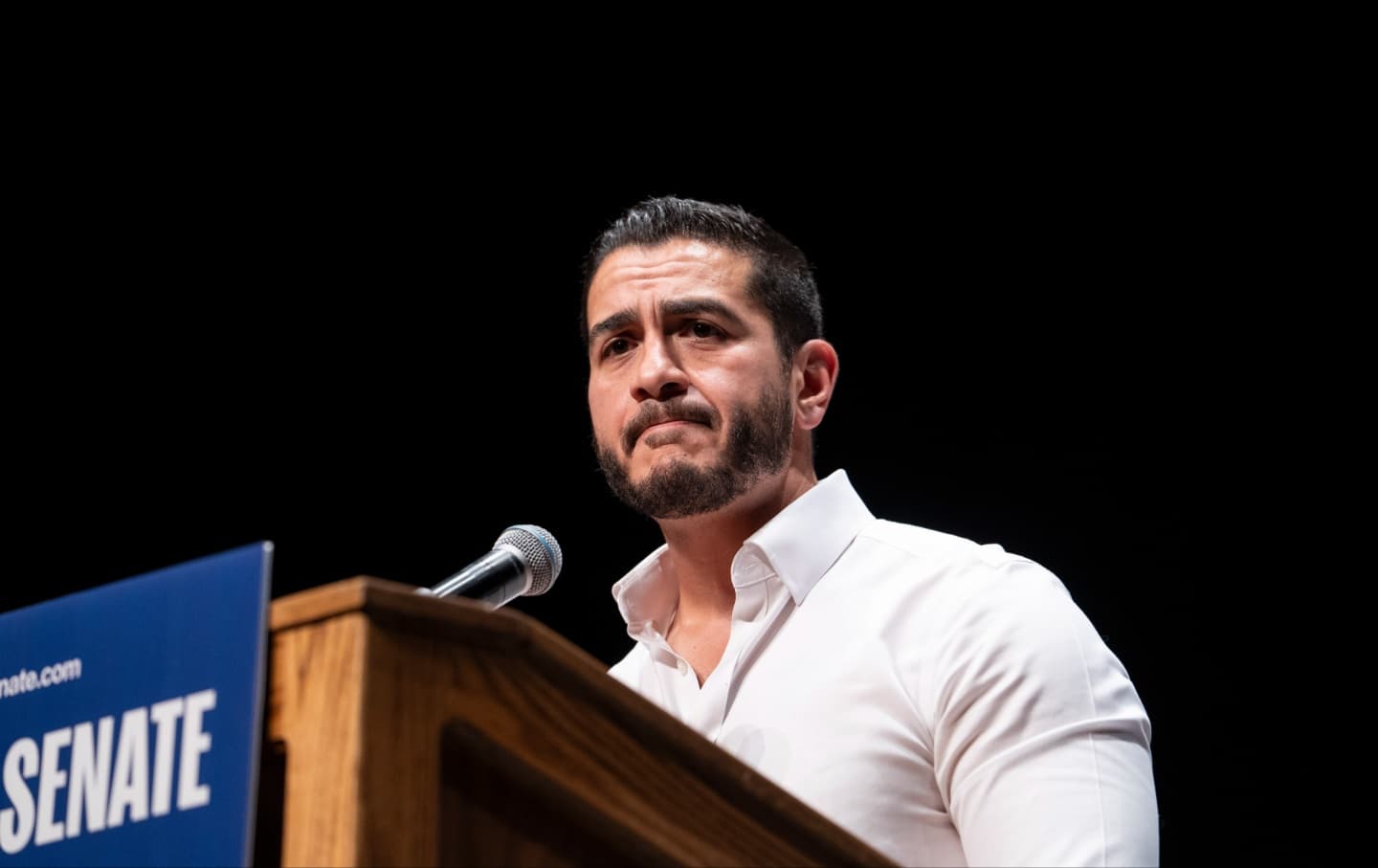
 Abdul El-Sayed speaks at a Senate campaign podium in Michigan.
Progressive Beats AIPAC-Backed Rival in Michigan Senate Upset
Intra-Party Split Detected
El-Sayed's progressive, pro-Palestinian, anti-establishment win exposed a deep rift between the Democratic Party's centrist/establishment wing (Stevens, Clinton, AIPAC-aligned donors) and its progressive/populist base (Sanders, AOC, UAW), with debate over electability, unity, and whether moderates still belong in the party.
Left says
- •El-Sayed's victory over an $60-70 million spending advantage backed by AIPAC and corporate interests shows grassroots organizing and small-dollar fundraising can defeat big money in politics.
- •His campaign centered on affordability, Medicare for All, and ending U.S. military funding to Israel resonated with voters frustrated by the cost of living and the war in Gaza.
- •Attacks invoking his full name and religion are viewed as Islamophobic smear tactics used because opponents could not win on substantive policy debates.
- •His win, along with other pro-Palestine candidates' primary victories nationwide, signals a broader shift within the Democratic base toward economic populism and away from establishment, AIPAC-aligned politics.
Right says
- •El-Sayed's positions, including cutting all military aid to Israel and abolishing ICE, are seen as too extreme for general-election voters, including moderates and independents.
- •His past comments and associations, including with commentator Hasan Piker over remarks about 9/11, raise concerns about his judgment and are cited as evidence he is unfit for the Senate.
- •His victory is portrayed as proof that the Democratic Party is drifting toward socialism and radicalism, alienating centrist voters the party needs to win in November.
- •Republicans see an opportunity to court disaffected moderate Democrats who may view El-Sayed's rhetoric as divisive rather than unifying.
Common Take
High Consensus- El-Sayed defeated Haley Stevens in one of the most expensive Democratic Senate primaries in U.S. history, with AIPAC-aligned spending reaching tens of millions of dollars.
- If elected in November, El-Sayed would become the first Muslim senator in U.S. history.
- The primary exposed real fractures within the Democratic Party between its establishment and progressive wings that will need to be addressed before the general election.
- El-Sayed will face Republican Mike Rogers in November, and both sides recognize that race as competitive and consequential.
The Arguments
Left argues
El-Sayed's victory over $60-70 million in outside spending, largely from AIPAC and corporate interests, demonstrates that grassroots organizing and small-dollar fundraising can overcome massive financial disadvantages in modern politics.
Right counters
A narrow, under-one-point victory despite polling that predicted a much wider margin suggests the money did have a significant effect and that El-Sayed's coalition is more fragile than the 'people beat money' narrative implies.
Right argues
El-Sayed's substantive positions—cutting all military aid to Israel, abolishing ICE, and past comments minimizing 9/11 or associating with figures who did—represent a genuine departure from mainstream general-election politics that could alienate the moderates and independents Democrats need in November.
Left counters
Framing policy disagreements as evidence of extremism ignores that ending unconditional military aid to a foreign government and reforming immigration enforcement are legitimate policy positions supported by a growing share of the electorate, not judgment failures.
Left argues
Attacks that emphasize El-Sayed's full name and religious background, rather than engaging his policy platform, are Islamophobic dog whistles deployed because opponents lack a substantive rebuttal to his affordability and anti-war message.
Right counters
Raising concerns about a candidate's judgment—such as his response to Hasan Piker's 9/11 remarks or his call for Schumer's ouster—is a legitimate line of political attack distinct from commentary on his name or faith, and conflating the two shields him from fair scrutiny.
Right argues
El-Sayed's win, alongside other AIPAC-rejecting, pro-Palestine candidates winning primaries nationwide, is real evidence that the Democratic Party is being pulled toward a socialist and anti-Israel fringe that could cost it winnable seats in the general election.
Left counters
Framing economic populism and Palestinian rights advocacy as 'socialism' or radicalism dismisses genuine voter frustration with the cost of living and foreign policy priorities that cut across traditional left-right lines, including among independents.
Left argues
El-Sayed's coalition—including Bernie Sanders, AOC, and the United Auto Workers—shows that an economically populist, anti-corporate message focused on affordability can build the multiracial, cross-regional support needed to beat well-funded Republicans in November.
Right counters
A coalition built around the party's most ideological figures may energize the base but risks failing to unify establishment and moderate Democrats, as evidenced by El-Sayed's own need to hastily patch things up with Schumer and Obama after the primary.
Challenge Questions
These questions target genuine internal contradictions — meant to provoke honest reflection.
Right asks Left
“If El-Sayed's win truly proves that grassroots money can overcome establishment spending, how do you account for the fact that pre-election polling showed him winning by a wide margin, yet the actual result was under one point—doesn't that suggest the $60-70 million did meaningfully narrow the race rather than fail entirely?”
Left asks Right
“If concerns about El-Sayed's 'judgment' regarding Hasan Piker's 9/11 comments are meant to be separate from attacks on his name and religion, why did the National Republican Senatorial Committee's first response lead with his full, unanglicized name rather than any specific policy critique?”
Outlier Report
Left Fringe
Figures like Hasan Piker (whose 9/11 remarks were cited in attacks) and hardline pro-Palestine activists (e.g., USCPR Action) represent perhaps 10-15% of the left who fully embrace anti-Israel-aid absolutism; most Democrats support a more moderate two-state/humanitarian aid position.
Right Fringe
Figures like Tommy Tuberville, who invoked 9/11 rhetoric, and Trump's 'Communist loser who hates Jews' framing represent an inflammatory ~15-20% of the right that uses overtly Islamophobic language, which likely alienates even some Republican moderates uncomfortable with such rhetoric.
Noise Assessment
High — much of the discourse (Trump's Truth Social posts, Tuberville's comments, activist praise from The Nation/Democracy Now) is performative base-mobilization rather than reflective of broader public sentiment, which is more ambivalent and less polarized than the loudest voices on both sides suggest.
Sources (10)
We speak with Dr. Abdul El-Sayed after his victory in Michigan’s primary race for U.S. Senate sent shockwaves through the Democratic Party. El-Sayed, a former public health official, ran a progressive campaign focused on affordability, Medicare for All, getting money out of politics, and opposing Israel’s genocide in Gaza. He defeated Congressmember Haley Stevens, who was backed by tens of millions in outside spending including by <span class="caps">AIPAC</span>, the powerful pro-Israel lobby group.</p> <p>“In an era where many of us can’t afford basic things like groceries or rent or healthcare, the idea that your government is sending your tax dollars to buy bombs and tanks for foreign governments seems anathema,” El-Sayed says. “That money could be spent to fix your potholes, rebuild your kid’s school.”</p> <p>El-Sayed says his focus now is on beating Republican nominee Mike Rogers, whom he calls a “bootlicker for Trumpism,” and to present a positive vision for his party that can lead into the next Democratic presidential administration.
Progressive candidate Abdul El-Sayed has been declared the winner of Michigan’s closely watched Democratic Senate primary, narrowly beating out Congressmember Haley Stevens, according to the Associated Press and other news agencies. <span class="caps">AIPAC</span> and its affiliated groups spent as much as $46 million to help Stevens in what has become the most expensive Democratic Senate primary contest in U.S. history. El-Sayed will face former Republican Congressman Mike Rogers in November to fill the seat now held by Democratic Senator Gary Peters, who is retiring. If El-Sayed wins the general election, he would become the first Muslim senator in U.S. history. His key supporters included Senator Bernie Sanders, Congresswoman Alexandria Ocasio-Cortez and the United Auto Workers.</p> <p>“Dr. Abdul El-Sayed worked unbelievably hard in this race,” says John Nichols, executive editor of <em>The Nation</em>, pointing out that El-Sayed campaigned in rural counties across Michigan. “It was literally about physically going to the people early, and then again and again and again, and talking to them about issues.”</p> <p>We also speak with Andy Levin, a former Democratic congressmember from Michigan who lost to Stevens in 2022 after <span class="caps">AIPAC</span> spent $4.3 million on her campaign. El-Sayed’s rise represents “a movement of Americans who are saying, 'Enough of politics as usual,'” says Levin. “’We’re done with the parties as they are. We need some way more active effort for us to be able to have living wages and healthcare and education and childcare and retirement.’”
The Senate candidate encouraged his opponents to get better talking points
Republican efforts to turn the Democratic Senate nominee into a bogeyman betray their fear
<p>Iman Abid</p> <div><img alt="" src="https://www.thenation.com/wp-content/uploads/2026/08/AP26217265488036.jpg" /></div> <div> <div class="wp-block-the-nation-dek article-title__dek"> <p>Even though the Palestine movement is on the march, we can’t afford any complacency.</p> </div> </div> <p>The post <a href="https://www.thenation.com/article/activism/abdul-el-sayed-aipac-win/">Abdul El-Sayed’s Win Is a Landmark. But the Fight Is Far From Over.</a> appeared first on <a href="https://www.thenation.com">The Nation</a>.</p>
<p>John Nichols</p> <div><img alt="" src="https://www.thenation.com/wp-content/uploads/2026/08/AP26217550375290.jpg" /></div> <div> <div class="wp-block-the-nation-dek article-title__dek"> <p>The lessons from a primary win that can be applied to defeat a Republican in November.</p> </div> </div> <p>The post <a href="https://www.thenation.com/article/politics/abdul-el-sayed-primary-results-speech/">Abdul El-Sayed: “The Power of Our Many Is Greater Than the Power of Their Money”</a> appeared first on <a href="https://www.thenation.com">The Nation</a>.</p>
<p>John Nichols</p> <div><img alt="" src="https://www.thenation.com/wp-content/uploads/2026/07/GettyImages-2286094598.jpg" /></div> <div> <div class="wp-block-the-nation-dek article-title__dek"> <p>His ability to hit hard against powerful moneyed interests makes him electable.</p> </div> </div> <p>The post <a href="https://www.thenation.com/article/politics/abdul-el-sayed-michigan-primary-money/">Abdul El-Sayed Knows Just How to Beat Billionaire-Funded Republicans</a> appeared first on <a href="https://www.thenation.com">The Nation</a>.</p>
Before going up against Republican Mike Rogers in November, Abdul El-Sayed must heal the wounds from his fierce race against Rep. Haley Stevens.
Michigan's Democratic nominee for the U.S. Senate, Abdul El-Sayed, on Sunday said the party has its differences but stands united in its desire to combat the "moral rot" at the Trump administration and corporate interests.