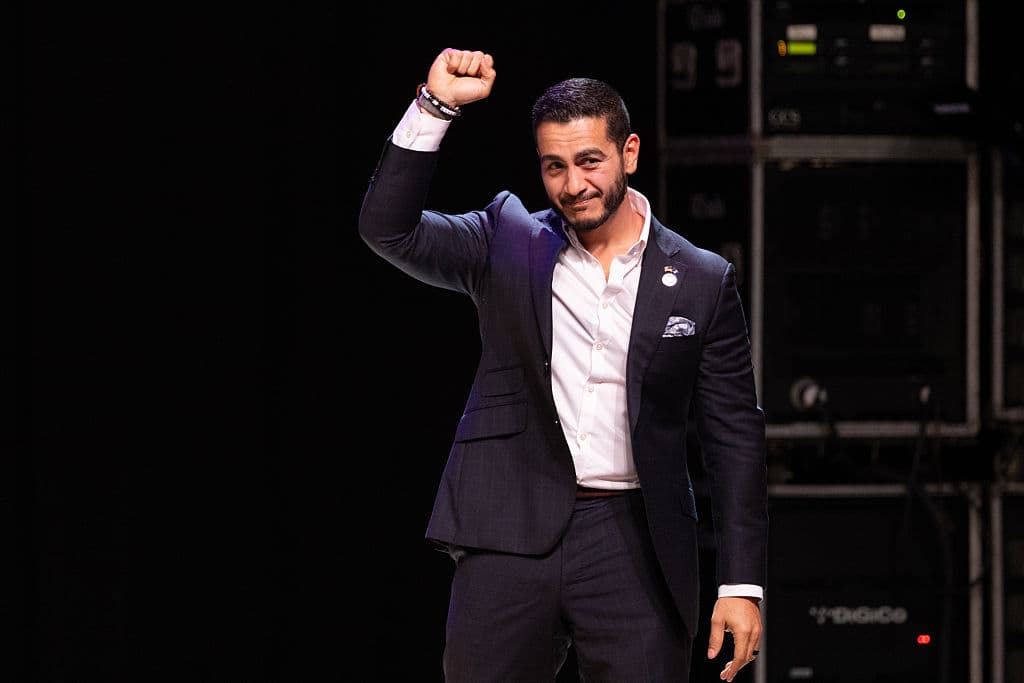
 Michigan politician raises fist in celebration at a campaign event.
Progressive Sweep in Michigan Splits Democrats Over Party's Future
Intra-Party Split Detected
Michigan Democrats are sharply divided between the party establishment (Schumer, Whitmer, moderates backing Haley Stevens and AIPAC-aligned spending) and a surging progressive/DSA-aligned wing (Sanders, AOC, Working Families Party) backing El-Sayed, Lawrence, and McKinney, with the narrow Senate primary margin fueling debate over whether the left's win represents broad strength or a risky, divisive victory heading into the general election.
Left says
- •El-Sayed's win over Haley Stevens, despite being outspent nine-to-one, shows grassroots organizing and small-dollar movements can overcome establishment money and AIPAC's massive super PAC spending.
- •The sweep across the Senate race, two House primaries, a mayoral race, and multiple state legislative seats reflects a genuine grassroots shift among Democratic voters, not an isolated fluke.
- •DSA and Working Families Party organizing methods are reviving door-knocking, volunteer-driven campaigning that the party establishment has struggled to replicate.
- •These results build momentum for a more unapologetically progressive national ticket in 2028, testing whether a left-populist message can win in a swing state.
Right says
- •El-Sayed underperformed pre-election expectations and won by a razor-thin margin, suggesting the progressive wave is weaker and more contested than the sweep narrative suggests.
- •Democratic Socialist and hard-left positions like abolishing ICE, Medicare for All, and cutting aid to Israel could alienate the independent and moderate voters Democrats need to actually win swing states in November.
- •Trump and Republicans see El-Sayed's positions as an opportunity, branding him a 'communist' and arguing Mike Rogers would have had an easier time against him than against Stevens.
- •Many centrist Democrats worry the party's establishment and big donors were rebuked by their own base, deepening a split that could hurt fundraising and unity heading into the general election.
Common Take
High Consensus- El-Sayed defeated Stevens by a narrow 48.5% to 47.5% margin in the Senate primary.
- Progressives and democratic socialists won multiple races up and down the Michigan ballot, including House, state legislative, and mayoral contests.
- Stevens and allied groups, including AIPAC's super PAC, significantly outspent El-Sayed and his supporters.
- The results expose real and unresolved tension between the Democratic Party's establishment and progressive wings heading into November.
The Arguments
Left argues
El-Sayed won despite being outspent roughly nine-to-one, including over $30 million from AIPAC's super PAC, proving that grassroots organizing and small-dollar movements can overcome establishment money in a major swing state.
Right counters
A win of less than one percentage point after being vastly outspent is at least as much evidence of a weak, underperforming candidate as it is proof that money doesn't matter — if anything, it shows the establishment's message nearly succeeded despite the spending gap.
Right argues
El-Sayed underperformed pre-election expectations and only narrowly survived a deeply flawed opponent, suggesting the 'progressive wave' is far more fragile than the sweep narrative implies and may not translate into a general election win against Mike Rogers.
Left counters
A win is a win in a bitter proxy war where the entire party establishment, AIPAC, and even the sitting governor campaigned against him — surviving that gauntlet by any margin, especially in a low-turnout primary, understates rather than overstates his strength heading into November.
Left argues
The sweep wasn't limited to El-Sayed — DSA and Working Families Party-backed candidates won a House primary, ousted an incumbent congressman, took a mayoral race, and won multiple state legislative seats, showing a genuine and broad-based shift in the Democratic electorate rather than one fluke race.
Right counters
Most of these down-ballot wins occurred in solidly blue districts or low-turnout local races where a small, highly motivated activist base can dominate; that's a very different test than winning a contested statewide race in a swing state during a general election.
Right argues
El-Sayed's positions — abolishing ICE, Medicare for All, and cutting aid to Israel — are exactly the kind of positions that alienate the independent and moderate voters Democrats need in swing states, and Republicans are already exploiting this by branding him a 'communist.'
Left counters
El-Sayed explicitly rejects the socialist label and calls himself a capitalist, and Republicans will attack any Democratic nominee as radical regardless of their actual positions — the real test will be the general election, not GOP messaging before it even starts.
Left argues
Stevens' loss, backed by Schumer, Whitmer, and a flood of AIPAC money, is the second major Senate primary this cycle where the Democratic establishment's preferred candidate lost, signaling that rank-and-file voters are rejecting both their party's leadership and its financial patrons.
Right counters
A base rebuking its own establishment in a primary is not the same as a general electorate embracing a socialist-adjacent platform; the same voters who deliver primary upsets can easily be outnumbered by moderates and independents in November.
Challenge Questions
These questions target genuine internal contradictions — meant to provoke honest reflection.
Right asks Left
“If money and establishment backing 'don't matter' as much as grassroots organizing, how do you explain that El-Sayed still only won by about one point despite a wave of down-ballot progressive victories — doesn't that margin suggest the coalition is narrower than the 'sweep' framing implies?”
Left asks Right
“If Republicans genuinely believe El-Sayed is a weaker general-election opponent than Stevens would have been, why are they already spending significant energy attacking him as a 'communist' rather than simply saving their resources for what should be an easy race?”
Outlier Report
Left Fringe
Figures like Jacobin writers and DSA leadership (e.g., those quoted celebrating an unambiguous 'left win') represent maybe 15-20% of the broader left, as most rank-and-file Democrats and independents are more cautious/centrist than committed socialist organizers.
Right Fringe
Figures like Trump calling El-Sayed a 'communist' or hardline commentators framing this as proof Democrats have gone off the rails represent an exaggerated framing embraced by maybe 25-30% of the right; most Republicans view it more pragmatically as a political opportunity rather than an existential ideological threat.
Noise Assessment
High noise ratio — this story is heavily amplified by political media and social media activists on both sides (DSA accounts, Jacobin, Trump's rhetoric) relative to how much attention the average American adult, especially outside Michigan, is paying to a state primary contest.
Sources (9)
<p>Michigan progressives woke up Wednesday after a banner night: Abdul El-Sayed <a href="https://www.axios.com/local/detroit/2026/08/05/michigan-senate-primary-el-sayed-narrow-lead-stevens" target="_blank">overcame</a> an outsized cash advantage in the Democratic Senate primary, Will Lawrence <a href="https://www.axios.com/2026/08/05/michigan-7th-district-will-lawrence-maasdam-brink" target="_blank">won</a> a battleground House nomination, and Donavan McKinney <a href="https://www.axios.com/2026/07/22/shri-thanedar-dsa-donavan-mckinney-detroit-mi-13" target="_blank">ousted</a> Rep. Shri Thanedar.</p><ul><li><strong>Why it matters: </strong>The<strong> </strong>sweep signals the left's growing strength in a key swing state.</li></ul><hr /><ul><li>The state's Democratic Socialists of America chapters, the Working Families Party and the United Auto Workers all flexed their muscles Tuesday up and down the ballot.</li></ul><p><strong>State of play: </strong>El-Sayed, a former Wayne County health director, clung to a <a href="https://www.nytimes.com/interactive/2026/08/04/us/elections/results-michigan-us-senate-primary.html" target="_blank">narrow lead</a> over four-term Rep. Haley <a href="https://apnews.com/article/michigan-senate-democrats-stevens-elsayed-b493c8c5d3897b4f82418f9df1f8b078" target="_blank">Stevens</a> — 48.5%–47.5% with <a href="https://apnews.com/projects/elections-2026/michigan-primary-results-us-senate/#Dem" target="_blank">99% of the vote</a> counted. He will face Republican Mike Rogers for Michigan's open Senate seat, a must-win for Democrats hoping to gain Senate control.</p><ul><li>Lawrence, a Sunrise Movement co-founder, upset Bridget Brink, a former U.S. ambassador to Ukraine and Matt Maasdam, a former Navy SEAL, winning the 7th district nomination by 15 points. Lawrence will try to flip the swing seat held by GOP Rep. Tom Barrett.</li><li>State Rep. McKinney, a Democratic Socialists of America member backed by Sen. Bernie Sanders (I-Vt.) and Rep. Rashida Tlaib (D-Mich.), defeated Thanedar<strong> </strong>51.9%–48.1% in a solidly blue seat. Thanedar is<strong> </strong>the latest House Democrat toppled by the left.</li></ul><p><strong>The big picture: </strong>The bitter and expensive campaign became the most notable proxy battle between the Democratic Party's establishment and progressive wings.</p><ul><li>El-Sayed <a href="https://www.newyorker.com/news/the-new-yorker-interview/abdul-el-sayeds-argument-for-america-and-against-his-own-party" target="_blank">has said</a> he's not a democratic socialist, but many DSA members have backed him.</li></ul><p><strong>Zoom in: </strong>The left saw even more victories downballot, with a DSA member <a href="https://x.com/DemSocialists/status/2084852648726127058" target="_blank">ousting</a> an incumbent state representative, a cofounder of the Uncommitted Movement <a href="https://votes.decisiondeskhq.com/races/2026-08-04/michigan-state-senate-2-democratic-primary" target="_blank">nominated</a> in a state senate race and a Working Families Party-endorsed candidate <a href="https://votes.decisiondeskhq.com/races/2026-08-04/michigan-state-house-11-democratic-primary" target="_blank">set to win</a> an open state house seat.</p><ul><li>A socialist was also <a href="https://www.wemu.org/wemu-news/2026-08-05/yousef-rabhi-declares-victory-in-ann-arbor-mayoral-race" target="_blank">named</a> the Democratic nominee in Ann Arbor's mayoral race and is unopposed in November.</li></ul><p><em>Editor's note: This story has been updated with additional information throughout.</em></p>
<p>Progressives scored their biggest win of the year Tuesday in <a href="https://www.axios.com/2026/08/05/michigan-elections-dsa-wfp-uaw-progressives-win" target="_blank">Michigan's Senate primary</a>, narrowly defeating the Democratic establishment in the clearest sign yet of how a populist surge is remaking the party.</p><p><strong>Why it matters: </strong>Left-wing outsider Abdul El-Sayed underperformed predictions, but his victory over moderate Rep. Haley Stevens was still a rebuke to party leaders in D.C. and Michigan, and to big donors who flooded Stevens' campaign with cash.</p><hr /><ul><li>El-Sayed was outspent 9 to 1 by Stevens and her allies — including AIPAC's political arm. He ran on an unapologetically progressive platform to abolish ICE, support Medicare for All and staunchly oppose aid to Israel.</li><li>In a bitter campaign, El-Sayed was painted as a sexist, an antisemite and critic of former First Lady Michelle Obama — much of it on the airwaves. Michigan Gov. Gretchen Whitmer cut a slick video backing Stevens.</li><li>It wasn't enough.</li></ul><p><strong>Key takeaways from Michigan:</strong></p><p><strong>1. Progressives lay the groundwork for 2028.</strong></p><ul><li><a href="https://www.axios.com/2026/08/05/michigan-elections-dsa-wfp-uaw-progressives-win" target="_blank">Progressives</a> and democratic socialists have been eager to show that one of their own can carry a battleground state that will be crucial in the next presidential election. They'll get a chance to prove that in November, now that El-Sayed has been nominated in Michigan.</li><li>If El-Sayed succeeds in November, it'll be seen as a boon for the prospects of a left-wing 2028 presidential contender such as New York Rep. <a href="https://www.axios.com/2025/09/19/aoc-2028-democrats-president-senate" target="_blank">Alexandria Ocasio-Cortez</a>.</li><li>On the other hand, if El-Sayed were to stumble, AOC — who's mulling a run for Senate or the White House in 2028 — likely would share some of the backlash. She's been among El-Sayed's top surrogates.</li></ul><p>2. <strong>Bernie hands Chuck an "L."</strong></p><ul><li>With the progressive movement he'd fostered for so long building unprecedented momentum, progressive icon and Vermont Sen. Bernie Sanders went on a mission to elect progressives up and down the ticket this year — often opposing Senate Minority Leader Chuck Schumer's favorites, including Stevens.</li><li>Sanders backed El-Sayed on the first day of his campaign. Stevens' loss marks the <a href="https://www.axios.com/2026/06/10/democrats-graham-platner-maine-senate-primary" target="_blank">second time</a> this year that Schumer failed to get his preferred candidate over the finish line in a Senate primary. The last time the Democratic Senatorial Campaign Committee whiffed in a major primary before this year was <a href="https://x.com/Robillard/status/2084750770792976459" target="_blank">in 2010</a>.</li></ul><p>3<strong>. Money isn't everything.</strong></p><ul><li>El-Sayed, a former a former Wayne County health director, compared himself to David going up against Goliath.</li><li>The Biblical allusion made many moderate Democrats roll their eyes, but the spending disparity in the race was truly enormous: Stevens and her allies spent $65 million on ads compared to $7.5 million by El-Sayed and his supporters<strong>, </strong>according to the ad-tracking firm AdImpact.</li><li>Stevens' loss is a large face-plant for AIPAC, the pro-Israel lobby whose super PAC poured more than $30 million into the race against El-Sayed. The results could lead more Democrats to distance themselves from AIPAC money at a time when Israel's image has nosedived among the party's voters.</li></ul><p>4.<strong> Republicans like the result, too. </strong></p><ul><li>El-Sayed has excited the left, but many Republicans are happy with his win as well. </li><li>Recent polls have suggested that former Rep. Mike Rogers, the GOP's Senate nominee, would fare better against El-Sayed than Stevens. Trump already has branded El-Sayed a "communist," a theme voters can expect to hear from the GOP throughout the fall. (El-Sayed has said he's a capitalist, not a socialist.)</li><li>El-Sayed, meanwhile, faces the challenge of reuniting a deeply divided Democratic Party, wooing independent voters and trying to attract some Republicans. </li><li>Many centrist Democrats are skeptical he can pull it off — and point to Tuesday's closer-than-expected results as evidence he could lack enough big-tent appeal in November.</li></ul><p>5. <strong>The left also shows its muscle in down-ballot races.</strong></p><ul><li>For progressives, it wasn't just El-Sayed: Will Lawrence <a href="https://www.axios.com/2026/08/05/michigan-7th-district-will-lawrence-maasdam-brink" target="_blank">won</a> a battleground House nomination, and Donavan McKinney <a href="https://www.axios.com/2026/07/22/shri-thanedar-dsa-donavan-mckinney-detroit-mi-13" target="_blank">was threatening</a> to oust Rep. Shri Thanedar.</li><li>Yousef Rabhi <a href="https://www.freep.com/story/news/politics/elections/2026/08/05/ann-arbor-mayor-race-yousef-rabhi-christopher-taylor/91172554007/" target="_blank">declared victory</a> over incumbent Christopher Taylor in the Democratic primary for mayor in solidly blue Ann Arbor. </li><li>And Abbas Alawieh of Dearborn — cofounder of Uncommitted, a group formed to protest U.S. support of Israel — was ahead of state Rep. Erin Byrnes in the race for the Democratic nomination of a state Senate seat.</li></ul>
Voters went to the polls in Kansas, Michigan, Missouri, Virginia and Washington state on Tuesday. We continue to look at the results of those primary elections, with <em>The Nation</em>’s John Nichols calling it “a very good night for insurgent candidacies and for outsiders,” especially for candidates that campaigned around the fight against AI data centers.
Before the votes had even been counted, some were treating last night’s Michigan result as a defeat for the Left. This is hard to square with the fact that well beyond Abdul El-Sayed’s win, progressives and socialists won major races.
The Democratic establishment’s hysteria over the Democratic Socialists of America’s organizing methods has it exactly backward: the Democratic Party has almost no ability to democratically organize voters, while DSA is reviving grassroots campaigning.
Progressive Abdul El-Sayed is trying to patch things up with moderates. And some party leaders have already started to file behind him.
Rep. Shri Thanedar lost to democratic socialist state Rep. Donavan McKinney as progressives continue their romp of primary wins this year.
The razor-thin margin will only deepen divisions over the future of the Democratic Party.
A strong performance across the Senate race and two House primaries would bolster the left’s argument that its message has potency in a key battleground.