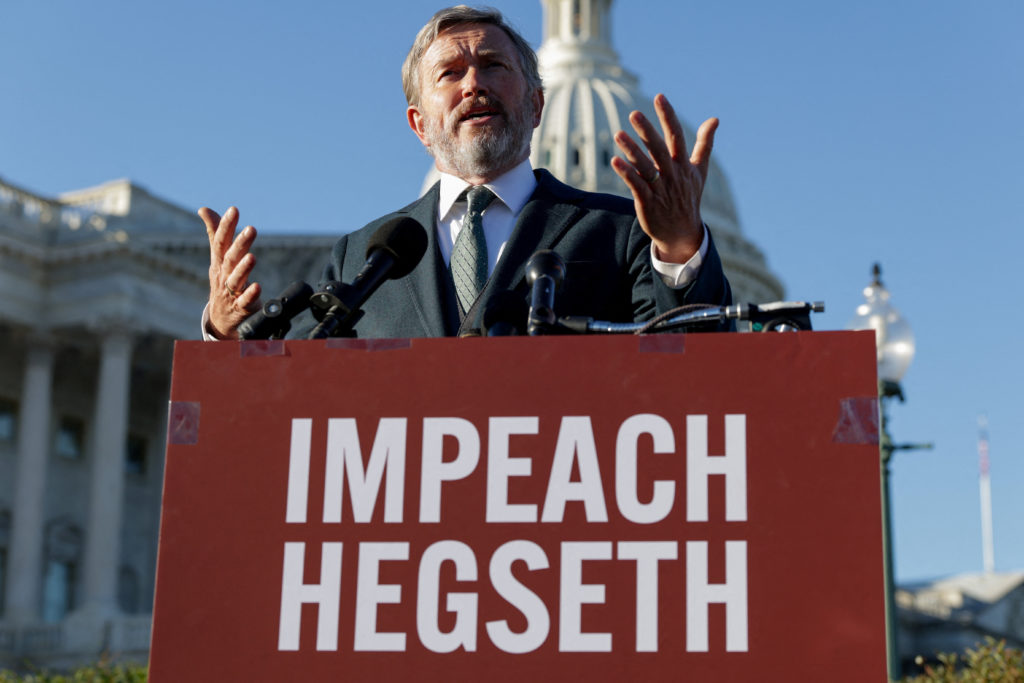
Republican Forces Impeachment Vote Against Trump's Own Defense Secretary
Intra-Party Split Detected
Rep. Thomas Massie, a Republican, is leading the impeachment push against a Trump administration official, breaking sharply with Trump and most GOP leadership; some other Republicans have also criticized Hegseth, though most of the party is expected to oppose impeachment.
Left says
- •Hegseth's conduct of the Iran war, along with strikes in Yemen and Venezuela, reflects a broader pattern of the executive branch bypassing Congress's constitutional war powers.
- •Hegseth's attempt to retaliate against Sen. Mark Kelly for reminding troops they don't have to follow illegal orders is itself a serious abuse of power and an attack on free speech and military accountability.
- •The war's fallout, including rising gas prices, contributed to major Republican losses in the midterms, suggesting the public already rendered judgment on this policy.
- •Democratic leadership's support for the resolution reflects a belief that accountability for alleged illegal military action should transcend partisan loyalty.
Right says
- •Thomas Massie is a frequent Republican dissenter who was already defeated in a primary by a Trump-backed challenger, raising questions about his motives and standing within the party.
- •President Trump's sharp personal criticism of Massie signals that this effort is viewed within the party as an act of betrayal rather than principled oversight.
- •A Senate conviction requiring 67 votes is extremely unlikely given Republican control of the chamber, making this largely a symbolic and politically disruptive gesture.
- •Hegseth's actions, including military operations against Iran, Yemen, and Venezuela, were carried out as part of the administration's broader national security strategy rather than as rogue or unlawful conduct.
Common Take
High Consensus- Massie filed eight articles of impeachment against Hegseth centered on the Iran war along with actions in Yemen and Venezuela.
- House rules required Speaker Johnson to schedule the vote within two legislative days of the resolution being read.
- The Iran conflict contributed to a spike in gas prices that factored into Republican losses in the recent midterms.
- Removal from office would require 67 Senate votes, a high bar given the current composition of the Senate.
The Arguments
Left argues
Hegseth's prosecution of military action in Iran, Yemen, and Venezuela without clear congressional authorization represents exactly the kind of unchecked executive war-making the Constitution's war powers clause was designed to prevent.
Right counters
These operations were carried out as part of a coherent national security strategy under presidential authority that past administrations of both parties have also exercised, not as rogue or uniquely illegal conduct by Hegseth personally.
Right argues
Thomas Massie was already rejected by his own party's primary voters after a Trump-backed challenge, which raises legitimate questions about whether this impeachment push is driven by principle or personal grievance against the administration that defeated him.
Left counters
A lawmaker's motives don't determine whether the underlying constitutional claims are valid; even an imperfect messenger can raise legitimate questions about war powers and retaliation against a sitting senator.
Left argues
Hegseth's attempt to retaliate against Sen. Mark Kelly for reminding troops they can refuse illegal orders is a direct attack on a bedrock principle of military accountability and on a sitting senator's free speech.
Right counters
Framing a personnel or disciplinary dispute with a political rival as a 'free speech attack' stretches the concept and conveniently serves Democrats' broader narrative against the administration.
Right argues
With a Senate conviction requiring 67 votes in a chamber Republicans control, this impeachment effort cannot realistically remove Hegseth and instead functions mainly as a disruptive, symbolic gesture that undermines party unity.
Left counters
The likelihood of acquittal doesn't negate the value of formally establishing a record of alleged illegal conduct, especially when public opinion—reflected in the midterm losses—already appears to have rendered judgment on the underlying policy.
Left argues
The midterm election losses tied to war-driven gas price spikes suggest voters have already registered disapproval of the administration's military conduct, lending democratic weight to congressional scrutiny now.
Right counters
Attributing election losses primarily to military policy oversimplifies a multi-causal result and uses an electoral setback to justify a separate, legally distinct impeachment process that should rest on its own constitutional merits.
Challenge Questions
These questions target genuine internal contradictions — meant to provoke honest reflection.
Right asks Left
“If Democratic support for this resolution is framed as principled accountability rather than partisanship, why has similar concern over unilateral military action not been raised as forcefully during previous administrations that conducted comparable strikes without formal war declarations?”
Left asks Right
“If the party's objection to Massie's effort rests on its futility and disruption rather than the substance of the allegations, does that imply the underlying claims about illegal orders and war powers violations are being left unaddressed rather than actually refuted?”
Outlier Report
Left Fringe
Figures like Rep. Rashida Tlaib or anti-war activists (e.g., CodePink) who would push for full removal and broader war-powers prosecutions represent a small, vocal minority within the left, maybe 10-15%, as most Democratic leadership (even if supportive) frame this more cautiously as oversight rather than a moral crusade.
Right Fringe
Pro-Trump commentators like Charlie Kirk or Sebastian Gorka who frame Massie as a traitor deserving expulsion or severe political punishment represent a vocal fringe, roughly 15-20% of the right, while many mainstream Republicans privately share some unease about Hegseth's conduct even if they won't say so publicly.
Noise Assessment
High noise ratio; cable news and social media amplify the spectacle of intra-party conflict far beyond what reflects sustained public attention, with most Americans only passively aware of the specifics of the impeachment articles themselves.
Sources (6)
Rep. Thomas Massie (R-Ky.) is forcing a House vote later in the week to impeach and remove Defense Secretary Pete Hegseth over his role in the Iran war, among other conflicts.
The House should vote on Massie’s resolution sometime this week.
Rep. Thomas Massie moved Monday to force a vote to impeach Defense Secretary Pete Hegseth, setting the stage for a dramatic vote on whether to remove one of the Trump administration's most prominent figures following sweeping election losses.
Rep. Thomas Massie (R-Ky.) is set to speak Monday as he pushes to force a House vote on ousting Defense Secretary Pete Hegseth. The Kentucky Republican introduced eight articles of impeachment, accusing Hegseth of violating congressional war powers, suppressing free speech and authorizing unlawful military operations, including in Iran and Venezuela. The effort comes as…
Who is the lawmaker leading the charge to impeach the secretary of defense?
Rep. Thomas Massie moved Monday to force a House vote on eight articles of impeachment against Defense Secretary Pete Hegseth, accusing him of illegally waging war against Iran and abusing his authority at the Pentagon.