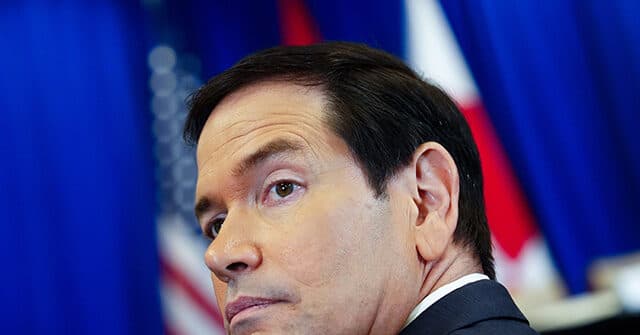
 Secretary of State Marco Rubio, who ordered the Iranian delegation to leave the U.S.
Rubio Expels Iranian Delegation as Trump Weighs 'Annihilating' Iran
Left says
- •The expulsion of Iran's delegation, including its foreign minister, signals a shift away from diplomacy at a moment when Qatari mediators were still actively working to bridge gaps between the two sides.
- •Trump's casual talk of 'blowing up' or 'annihilating' Iran after the midterms raises concerns about escalating a seven-month war without clear congressional authorization or a defined endgame.
- •Iran's proposal to reopen the Strait of Hormuz in exchange for lifting the naval blockade, removing oil sanctions, and reinstating a ceasefire represents a potential off-ramp that deserves serious engagement rather than outright rejection.
- •Tying potential military escalation to the timing of the midterm elections invites questions about whether political calculations are influencing decisions about war and peace.
Right says
- •Rubio's decision to expel the delegation reflects a reasonable judgment that Iran's negotiators had overstayed their purpose once the UN General Assembly concluded and talks produced nothing.
- •Iran's demand to control terms around the Strait of Hormuz is seen as an overreach, since U.S. officials maintain Iran does not control the waterway and cannot dictate conditions there.
- •Trump's willingness to consider further strikes reflects a position of strength, backed by months of U.S. military rebuilding, rather than empty rhetoric.
- •The regime's pattern of bad-faith negotiating, including hedging public statements while stalling behind closed doors, justifies a tougher U.S. posture and reduced patience for prolonged talks.
Common Take
High Consensus- Rubio ordered the Iranian delegation, led by Foreign Minister Abbas Araghchi, to leave New York on Monday after talks stalled.
- Qatari mediators have been shuttling a compromise proposal between the U.S. and Iran even after the expulsion.
- Iran's proposal involved reopening the Strait of Hormuz and resuming nuclear talks in exchange for the U.S. lifting its naval blockade and sanctions.
- Trump has said future strikes on Iran remain a real possibility depending on how negotiations unfold.
The Arguments
Left argues
Expelling Iran's foreign minister while Qatari mediators were actively shuttling a compromise proposal between the two sides undercuts diplomacy at a sensitive moment and risks closing off the very channel that might end a seven-month war.
Right counters
The talks had already stalled and Araghchi was reportedly scheduled to leave that night anyway, so the expulsion was more symbolic housekeeping than a real rupture in diplomacy, and Qatari mediation continued unabated afterward.
Right argues
Once the UN General Assembly concluded and the stated purpose of the delegation's visa had lapsed, ordering the Iranians to leave was a routine assertion of diplomatic protocol, not an escalation, especially since talks had produced nothing.
Left counters
Routine or not, the optics and timing matter in wartime diplomacy; publicly ejecting a counterpart's foreign minister during live negotiations sends a signal of contempt that can harden positions and make a negotiated exit from the war less likely.
Right argues
Iran's proposal conditioned reopening the Strait of Hormuz on the U.S. lifting its naval blockade and sanctions, effectively asking Washington to pay for Iran to stop obstructing a waterway it doesn't control, which is a demand U.S. negotiators were right to reject as overreach.
Left counters
Regardless of legal control over the strait, Iran has the practical capacity to disrupt shipping there through its military presence, so treating its conditions as mere posturing ignores the real leverage it holds and the reason mediators kept pursuing a deal.
Left argues
Trump tying the possibility of 'annihilating' Iran to the timing of the midterm elections raises legitimate concerns that decisions about further war and mass casualties could be shaped by domestic political calculation rather than strategic necessity.
Right counters
Trump's comments reflect strategic patience and leverage-building, not political scheduling; rebuilding the arsenal over six months and signaling resolve is a standard tool of coercive diplomacy meant to pressure Iran into real concessions before further strikes are needed.
Right argues
Iran's documented pattern of stalling in private while making conciliatory statements in public, as Araghchi did on NBC after Trump's rejection, justifies the administration's reduced tolerance for prolonged, fruitless talks and its tougher posture.
Left counters
Dismissing Iran's public statements as mere hedging forecloses the possibility that genuine openings exist, and treating every Iranian overture as bad faith becomes a self-fulfilling prophecy that forecloses off-ramps mediators are still trying to construct.
Challenge Questions
These questions target genuine internal contradictions — meant to provoke honest reflection.
Right asks Left
“If Qatari mediators were still actively negotiating a compromise text days after the expulsion, how does expelling the delegation represent a meaningful setback to diplomacy rather than a procedural formality that didn't actually interrupt the talks?”
Left asks Right
“If the administration's position is that Iran cannot be trusted to negotiate in good faith and deserves no patience, what is the actual diplomatic endgame being pursued through continued Qatari-mediated talks, and why keep negotiating at all rather than simply escalating?”
Outlier Report
Left Fringe
Figures like Rep. Ro Khanna and antiwar progressives (e.g., some in the Quincy Institute orbit) who would call for immediate diplomatic de-escalation and congressional war powers votes represent roughly 15-20% of the left, pushing a more strongly anti-interventionist stance than the mainstream Democratic position.
Right Fringe
Commentators like those at RedState explicitly calling for 'nation-wrecking' and the 'final ending of the Islamic Republic' represent a more maximalist interventionist position held by perhaps 20-25% of the right, beyond the more cautious 'peace through strength' mainstream GOP framing.
Noise Assessment
High noise ratio: much of the loudest commentary (both anti-war absolutism and 'annihilate Iran' rhetoric) is amplified by partisan media and social media accounts rather than reflecting where most ordinary Americans sit, which is a more ambivalent, war-weary but Iran-skeptical middle.
Sources (7)
<p>Secretary of State Marco Rubio demanded on Monday that the Iranian delegation to the United Nations General Assembly immediately leave the country after negotiations stalled, according to a U.S. official and a second source with knowledge of the matter.</p><p><strong>Why it matters:</strong> Though the Iranians were likely to depart soon anyway,<strong> </strong>Rubio's move was a highly unusual diplomatic rebuke and laid bare the deep distrust between the two countries amid fruitless efforts to broker an end to the war. </p><hr /><ul><li>Qatari mediators tried to secure a diplomatic breakthrough between the U.S. and <a href="https://www.axios.com/world/iran" target="_self">Iran</a> but made little progress, with neither side willing to budge.</li><li>Among those ordered to leave New York was Rubio's Iranian counterpart, Foreign Minister Abbas Araghchi.</li></ul><p><strong>What they're saying:</strong> "Secretary Rubio kicked out the Iranian delegation who had overstayed their welcome. The UN General Assembly was over, so it was time for them to go," the U.S. official said.</p><p><strong>Behind the scenes:</strong> On Monday morning, the White House thought there might be progress in talks with Iran later in the day. But by late<strong> </strong>afternoon it became clear negotiations were at a stalemate. </p><ul><li>Then on Monday evening, at Rubio's orders, the U.S. mission to the UN told the Iranian mission to the UN that Araghchi's delegation had to leave New York immediately, according to the U.S. official. </li><li>The Iranian delegation, including Araghchi, left for the airport several hours later and boarded a flight from New York to Doha at 1:20 a.m. Tuesday. </li><li>A second<strong> </strong>source confirmed that the U.S. demanded that the Iranian delegation leave, but said Araghchi was scheduled to travel back to Tehran on Monday night anyway.</li></ul><p><strong>What's next: </strong>Qatari mediators are continuing to talk to both sides about their compromise proposal, regional sources say. </p><ul><li>"Maybe I will blow 'em up," President Trump told reporters on Wednesday when asked how he can reach a deal with a regime he says is crazy. "Maybe I blow 'em up. We have to make that decision. We will blow 'em up or make a deal. But the time is coming. It's gonna end very soon one way or the other."</li></ul>
<p>One day after he rejected <a href="https://www.axios.com/2026/09/26/trump-iran-un-proposal" target="_blank">an Iranian proposal</a> to end the war, President <a href="https://www.axios.com/politics-policy/donald-trump" target="_blank">Trump</a> told Axios in a phone interview on Sunday that he expects U.S. negotiators to engage in more talks with the country this week.</p><p><strong>Why it matters:</strong> Qatar and other regional mediators are trying to revive negotiations between the U.S. and Iran, but the two sides are <a href="https://www.axios.com/2026/09/26/trump-iran-un-proposal" target="_blank">far apart</a> on the key issues.</p><hr /><ul><li>While Iran wants to focus any talks on the <a href="https://www.axios.com/2026/09/04/trump-strait-hormuz-oil-claims-iran" target="_blank">Strait of Hormuz</a> and the U.S. naval blockade, the Trump administration is demanding that Iran agree to nuclear concessions. </li><li>Two regional sources confirmed Trump's comment about more talks this week. They said they expect another round of indirect dialogue between the U.S. and Iran as early as Monday. But it isn't clear if the gaps can be bridged. </li></ul><p><strong>What he's saying:</strong> "I expect more talks with Iran [this week]. They want to make a deal, but it is not the deal that I want to make. It is what we would have maybe agreed to a year ago. They overplayed their hand," Trump said.</p><ul><li>Asked if he is considering resuming strikes against Iran, Trump said: "I am always thinking about it."</li></ul><p><strong>State of play:</strong> In the meantime, Trump said, the U.S. military is facilitating a lot of oil out of the Strait of Hormuz. </p><ul><li>He said that over the weekend the largest amount of oil transited through the strait since the war began. "More than 20 million barrels," Trump said. </li><li>A U.S. defense official confirmed Trump's assertion, saying that on Friday night 22 million barrels of oil were exported through the strait. </li></ul><p><strong>Driving the news:</strong> U.S. envoys Steve Witkoff and Jared Kushner <a href="https://www.axios.com/2026/09/22/unga-iran-us-trump-war" target="_self">held a new round of indirect negotiations</a> with Iranian Foreign Minister Abbas Araghchi on the sidelines of the UN General Assembly in New York last Tuesday.</p><ul><li>Qatari officials participated, passing messages between the two sides.</li><li>Araghchi delivered to Witkoff and Kushner Iran's conditions for reopening the Strait of Hormuz and resuming nuclear talks.</li><li>Iran proposed reopening the strait and restarting nuclear talks in a week, if the U.S. lifts its naval blockade, removes sanctions on oil sales and reinstates a ceasefire across the region.</li><li>Trump rejected the Iranian proposal on Saturday. </li></ul><p><strong>Behind the scenes:</strong> But a U.S. official and two regional sources told Axios that Qatari mediators are continuing shuttle diplomacy to try to reach a deal.</p><ul><li>On Thursday, the prime minister of Qatar met in New York with the Iranian president and discussed the potential deal with the Trump administration. </li><li>Shortly after, senior Qatari officials met Witkoff and briefed him. </li><li>A regional source with knowledge of the indirect negotiations said the Qatari mediators discussed the original Iranian proposal with both parties and provided a compromise proposal to both sides to review. </li></ul><p><strong>What to watch:</strong> Over the weekend, the Qatari mediators have been going back and forth separately with Iranian and U.S. negotiators on changes to the text. </p><ul><li>Qatari mediators are expected to meet separately with Araghchi and Witkoff as early as Monday.</li></ul><p><strong>The other side:</strong> Araghchi told NBC on Sunday that despite Trump's rejection of the Iranian proposal, Iran still wants a diplomatic solution. </p><ul><li>He said that the midterm elections aren't part of Iran's calculations. "We only care about our national interests. We are ready for negotiations," he said. </li><li>"Although we heard from President Trump that he's rejecting this deal ... we are still waiting for an official response through the mediators," Araghchi added.</li></ul>
<p><a href="https://www.axios.com/politics-policy/donald-trump" target="_blank">President Trump</a> said on Saturday that he rejected the latest Iranian proposal that was conveyed to the U.S. during indirect negotiations in New York this week.</p><p><strong>Why it matters:</strong> While Qatar and other regional mediators are trying to revive negotiations between the U.S. and Iran, the gaps on the key issues are still very wide. </p><hr /><ul><li>While Iran wants to focus any talks on the Strait of Hormuz and the U.S. naval blockade, the Trump administration demands the Iranians agree to nuclear concessions. </li></ul><p><strong>What he is saying:</strong> "They have made a proposal and I rejected it," Trump said.</p><ul><li>But a U.S. official claimed "positive and constructive" discussions are still ongoing between the U.S. and Iran through the mediators, including on nuclear issues. </li></ul><p><strong>Driving the news:</strong> U.S. envoys Steve Witkoff and Jared Kushner <a href="https://www.axios.com/2026/09/22/unga-iran-us-trump-war" target="_self">held a new round of indirect negotiations</a> with Iranian Foreign Minister Abbas Araghchi on the sidelines of the UN General Assembly in New York this week.</p><ul><li>Qatari officials participated in the negotiations, passing messages between the two parties, sources with direct knowledge said.</li><li>Araghchi gave Witkoff and Kushner Iran's conditions for reopening the Strait of Hormuz and resuming nuclear talks.</li><li>Iran proposed reopening the strait and resuming nuclear talks in a week, if the U.S. lifts its naval blockade, removes sanctions on oil sales and reinstates a ceasefire across the region.</li><li>The U.S. negotiators made it clear to the Iranians during the talks on Tuesday that Iran doesn't control the strait and therefore can't make demands about it, a source told Axios. </li></ul><p><strong>State of play:</strong> Dozens of oil tankers are transiting the strait each day under U.S. protection, moving millions of barrels of oil to global markets — still well below pre-war volumes but enough to ease some pressure.</p><ul><li>U.S. officials claim that over the last 72 hours around 60 million barrels of oil transited through the Strait of Hormuz. </li></ul>
<p>The Washington, DC, outlet Axios reported on Thursday that Secretary of State Marco Rubio personally ordered Iranian diplomats, allegedly in the United States to attend last week's U.N. General Assembly, to leave the country after low-level discussions with the U.S. failed to produce results.</p> <p>The post <a href="https://www.breitbart.com/middle-east/2026/10/01/report-rubio-kicks-iran-diplomats-out-after-they-overstayed-their-welcome-in-nyc/" rel="nofollow">Report: Rubio Kicks Iran Diplomats Out After They ‘Overstayed Their Welcome’ in NYC</a> appeared first on <a href="https://www.breitbart.com" rel="nofollow">Breitbart</a>.</p>
Marco Rubio ordered Iran's delegation to leave New York after talks stalled, as President Donald Trump warned ramped-up bombing is "possible."
Secretary of State Marco Rubio ordered the Iranian delegation to leave the U.S. immediately Monday after the United Nations General Assembly as negotiations between both countries have stalled. The Hill’s broadcast partner NewsNation on Thursday confirmed this with the State Department, which previously approved visas for the “core” Iranian delegation to the U.N. last month.…