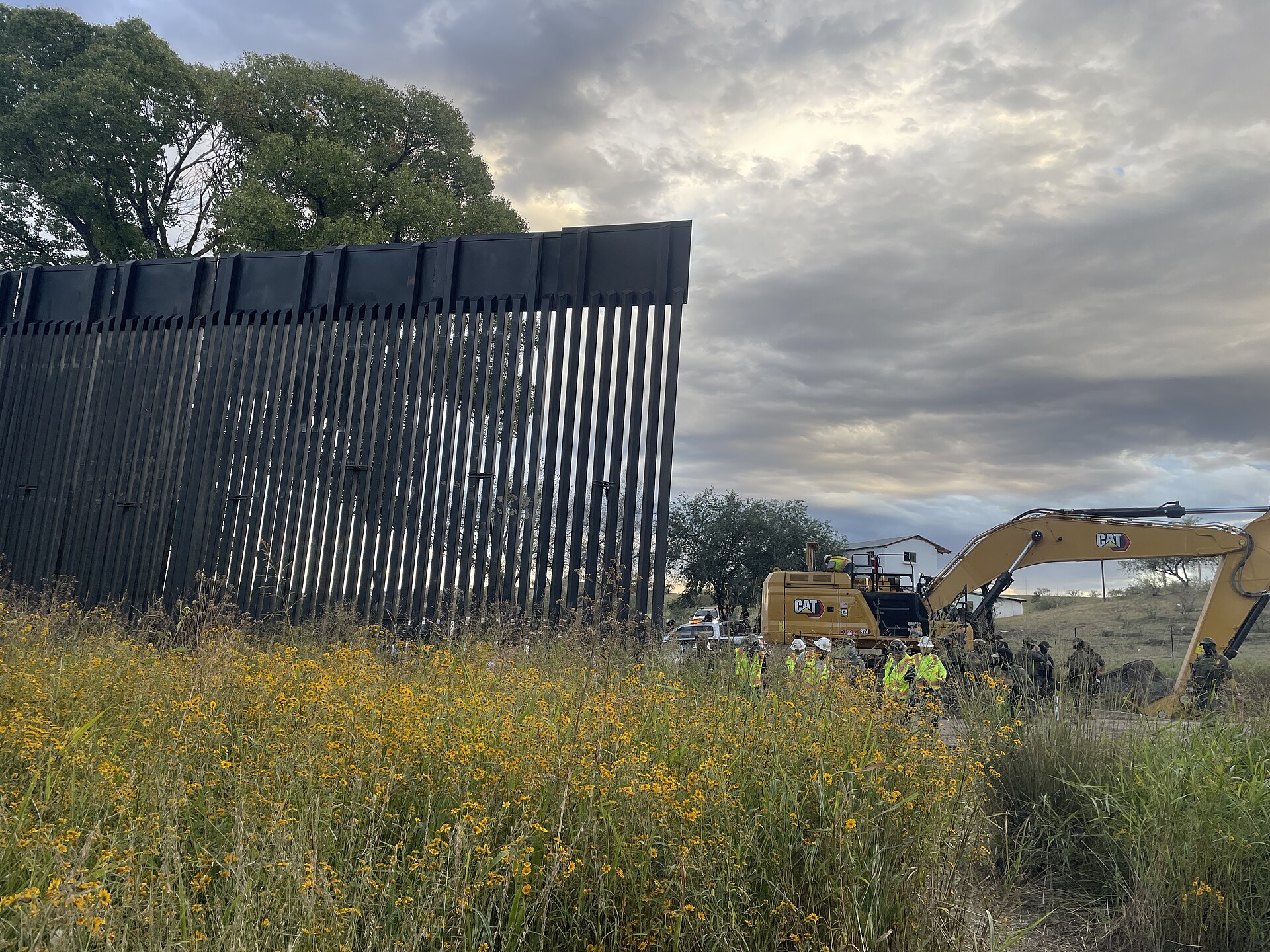
SCOTUS Lets Trump Build Border Wall Through National Park
Intra-Party Split Detected
Judge Kathleen Cardone, a George W. Bush appointee, issued the injunction blocking construction that the Supreme Court later overturned, indicating some divergence among Republican-appointed jurists on the legal merits, though the broader conservative legal and political establishment strongly backed the administration's position.
Left says
- •The 8-1 ruling lets the administration bypass environmental and conservation laws via a 1996 waiver provision, undermining judicial oversight of agency power in one of the few remaining stretches of undeveloped borderland.
- •Big Bend Sector accounted for just 1.3% of border apprehensions in 2025, raising questions about whether the administration's 'high illegal entry' designation is factually justified rather than politically motivated.
- •A Terlingua river guide, a historic church preservation group, and local landowners like Charlie Angell face property seizure and loss of livelihood, with one business owner describing the toll on his retirement and life's work.
- •The decision strips district courts of meaningful jurisdiction to review major questions doctrine claims, limiting a key check on executive authority even when constitutional separation-of-powers concerns are raised.
Right says
- •Congress explicitly authorized the Homeland Security secretary to waive environmental and conservation laws in IIRIRA, and the Court found this reflects a clear legislative preference for expeditious border construction over aesthetic or recreational objections.
- •The government presented data showing roughly 89,000 apprehensions and significant drug seizures in the Big Bend sector from fiscal years 2021-2025, supporting the designation of the area as one of high illegal entry.
- •Blocking construction was costing taxpayers nearly half a million dollars per day in unrecoverable costs, and the Court found the balance of equities favored resuming work while litigation continues.
- •The administration scaled back its original plans after public feedback, opting for vehicle barriers, roads, and surveillance technology rather than a full pedestrian wall within the national park itself.
Common Take
High Consensus- The Supreme Court ruled 8-1, with only Justice Ketanji Brown Jackson dissenting without a written explanation.
- The case centers on whether the 1996 Illegal Immigration Reform and Immigrant Responsibility Act gives the DHS secretary authority to waive environmental and conservation laws for border construction.
- Construction plans span roughly 500 miles and include physical barriers, access roads, and surveillance technology, with a scaled-back approach inside Big Bend National Park itself.
- Local residents, including a river guide and landowners, along with environmental and historic preservation groups, raised concerns about the project's impact on their land and the region's natural and cultural resources.
- The underlying legal challenge continues in lower courts even though construction can now resume.
The Arguments
Left argues
Big Bend Sector accounted for just 1.3% of border apprehensions in 2025, suggesting the 'high illegal entry' designation used to trigger waiver authority may be a pretext rather than a data-driven necessity.
Right counters
The government's cited figures—roughly 89,000 apprehensions and significant drug seizures across fiscal years 2021-2025—reflect a multi-year trend, not a single snapshot, and Congress gave the secretary, not courts, the discretion to weigh that record.
Right argues
Congress explicitly wrote IIRIRA §102(c) to let the Homeland Security secretary waive environmental and conservation laws for border construction, and courts of equity cannot override a balance that Congress itself already struck in statute.
Left counters
That same statutory logic is being used to strip district courts of jurisdiction even over constitutional separation-of-powers claims, effectively insulating sweeping executive action from any meaningful judicial check.
Left argues
Real people—a Terlingua river guide, a historic church preservation group, and landowners like Charlie Angell—face property seizure, severed access to the Rio Grande, and the loss of life's-work businesses, harms the Court dismissed as merely 'aesthetic' and 'recreational.'
Right counters
Congress anticipated exactly this kind of individualized hardship when it crafted a waiver provision prioritizing expeditious border security over localized harms, and the administration has already softened its plans inside the park itself by dropping the full pedestrian wall.
Right argues
The injunction was costing taxpayers nearly half a million dollars per day in unrecoverable costs, and the Supreme Court correctly found that equity favored letting construction resume while the underlying legal questions are litigated.
Left counters
Cost and urgency arguments shouldn't determine whether a district court has jurisdiction to hear a constitutional challenge in the first place—efficiency concerns are being used to foreclose judicial review before the merits are even decided.
Left argues
By reading the major questions doctrine challenge as non-constitutional and thus outside district court jurisdiction, the ruling narrows one of the few remaining avenues for checking expansive executive claims of regulatory waiver power.
Right counters
The Court wasn't closing off all review—it was applying Congress's explicit, narrow limitation on judicial review to constitutional claims only, which is a statutory design choice, not a judicial power grab.
Challenge Questions
These questions target genuine internal contradictions — meant to provoke honest reflection.
Right asks Left
“If Congress has the constitutional authority to pass IIRIRA and explicitly delegate waiver power to the executive, on what basis should unelected judges substitute their own balancing of environmental versus security interests for the one Congress already enacted into law?”
Left asks Right
“If the administration's own data shows Big Bend accounted for only 1.3% of apprehensions nationwide, and it already scaled back wall plans in the park after public pressure, what does that say about whether 'high illegal entry' is being applied as a genuine threshold or as a flexible label to justify whatever construction is politically desired?”
Outlier Report
Left Fringe
Groups like the Center for Biological Diversity and figures such as Rep. Alexandria Ocasio-Cortez represent a faction (roughly 15-20% of the left) that frames this primarily as environmental devastation and executive overreach, sometimes minimizing border security concerns entirely.
Right Fringe
Figures like Stephen Miller and some Breitbart/Daily Caller commentators represent a faction (roughly 15-20% of the right) that frames any judicial or environmental objection as illegitimate obstruction, dismissing property rights and environmental concerns as bad-faith political theater.
Noise Assessment
Significant amplification from national political media and advocacy groups on both sides, but most ordinary Americans likely have only passing awareness of the Big Bend specifics, relying instead on pre-existing views about border walls and Trump immigration policy.
Sources (12)
Ruling said law enacted by Congress reflects preference for border control over environmental and recreational harm
The construction will include physical walls, access roads and vehicle barriers, according to Trump administration plans.
<p>The Supreme Court ruled that the Trump administration can resume building a border wall through the Big Bend region of West Texas.</p> <p>The post <a href="https://www.breitbart.com/immigration/2026/11/09/supreme-court-lifts-order-blocking-trumps-big-bend-border-wall/" rel="nofollow">Supreme Court Lifts Order Blocking Trump’s Big Bend Border Wall</a> appeared first on <a href="https://www.breitbart.com" rel="nofollow">Breitbart</a>.</p>
‘compelling interests’
The Supreme Court lifted a federal injunction blocking Trump border wall construction in the Big Bend Sector, but environmental groups' lawsuit continues.
<p>Blocking construction "impedes the Government from advancing its 'compelling interests' in border security and integrity."</p> The post <a href="https://legalinsurrection.com/2026/11/supreme-court-pauses-block-on-trumps-border-wall-construction-in-texas/">Supreme Court Pauses Block on Trump’s Border Wall Construction in Texas</a> first appeared on <a href="https://legalinsurrection.com">Le·gal In·sur·rec·tion</a>.
The Trump administration has the green light to continue building a border wall in the Big Bend region of Texas after a Supreme Court ruling Monday. Plaintiffs seeking to block construction of the wall argued that it threatened the landscape of Big Bend National Park, which historically did not have high rates of illegal immigration,...
<img alt="Wall construction on U.S.-Mexico border." class="webfeedsFeaturedVisual wp-post-image" src="https://thefederalist.com/wp-content/uploads/2026/10/Border-Wall-1200x675.jpg" style="display: block; margin: auto; margin-bottom: 5px;" />'The Government’s interest therefore outweighs any aesthetic, recreational, and environmental harm alleged by respondents.'
<p>Ruling said law enacted by Congress reflects preference for border control over environmental and recreational harm</p><p>The US supreme court has allowed Donald Trump to continue his administration’s construction of a border wall in Texas’s Big Bend region, including parts of Big Bend national park.</p><p>In an unsigned, five-page <a href="https://s3.documentcloud.org/documents/28876645/order-in-26a560.pdf">ruling</a>, the nation’s highest court granted the Trump administration’s emergency request to suspend a lower court order that had <a href="https://www.theguardian.com/us-news/2026/oct/02/big-bend-national-park-border-wall-halt">temporarily stopped</a> the project last month.</p> <a href="https://www.theguardian.com/us-news/2026/nov/09/us-supreme-court-border-wall-texas-big-bend">Continue reading...</a>
The Supreme Court is allowing border barrier construction to continue in and around Big Bend National Park in Texas, in a win for the Trump administration.  The justices on Monday halted a lower court’s decision last month to pause the construction while the underlying case against it plays out.  In a brief statement outlining its…
The Supreme Court gave the Trump administration the OK on Monday to resume building border wall in Texas' Big Bend area, including through the rugged national park, setting aside a lower court's injunction.