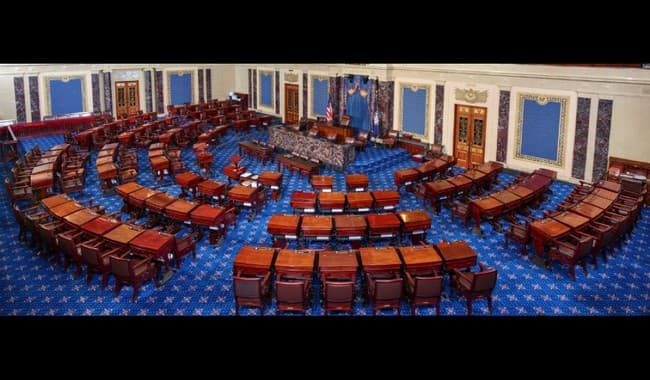
 The Senate chamber where the bipartisan deal blocking Trump's measures was reached.
Senate Blocks Trump Battleships, Grant Overhaul in Bipartisan Deal
Intra-Party Split Detected
Most Republicans and Democrats backed the bipartisan stopgap (90-6), but a small faction dissented: conservative Sen. Rand Paul opposed it over lack of spending cuts and some Republicans objected to the hemp provision, while progressives Sanders, Warren, and Markey opposed it from the left, and Sen. Kaine broke with Democrats over war funding concerns.
Left says
- •Blocking the OMB rule change prevents political appointees from reviewing and potentially canceling federal grants based on whether they align with the president's agenda, which Democrats warn could be used to strip funding from disfavored programs or states.
- •Closing the loophole that would have let the administration divert money from other programs to Border Patrol reflects Democrats' broader push to constrain what they see as executive overreach on immigration enforcement funding.
- •Rejecting the $1 billion request for new 'Trump-class' battleships is framed as fiscal responsibility, with critics arguing the project serves the president's personal branding rather than genuine national security needs.
- •Securing these provisions gives Democrats leverage to negotiate a fuller budget after the midterms that addresses affordability and reins in what they describe as chaotic or unchecked administration spending decisions.
Right says
- •Avoiding a shutdown before the midterms reflects responsible governance and keeps campaign season focused on voters' priorities rather than a Washington funding crisis.
- •Senate Republican leadership pursued a bipartisan deal to meet the 60-vote threshold, showing a pragmatic willingness to compromise rather than force a confrontation.
- •Some conservatives are uneasy that the bill concedes ground on the grant oversight rule, seeing it as a missed opportunity to ensure taxpayer-funded grants align with the administration's priorities.
- •The one-month delay on the hemp product ban drew criticism from Republicans concerned about products marketed in ways that could appeal to children, showing the deal wasn't universally popular even within the GOP.
Common Take
High Consensus- The Senate passed the stopgap funding bill 90-6, reflecting overwhelming bipartisan support.
- The bill funds the government at current levels through Dec. 11, avoiding a shutdown before the Sept. 30 fiscal year deadline.
- Both parties wanted to avoid a repeat of the two shutdowns from the past year, especially heading into a contentious midterm election season.
- The bill still needs House approval, and it's uncertain whether the House will accept the Senate's version given the House already passed a different continuing resolution.
The Arguments
Left argues
Blocking the OMB rule change prevents political appointees from reviewing federal grants for alignment with the president's agenda, which Democrats warn could let the administration cancel funding for disfavored programs or states without a legislative check.
Right counters
Some conservatives argue the administration should have latitude to ensure taxpayer-funded grants reflect the priorities of the elected executive branch, and see the delay as Democrats obstructing legitimate oversight of how discretionary funds are spent.
Right argues
Senate Republican leadership pursued a bipartisan, 60-vote-threshold deal to avoid a shutdown before the midterms, reflecting pragmatic governance that keeps the campaign focused on voters' concerns rather than a Washington funding crisis.
Left counters
Democrats argue this pragmatism only came because they had leverage to force real concessions—like blocking the grant rule and closing the Border Patrol funding loophole—showing the deal reflects negotiated wins, not simply GOP goodwill.
Left argues
Rejecting the $1 billion request for new 'Trump-class' battleships reflects fiscal responsibility, with critics like Schumer arguing the project primarily serves the president's personal branding rather than a demonstrated national security need.
Right counters
Defenders of a stronger naval posture could argue that investing in new ship classes is a legitimate long-term defense priority, and that dismissing it as vanity branding ignores broader strategic modernization goals the administration says are necessary.
Right argues
Some conservatives are uneasy that the bill concedes ground on the grant oversight rule, viewing it as a missed opportunity to ensure federal grants align with the administration's agenda and a sign GOP leadership gave away leverage too easily.
Left counters
Democrats counter that the rule was so broadly written it risked becoming a tool for arbitrary defunding of programs or states based on political disfavor, making the delay a necessary guardrail rather than a concession of substance.
Right argues
The one-month delay on the hemp product ban drew criticism from Republicans worried about products marketed in ways that could appeal to children, showing the deal wasn't universally popular even within the GOP and reflects real policy trade-offs made for speed.
Left counters
Democrats and bill negotiators would argue a short, one-month delay is a minor procedural accommodation to work out implementation details, not an abandonment of child-safety concerns, especially compared to the larger wins secured in the bill.
Challenge Questions
These questions target genuine internal contradictions — meant to provoke honest reflection.
Right asks Left
“If Democrats say this short-term deal gives them leverage to fight 'chaotic' executive spending after the midterms, doesn't blocking the grant rule now—rather than legislating a permanent statutory fix—suggest they're relying on temporary procedural wins instead of durable policy change?”
Left asks Right
“If Senate GOP leadership touts this deal as pragmatic bipartisan governance, how do you reconcile that with conservative critics who see the same deal as an unnecessary surrender of executive authority over grantmaking?”
Outlier Report
Left Fringe
Senators Bernie Sanders and Elizabeth Warren voted no from the left, arguing the deal didn't go far enough in constraining executive power or securing progressive priorities; they represent roughly 5-10% of the Democratic base.
Right Fringe
Senator Rand Paul and some House Freedom Caucus members criticize the deal for failing to cut spending or fully block the grant oversight rule, representing about 10-15% of the GOP base who prioritize fiscal hawkishness over political loyalty to Trump's agenda.
Noise Assessment
Moderate; much of the intense rhetoric (e.g., Schumer's 'golden ships' comment, conservative hemp policy backlash) is amplified political theater rather than reflecting deep public engagement, as most Americans are largely indifferent to procedural budget details and more focused on avoiding disruption.
Sources (10)
The Senate has passed a short-term measure to keep federal agencies funded into early December and avoid a government shutdown during campaign season
<p>The Senate passed a stopgap spending bill early Saturday that would keep the government funded through Dec. 11, <a href="https://www.axios.com/2026/08/07/senate-republicans-august-recess-hemp-save-act-crypto" target="_blank">moving Washington</a> closer to avoiding <a href="https://www.axios.com/2026/07/22/senate-government-shutdown-democrats-republicans" target="_blank">another shutdown</a> before the November midterms.</p><p><strong>Why it matters:</strong> The bipartisan 90-6 vote would push the next government funding deadline past Election Day while offering some checks on the Trump administration.</p><hr /><p><strong>State of play:</strong> The measure, which now goes to the House, generally maintains funding levels after the fiscal year ends Sept. 30, with a few negotiated exceptions.</p><ul><li>It blocks the administration from implementing a proposed rule to give senior political appointees a larger role in reviewing federal grants, the Associated Press <a href="https://apnews.com/article/government-funding-shutdown-cr-a50b86875105a299498b846184a3736d#:~:text=Democrats%20secured%20language%20to%20ensure%20no%20money%20could%20be%20transferred%20to%20the%20Border%20Patrol." target="_blank">reported</a>.</li><li>It prevents the administration from transferring money from other programs to the Border Patrol.</li><li>It rejects a White House request for $1 billion to begin work on President Trump's proposed new class of battleships.</li><li>And it <a href="https://www.axios.com/2026/08/05/trump-ted-budd-senate-republicans-hemp" target="_blank">delays for one month</a> a looming ban on intoxicating hemp products, an issue that divided Senate Republicans.</li></ul><p><strong>Zoom in:</strong> The grants provision could prove one of the more consequential pieces of the short-term bill.</p><ul><li>The Office of Management and Budget <a href="https://www.axios.com/2026/07/09/omb-grant-overhaul-pushback" target="_blank">proposed</a> rewriting rules in May to require senior political appointees review and consider whether discretionary grants advance the president's agenda.</li></ul><p><strong>The big picture:</strong> The Senate worked through the night, taking votes on the stopgap funding measure, the confirmation of Attorney General Todd Blanche and a failed voter ID measure, which would change voting requirements.</p><ul><li>The vote reflects how eager lawmakers in both parties are to avoid putting another shutdown at the center of an election campaign.</li></ul><p><strong>What's next:</strong> The House will have to approve the Senate's changes after lawmakers return from their August recess.</p><ul><li>If it does, Washington will have traded a possible pre-election shutdown fight for a potentially much larger post-election showdown in December over spending levels, Trump's grantmaking powers and the rest of the unfinished fiscal 2027 appropriations process.</li></ul>
The measure was approved in a 90 to 6 vote and now goes to the House.
The Republican-led U.S. Senate passed a temporary measure to fund federal agencies through December 11 on Saturday, in a move intended to avert a crippling federal government shutdown weeks before the November midterm elections. The Republican-controlled House of...
The move came more than a month before the spending deadline, reflecting an eagerness in both parties to avoid a messy fight before the midterm elections.
<p>Bill must still be approved by House but would keep government running at current funding levels</p><p>The US Senate on Friday passed a government funding bill that will prevent a shutdown through the midterm elections, though it still must be approved by the House of Representatives.</p><p>The continuing resolution (CR) passed by a 90-6 vote will keep the government running at its current funding levels until 11 December, more than a month past the midterms in which Democrats are hoping to regain control of Congress and block Donald Trump’s legislative agenda for the final two years of his presidency.</p> <a href="https://www.theguardian.com/us-news/2026/aug/08/government-shutdown-vote-senate-funding-bill">Continue reading...</a>
Senators wrapped up a busy final stretch of work early Saturday, confirming Todd Blanche to lead the Justice Department (DOJ) and passing a stopgap funding bill before adjourning for the August recess. Blanche, President Trump’s former personal attorney, has served as acting attorney general since April and was confirmed in a narrow 50-49 vote. Sens.…
The Senate voted early Saturday morning to fund the federal government until Dec. 11 with the aim of averting another government shutdown before the midterm election, sending the bill to the House before leaving for a five-week recess. The continuing resolution (CR) passed 90-6 after Republicans spent days haggling over a provision inserted by the White House…
The Senate in an overnight vote Saturday approved a short-term measure to fund federal agencies into early December and avoid a potentially chaotic government shutdown during the middle of campaign season.