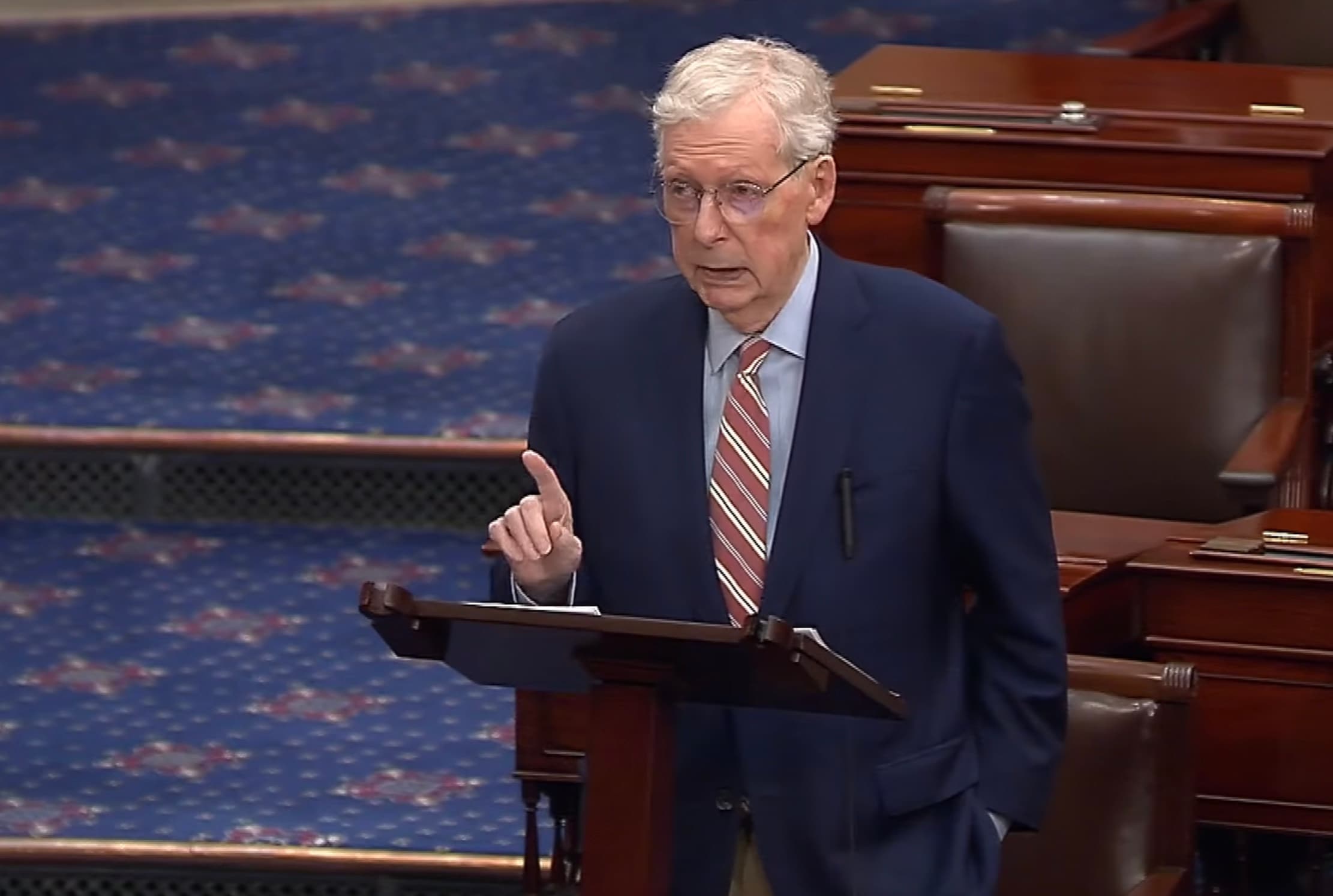
 Senator speaking at podium during Senate floor debate
Senate Fails to Advance Iran War Powers Resolution
Intra-Party Split Detected
Rand Paul was the only Republican supporting the war powers resolution to limit Trump's Iran military actions
Left says
- •Congress must reassert its constitutional authority over war powers and prevent unilateral military action without proper legislative approval
- •The failure to advance this resolution effectively gives the administration a blank check to escalate military conflict
- •Republican senators are abandoning their constitutional duty to provide oversight and check executive power when it comes to military engagement
Right says
- •The Senate debate devolved into incoherent political theater with senators more focused on domestic talking points than serious national security discussion
- •Many Democrats are using the war powers resolution as a vehicle for unrelated political messaging rather than genuine concern about military policy
- •The administration needs flexibility to respond to threats without being hamstrung by lengthy congressional processes that could compromise national security
Common Take
High Consensus- The Senate's debate process appeared disorganized and unfocused on the core war powers issues
- Constitutional questions about the balance between executive and legislative authority in military matters remain unresolved
- Senators from both parties expressed concerns about the seriousness and coherence of the legislative process
The Arguments
Left argues
The Constitution explicitly grants Congress the power to declare war, and allowing the executive branch to conduct military operations without legislative approval fundamentally undermines this constitutional separation of powers and democratic accountability.
Right counters
Modern warfare requires rapid response capabilities that congressional deliberation cannot provide, and the administration already operates within existing legal frameworks like the Authorization for Use of Military Force that Congress previously approved.
Right argues
The Senate debate demonstrated that many Democrats are exploiting national security issues for domestic political gain, with senators using war powers discussions as platforms for unrelated campaign talking points about healthcare and economic inequality.
Left counters
Connecting military spending to domestic priorities is legitimate oversight, as Congress must weigh the full costs of war against other national needs, and questioning executive war powers is precisely the constitutional role senators should fulfill.
Left argues
The failure to advance this resolution effectively gives the administration unlimited authority to escalate military conflict, creating a dangerous precedent where future presidents can wage war without meaningful congressional constraint or public debate.
Right counters
The administration already faces significant legal and political constraints on military action, and overly restrictive congressional micromanagement could telegraph American intentions to adversaries and compromise operational security.
Right argues
Congressional war powers resolutions often become performative political theater that weakens America's negotiating position internationally by signaling internal division and limiting the president's ability to respond decisively to threats.
Left counters
Democratic debate and legislative oversight actually strengthen America's position by ensuring military actions have broad public support and legitimacy, while unchecked executive power has historically led to costly military overreach.
Challenge Questions
These questions target genuine internal contradictions — meant to provoke honest reflection.
Right asks Left
“If congressional oversight of war powers is so crucial, why do many Democrats simultaneously refuse to fund DHS agencies while demanding more oversight of military operations - doesn't this suggest they're more interested in political obstruction than genuine constitutional governance?”
Left asks Right
“If executive flexibility in military matters is essential for national security, how do you reconcile supporting broad presidential war powers with traditional conservative principles of limited government and strict constitutional interpretation?”
Outlier Report
Left Fringe
Progressive caucus members who would demand immediate Pentagon funding cuts and complete military withdrawal represent approximately 15-20% of the Democratic coalition, though specific names aren't provided in these articles.
Right Fringe
Rand Paul, explicitly named as the only Republican supporting the war powers resolution, represents roughly 5-10% of Senate Republicans willing to break with Trump on Iran military action. Traditional isolationist Republicans like Thomas Massie likely align with this position.
Noise Assessment
High performative element evident in The Federalist's characterization of 'senile men shouting at sky' and senators giving campaign speeches during war debates, suggesting significant theatrical posturing rather than substantive policy debate.
Sources (7)
<img alt="In a dark suit, Senator Mitch McConnell speaks behind a lectern on the Senate floor." class="webfeedsFeaturedVisual wp-post-image" src="https://thefederalist.com/wp-content/uploads/2026/03/mitch-1200x675.jpg" style="display: block; margin: auto; margin-bottom: 5px;" />If the United States Senate can figure out who's responsible for all these unfortunate wars over the last couple of decades, somebody's really gonna hear about it.
House Democratic Leader Hakeem Jeffries (N.Y.) on Sunday did not commit to either supporting or opposing additional funding for the Pentagon amid the war in Iran. “We’ll cross that bridge when we get to it in terms of if the administration makes a request to Congress to consider additional funding,” Jeffries told host Kristen Welker…
A week after President Trump launched strikes against Iran, Democrats are digging in against reopening the Department of Homeland Security (DHS) without significant reforms to the agency. Party leaders are amplifying their demands for tougher rules governing agents of U.S. Immigration and Customs Enforcement (ICE) and Customs and Border Protection (CBP). Rank-and-file Democrats appear to…
Sen. Tim Kaine (D-Va.) on Sunday said Democrats want to fund several agencies housed under the Department of Homeland Security (DHS) with the exception of Immigration and Customs Enforcement (ICE) and Customs and Border Protection (CBP). “Let’s just pass those funding bills. Let’s confine the ICE and CBP reform discussion just to those two agencies…
Sen. Tim Kaine (D-Va.) on Sunday said White House deputy chief of staff Stephen Miller was “calling the shots” at the Department of Homeland Security (DHS) under DHS Secretary Kristi Noem, and he said Miller will continue to remain in control after her departure. Noem was ousted from her role on Thursday after facing months…
While Department of Homeland Security (DHS) Secretary Kristi Noem will soon depart her Cabinet-level post, Sen. Thom Tillis (R-N.C.) also wants White House deputy chief of staff Stephen Miller to leave President Trump’s inner circle. Tillis told CNN’s Jake Tapper on “State of the Union” on Sunday that Miller, a longtime adviser to Trump dating…
Republican Sen. Thom Tillis (N.C.) said Sunday his party has “lost the debate” on immigration, days after President Trump tapped Sen. Markwayne Mullin (R-Okla.) to replace Department of Homeland Security (DHS) Secretary Kristi Noem. “We’ve lost the debate over immigration and deportations. I believe that we should deport everyone that we can find that came…