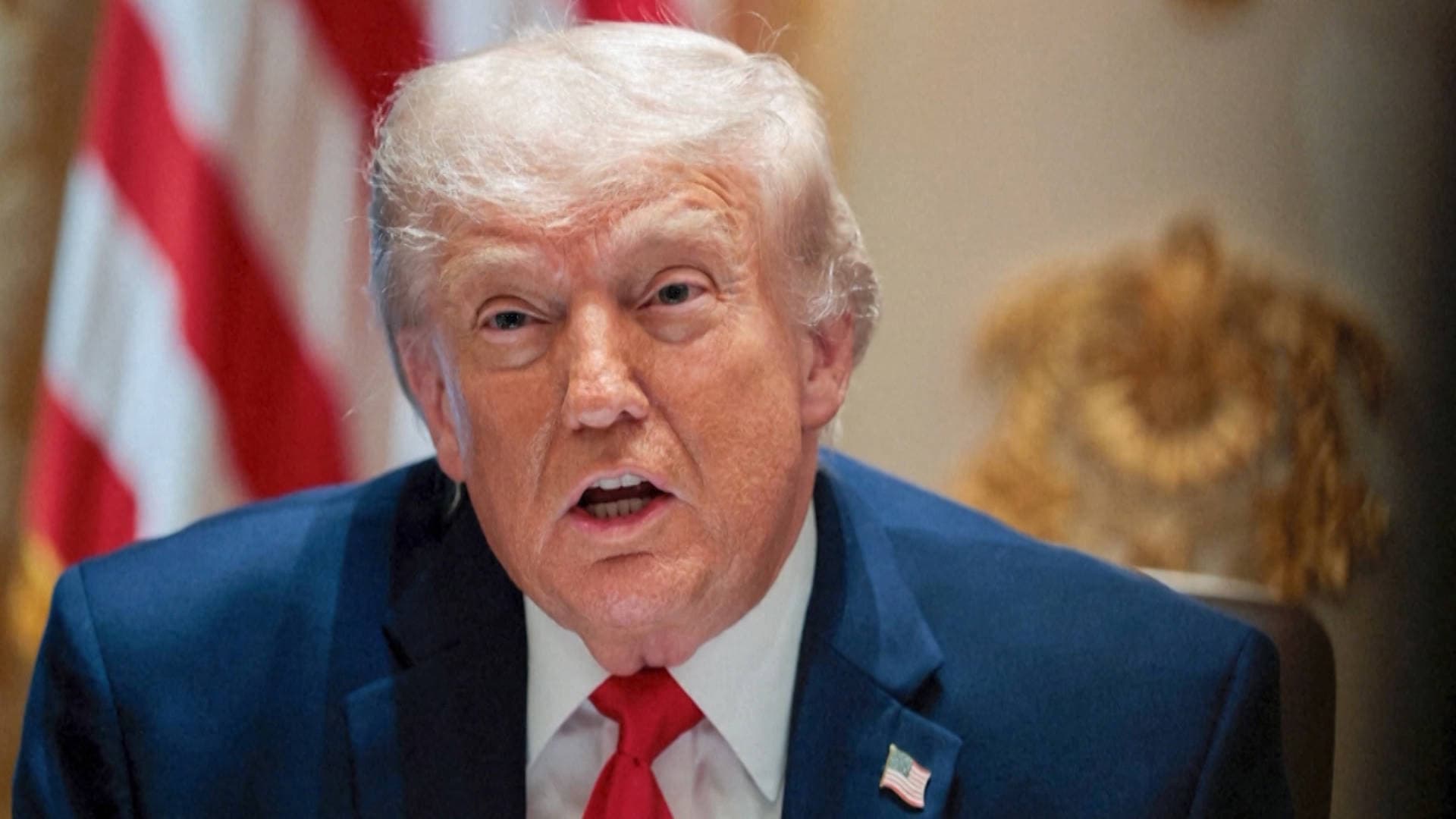
 Donald Trump speaking, with American flag in background
Senate Republicans Split Over Trump's $1.8B 'Anti-Weaponization' Fund
Intra-Party Split Detected
Multiple GOP senators opposed Trump's anti-weaponization fund, with some voting against it and others expressing private skepticism about Trump's political judgment
Left says
- •The fund operates as an unprecedented slush fund with no congressional authorization, allowing the attorney general to handpick commissioners who decide payouts without appeal or public disclosure requirements
- •January 6th rioters who attacked police officers and threatened democracy could receive taxpayer compensation, rewarding those who made credible death threats against law enforcement
- •The settlement represents potential fraud on the court since Trump was essentially suing himself as president, controlling both sides of the lawsuit against his own administration
- •Federal judges have temporarily blocked the fund and former prosecutors are challenging its constitutionality as a violation of separation of powers
Right says
- •The fund addresses legitimate concerns about government weaponization against conservatives who faced politically motivated investigations and prosecutions during previous administrations
- •Senate Republicans successfully passed $70 billion in immigration enforcement funding despite internal disagreements, demonstrating party unity on border security priorities
- •The administration has indicated flexibility by saying the fund will not move forward, showing responsiveness to congressional concerns while maintaining focus on core immigration policies
- •An independent five-member commission would make decisions about compensation, providing oversight rather than direct political control over disbursements
Common Take
High Consensus- The Senate passed the $70 billion immigration enforcement package with a 52-47 vote, funding ICE and Border Patrol through 2029
- Multiple Republican senators expressed concerns about the anti-weaponization fund, creating bipartisan opposition to the proposal
- Acting Attorney General Todd Blanche announced the Justice Department would not move forward with the controversial fund
- Federal courts have issued temporary restraining orders blocking implementation of the fund pending legal challenges
The Arguments
Right argues
The fund addresses legitimate concerns about government weaponization against conservatives who faced politically motivated investigations and prosecutions during previous administrations, with an independent five-member commission providing oversight rather than direct political control.
Left counters
The attorney general handpicks all five commissioners with no congressional authorization, creating an unprecedented slush fund where decisions cannot be appealed or challenged in court, and there are no public disclosure requirements for payouts.
Left argues
The settlement represents potential fraud on the court since Trump was essentially suing himself as president, controlling both sides of the lawsuit against his own administration while the IRS operates under executive branch authority.
Right counters
The administration has demonstrated responsiveness to congressional concerns by indicating the fund will not move forward, showing flexibility while maintaining focus on core immigration enforcement priorities that successfully secured $70 billion in funding.
Left argues
January 6th rioters who attacked police officers and threatened democracy could receive taxpayer compensation, potentially rewarding those who made credible death threats against law enforcement officers who defended the Capitol.
Right counters
An independent commission would evaluate each case individually based on evidence of government overreach, ensuring that only legitimate victims of political persecution receive compensation rather than blanket payments to any particular group.
Right argues
Senate Republicans successfully demonstrated party unity by passing $70 billion in immigration enforcement funding despite internal disagreements, showing they can prioritize border security while addressing concerns about specific provisions.
Left counters
Multiple Republican senators voted against the fund provisions, and federal judges have temporarily blocked it while former prosecutors challenge its constitutionality as a violation of separation of powers, indicating serious legal and political problems.
Challenge Questions
These questions target genuine internal contradictions — meant to provoke honest reflection.
Right asks Left
“If the fund is truly unconstitutional and represents fraud on the court, why did it take weeks of political pressure rather than immediate legal action to halt it, and doesn't this suggest the legal objections may be more about policy disagreement than genuine constitutional violations?”
Left asks Right
“If the administration was genuinely responsive to congressional concerns by abandoning the fund, why did Trump himself later defend it as a 'great idea,' and how does this square with claims that the fund represented good-faith governance rather than political reward-giving?”
Outlier Report
Left Fringe
Progressive activists like Alexandria Ocasio-Cortez and groups like Democracy Forward who frame this as part of broader authoritarian takeover represent about 15% of the left with their most extreme constitutional crisis rhetoric.
Right Fringe
MAGA loyalists like Steve Bannon and some Freedom Caucus members who fully defend the fund as necessary justice for persecuted conservatives represent about 25% of the right, while most Republicans privately have concerns about the optics and process.
Noise Assessment
Moderate noise level - while partisan media amplifies the extremes, the core concerns about transparency and fiscal responsibility reflect genuine mainstream public sentiment rather than manufactured outrage.
Sources (11)
Senate Republicans managed to stitch together a unified front to advance President Donald Trump's roughly $70 billion immigration enforcement package, but divisions over the president's agenda were laid bare after a marathon day of votes. Passage of the budget reconciliation package geared toward funding Immigration and Customs Enforcement (ICE) and Border Patrol for the next three and a half years closes a long, drawn out chapter in the Senate that began during the longest shutdown in history...
The Senate passed the $69.5 billion reconciliation package to fund immigration enforcement Friday after an anti-weaponization fund and White House ballroom funding threatened its passage. The Senate passed the package in a 52-47 vote, which would provide over $30.73 billion to Immigration and Customs Enforcement (ICE), $22.57 billion to Customs and Border Protection (CBP) and $2.5 billion in Department of Homeland Security (DHS) appropriations through 2029. The passage didn't meet President Donald Trump's June 1 deadline after the administration's $1.8 billion anti-weaponization fund threatened its passage...
The Senate voted early Friday morning to pass a $69.5 billion budget reconciliation package to fund immigration enforcement operations through 2029, overcoming the concerns of several Republicans who were upset the bill did not include language barring the Trump administration from creating a $1.8 billion "anti-weaponization" fund to pay MAGA allies. The legislation passed 52-47, taking Republicans one big step closer to ensuring that Immigration and Customs Enforcement (ICE) and Border Patrol are funded through the end of President Trump's second term...
The US Senate passed legislation to fund Donald Trump's controversial immigration crackdown early on Friday morning. The 52-47 vote on funding for US Immigration and Customs Enforcement (ICE) and the Department of Homeland Security (DHS) passed with no Democratic support at 5am, after a marathon session of votes to knock down proposed amendments. Senator Lisa Murkowski of Alaska was the only Republican who voted against the bill, which used a budget reconciliation process to sidestep the Democratic filibuster. The bill would give the DHS another $70bn to fund immigration enforcement through the remainder of Trump's term as US president...
<p>Senate Republicans advanced <a href="https://www.axios.com/2026/05/21/trump-weaponization-fund-senate-ice-funding" target="_blank">ICE and Border Patrol funding</a> through the end of President Trump's second term, after beating back multiple amendments targeting his priorities during an 18-hour "vote-a-rama."</p><p><strong>Why it matters: </strong>The party-line vote had been deeply in doubt over the past weeks, as senators revolted against the "<a href="https://www.axios.com/2026/06/01/trump-weaponization-fund-drop" target="_blank">anti-weaponization fund</a>" and spending requests for the president's White House renovations. </p><hr /><ul><li>The final vote was 52-47, with Sen. Lisa Murkowski (R-Alaska) voting "no" and Sen. Michael Bennet (D-Colo.) not voting. </li><li>The "vote-a-rama" allowed senators to offer unlimited amendments, forcing GOP leadership to repeatedly defeat amendments that targeted the two Trump provisions.</li></ul><p><strong>Zoom in:</strong> In the vote's opening act — a series of Democratic amendments designed to force uncomfortable votes for Republicans — Senate Majority Leader John Thune (R-S.D.) relied on Sen. Bill Cassidy (R-La.) to help defeat a Democratic proposal targeting the "anti-weaponization fund."</p><ul><li><strong>Cassidy's vote </strong>allowed a pair of politically vulnerable Republicans — Sens. Jon Husted (Ohio) and Dan Sullivan (Alaska) — to side with Democrats without jeopardizing the amendment's defeat.</li><li><strong>For both senators,</strong> it marked one of their first meaningful breaks with a president whose political standing appears to be sliding.</li><li><strong>The vote failed,</strong> 49-50. Sen. Susan Collins (R-Maine), who is also vulnerable but was expected to vote with Democrats, joined Husted and Sullivan in voting for the amendment.</li></ul><p><strong>Between the lines:</strong> On Trump's ballroom, the universe of Republicans willing to buck their party expanded, with seven GOP senators voting with Democrats to bar any funds for it. But the threshold for that vote was at 60, leading it to fail.</p><ul><li><strong>Collins, Husted and Sullivan</strong> again voted with the Democrats.</li><li><strong>But so did</strong> Sens. Jerry Moran (R-Kan.), Thom Tillis (R-N.C.), Murkowski and Cassidy. Moran is up for reelection in 2028.</li></ul><p><strong>Zoom out:</strong> The vote-a-rama comes as Senate Republicans grapple with deteriorating polling and a series of Trump decisions that have led some GOP senators to question his political judgment.</p><ul><li>Many Republicans are privately skeptical of Trump's choice of FHFA Director <a href="https://www.axios.com/2026/06/04/pulte-senate-section-702-trump" target="_blank">Bill Pulte</a> as acting director of national intelligence.</li><li>Trump sought to ease concerns by saying Thursday that Pulte would not be his permanent nominee — a move aimed in part at preventing the nomination from complicating the reauthorization of Section 702 of FISA.</li><li>But enough Republicans joined Democrats in voting to block a procedural vote on FISA renewal that the vote failed shortly after reconciliation advanced early Friday morning. </li></ul><p><strong>What's next</strong>: The House plans to move quickly on the bill when it's back next week.</p>
Republicans narrowly defeated multiple attempts to add language to the bill that would permanently ban the president's settlement fund.
<p>A federal judge temporarily blocked the Trump administration from moving forward with its <a href="https://www.axios.com/2026/05/18/trump-irs-lawsuit-dropped" target="_blank">$1.776 billion "anti-weaponization" fund</a> in a Friday order.</p><p><strong>The big picture:</strong> The controversial plan aims to create an <a href="https://www.axios.com/2026/05/20/trump-anti-weaponization-fund-judgment-fund-explainer" target="_blank">unprecedented mechanism</a> to compensate people who claim they were wrongfully targeted by the government.</p><hr /><p><strong>Driving the news: </strong>U.S. District Judge Leonie Brinkema, who was nominated by former President Clinton, <a href="https://storage.courtlistener.com/recap/gov.uscourts.vaed.596617/gov.uscourts.vaed.596617.31.0_1.pdf" target="_blank">ordered</a> the Department of Justice to hold off on taking further action on the fund, including transferring money to it.</p><ul><li>Brinkema's order also blocks the DOJ from considering any claims submitted to the fund or disbursing any money from the pot "to ensure that no funds are irreversibly disbursed from the Anti-Weaponization Fund" while the case proceeds. </li><li>Former Assistant U.S. Attorney and Jan. 6 prosecutor Andrew Floyd and his fellow plaintiffs <a href="https://storage.courtlistener.com/recap/gov.uscourts.vaed.596617/gov.uscourts.vaed.596617.1.0.pdf" target="_blank">sued</a> the administration to block what they called a "slush fund" that's "on a collision course with the United States Constitution."</li><li>A DOJ spokesperson told Axios in a statement that the department "remains extremely confident" in the fund's legality and said it "will not allow the policy preferences of judges to interfere with our efforts to provide restitution to victims of lawfare."</li></ul><p><strong>What they're saying: </strong>"This is a victory for transparency, the rule of law, and the American people," Skye Perryman, whose organization Democracy Forward <a href="https://democracyforward.org/news/press-releases/individuals-organizations-harmed-by-the-trump-vance-administration-sue-to-block-1-776-billion-slush-fund/" target="_blank">filed the lawsuit</a>, said in a statement.</p><ul><li>"No administration has the authority to spend public money through a political rewards program that Congress never authorized," Perryman added.</li></ul><p><strong>Catch up quick: </strong>The DOJ <a href="https://www.justice.gov/opa/pr/justice-department-announces-anti-weaponization-fund" target="_blank">announced</a> the formation of the fund as part of a settlement agreement from Trump's suit against the IRS and Treasury over the leak of his tax returns. </p><ul><li>The attorney general will handpick the five-member commission that decides who will collect money from the fund. </li><li>Those decisions can't be appealed or challenged in court, and public disclosure of who got a payout and how much money they received is not required, Axios' <a href="https://www.axios.com/2026/05/20/trump-anti-weaponization-fund-judgment-fund-explainer" target="_blank">Andrew Pantazi writes</a>.</li></ul><p><strong>What we're watching: </strong>The suit in the Eastern District of Virginia is one of multiple lawsuits challenging the Trump administration's fund. </p><ul><li>On Wednesday, a coalition of 35 former federal judges <a href="https://storage.courtlistener.com/recap/gov.uscourts.flsd.706172/gov.uscourts.flsd.706172.63.0.pdf" target="_blank">urged</a> the judge who oversaw Trump's lawsuit against the IRS to reopen the case and consider whether the extraordinary deal to wrap up the challenge was an act of fraud. </li></ul><p><em>Editor's note: This story has been updated with additional information throughout.</em></p>
After widespread bipartisan outcry, the Justice Department says it is permanently abandoning plans for a $1.776 billion “anti-weaponization” fund. Widely branded as a “slush fund,” it was expected to reward President Donald Trump’s supporters, including those who attacked the Capitol on January 6, 2021. The fund was announced in May as part of a settlement in Trump’s personal lawsuit against the <span class="caps">IRS</span> over the leak of his tax data. That case was recently reopened, after dozens of former federal judges filed a motion alleging that Trump’s actions were “collusive.” As Nancy Gertner, one of the judges who joined the motion, explains, “What happened in this case was, essentially, Trump was suing himself. There was no question that Trump was on both sides of the '<i>v.</i>'” Gertner and her fellow judges are represented by attorney Matt Platkin, who says, “It is illegal for the president to ask for any <span class="caps">IRS</span> audit to be opened or closed. That is a federal crime.”
The lawsuit was filed by a former Capitol Police officer and a Metropolitan Police Department officer, both of whom defended against the Jan. 6 riots and later testified to Congress.
President Trump on Friday defended his administration’s short-lived nearly $1.8 billion “anti-weaponization” fund, days after acting Attorney General Todd Blanche said that the Justice Department was not moving ahead with it. “So, me, personally, I think the weaponization fund is a great idea, and so do many other Republicans,” Trump told host Kristen Welker during…
The promised end of President Trump’s “anti-weaponization” fund won’t necessarily stop the Justice Department from making payouts to those who argue they’ve been wronged by the government and who are instead eyeing new pathways to access federal money. After acting Attorney General Todd Blanche said the controversial fund would “not be moving forward,” Sen. Lindsey Graham (R-S.C.)…