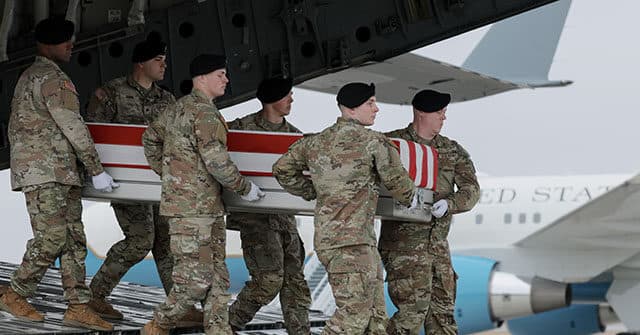
 U.S. service members carry flag-draped casket during dignified transfer ceremony
Seventh U.S. Service Member Dies in Iran War
Left says
- •The escalating death toll demonstrates the human cost of military intervention that could have been avoided through diplomatic solutions
- •American families are paying the ultimate price for a conflict that risks drawing the U.S. into another prolonged Middle Eastern war
- •The administration's military approach prioritizes force over negotiation, potentially destabilizing the entire region
Right says
- •These service members died defending America and its allies against Iranian aggression that threatened regional stability
- •Iran's attacks on U.S. forces and allies required a strong military response to deter future terrorism
- •The sacrifice of these brave soldiers upholds America's commitment to protecting democratic allies like Israel from authoritarian regimes
Common Take
High Consensus- Seven U.S. service members have now died in the conflict with Iran, including six killed in a March 1 drone attack
- The fallen soldiers deserve honor and respect for their service and sacrifice
- American military families are bearing a heavy burden during this conflict
- The situation represents a significant escalation in U.S.-Iran tensions with serious regional implications
The Arguments
Left argues
These seven deaths represent the predictable human cost of choosing military escalation over diplomatic engagement, with American families paying the ultimate price for a conflict that could have been prevented through sustained negotiations with Iran.
Right counters
Iran's repeated attacks on U.S. forces and allies demonstrated that diplomatic approaches had already failed, making military action necessary to protect American lives and prevent further Iranian aggression across the region.
Right argues
These service members died defending America's strategic interests and democratic allies against an authoritarian regime that has consistently threatened regional stability and sponsored terrorism throughout the Middle East.
Left counters
Military intervention has historically destabilized the Middle East further, and these deaths risk drawing America into another prolonged conflict that could ultimately create more instability and threaten more American lives.
Right argues
Iran's direct attacks on U.S. military installations required a strong response to establish deterrence and demonstrate that America will protect its forces and allies from state-sponsored aggression.
Left counters
Military retaliation often escalates conflicts rather than deterring them, and the current approach risks expanding the war beyond Iran to involve other regional powers and proxy groups.
Left argues
The administration's military-first approach has prioritized force over exhausting diplomatic alternatives, potentially missing opportunities to resolve underlying tensions through negotiation and economic incentives.
Right counters
Years of diplomatic efforts and economic sanctions failed to curb Iran's aggressive behavior, and military action became necessary only after Iran escalated to direct attacks on American personnel and facilities.
Right argues
The sacrifice of these brave soldiers upholds America's commitment to its allies and demonstrates that attacks on U.S. forces will be met with decisive action, which is essential for maintaining credible deterrence globally.
Left counters
Using military force as the primary tool of foreign policy risks creating a cycle of retaliation that ultimately makes both American forces and regional allies less secure, not more.
Challenge Questions
These questions target genuine internal contradictions — meant to provoke honest reflection.
Right asks Left
“If diplomatic solutions were genuinely viable, how do you explain Iran's escalation to direct attacks on U.S. military installations despite years of sanctions and diplomatic overtures, and what specific diplomatic approach would have prevented these deaths?”
Left asks Right
“If military deterrence is the goal, how do you reconcile the claim that force protects American lives with the reality that military escalation has now resulted in seven American deaths, and what evidence suggests this approach will prevent rather than invite further casualties?”
Outlier Report
Left Fringe
Unable to identify specific left-wing figures taking extreme positions on this story based on available evidence - would need additional social media discourse data or public statements to make specific attributions.
Right Fringe
Unable to identify specific right-wing figures taking extreme positions on this story based on available evidence - coverage appears relatively mainstream within conservative outlets without identifying fringe voices.
Noise Assessment
Low noise ratio - coverage appears factual and focused on casualty reporting rather than performative political discourse, though limited sample size prevents comprehensive assessment of social media amplification patterns.
Sources (5)
<p>A seventh U.S. service member has been killed following strikes against the Islamic Republic of Iran; no identity has been revealed.</p> <p>The post <a href="https://www.breitbart.com/politics/2026/03/08/seventh-u-s-service-member-killed-during-iran-conflict/" rel="nofollow">Seventh U.S. Service Member Killed During Iran Conflict</a> appeared first on <a href="https://www.breitbart.com" rel="nofollow">Breitbart</a>.</p>
Army identifies seventh US casualty in Iran War as Maj. Sorffly Davius, a NY National Guard soldier who died in Kuwait on March 6.
The service member killed was not publicly identified, but U.S. Central Command said the death was caused by injuries after an attack on a Saudi military base.
A seventh U.S. service member has died in the conflict with Iran, U.S. Central Command (Centcom) announced Sunday. Centcom wrote on the social platform X that the service member passed away “from injuries received during the Iranian regime’s initial attacks across the Middle East” on Mar. 1. The service member was “seriously wounded at the…