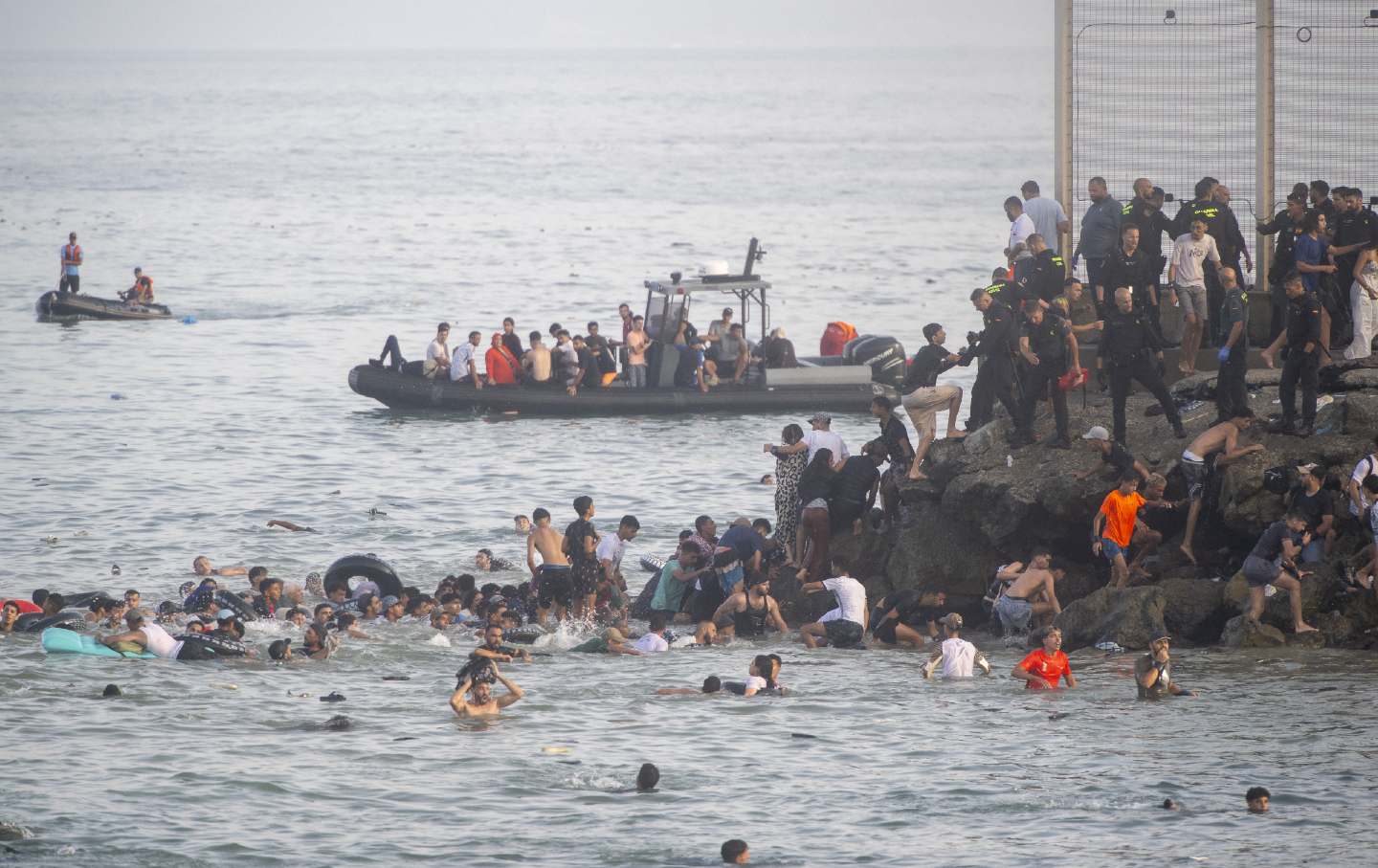
 Migrants swim past police and boats at the Ceuta border fence.
Spain-Italy Border Clash Exposes EU Split Over Migration
Intra-Party Split Detected
Some left-leaning outlets (Democracy Now, The Nation) focus on Morocco's geopolitical motives and humanitarian framing, while The Intercept criticizes liberals/centrists, including Spain's government and the EU, for adopting anti-immigrant framing similar to the right, revealing disagreement over how sympathetically to portray Spain's response.
Left says
- •The migrant surge into Ceuta appears to have been orchestrated by Morocco as a geopolitical provocation against Spain over its warming ties with Algeria, not a spontaneous refugee crisis.
- •Video evidence suggesting organized transport and border guards waving migrants through undercuts far-right narratives of an uncontrolled 'invasion' driven by lax Spanish policy.
- •Liberal and centrist leaders, including some in Spain and the EU, are echoing far-right anti-immigrant framing instead of defending humane treatment of vulnerable people, including unaccompanied minors sleeping in the streets.
- •Spain's regularization program for over a million undocumented residents already living and working in the country is a reasonable humanitarian policy being unfairly blamed for the crisis.
Right says
- •Spain's Supreme Court ruling barring immediate deportation of migrants who arrive by sea, combined with a sweeping amnesty program, created incentives that triggered the mass crossing.
- •Italy's Giorgia Meloni and other hawkish EU leaders argue the crisis demonstrates the need for stricter, unified migration rules across the bloc rather than unilateral open-door policies by individual member states.
- •Local Ceuta residents, including its multi-faith religious communities, feel abandoned by both the Spanish government and the EU and are demanding concrete action to prevent future mass crossings.
- •Reports of women and girls facing abuse amid the influx of predominantly male migrants raise serious humanitarian and security concerns that critics say have been downplayed.
Common Take
High Consensus- Roughly 50,000-78,000 migrants crossed from Morocco into Ceuta within a matter of days, overwhelming the city's infrastructure.
- At least 72-86 people died during the crossing attempts, mostly by drowning or being crushed.
- Spain and Italy each imposed retaliatory border controls on the other's travelers, escalating tensions within the Schengen zone.
- Most of the migrants who entered Ceuta returned to Morocco within days, leaving a smaller remaining population, including over 1,000 unaccompanied minors, in urgent need of housing and care.
The Arguments
Left argues
Video evidence of organized truck transport, Moroccan border guards waving migrants through, and the absence of typical refugee belongings suggests this was a state-orchestrated geopolitical provocation by Morocco against Spain's warming ties with Algeria, not an organic migration crisis.
Right counters
Even if Morocco facilitated or tolerated the crossing, the scale of the response was only possible because Spain's Supreme Court ruling and amnesty program created a clear incentive structure that Morocco could exploit — the vulnerability was self-inflicted regardless of who pulled the trigger.
Right argues
Spain's Supreme Court ruling barring immediate deportation of sea arrivals, combined with a sweeping million-person amnesty program, created a foreseeable incentive that transformed a 'slow trickle' into an 'explosion,' according to Spain's own Guardia Civil.
Left counters
Attributing tens of thousands of coordinated crossings primarily to a domestic court ruling ignores the extensive evidence of Moroccan state logistics and intelligence involvement, and lets an external geopolitical actor off the hook while blaming humane domestic policy.
Left argues
Centrist and liberal leaders, including at the EU level, are legitimizing far-right 'invasion' rhetoric by treating desperate people, including unaccompanied minors sleeping in the streets, primarily as a security threat rather than defending humane treatment.
Right counters
Acknowledging genuine security and social strain — including credible reports of assaults on women and girls amid a predominantly male influx — is not far-right fearmongering but a responsible response to real harms that vulnerable populations, especially local women, are experiencing.
Right argues
Ceuta's own multi-faith religious communities and local government, not just outside politicians, are demanding concrete EU and Spanish action, showing this is a grassroots demand for functioning border policy rather than a manufactured right-wing narrative.
Left counters
Local frustration with being abandoned by both Madrid and Brussels reflects a failure of burden-sharing and resource allocation, not evidence that stricter deportation rules or ending regularization programs would have prevented a geopolitically engineered crisis.
Right argues
Giorgia Meloni's push for unified, stricter EU migration rules is a reasonable response to a situation where one member state's unilateral policies produced a crisis that spilled into Schengen-wide disputes and border closures between Spain and Italy.
Left counters
Using a crisis substantially caused by Moroccan state provocation to justify suspending Schengen and imposing blanket restrictions on ordinary travelers punishes innocent people and EU cohesion rather than addressing the actual external actor responsible.
Challenge Questions
These questions target genuine internal contradictions — meant to provoke honest reflection.
Right asks Left
“If the Ceuta crossing was primarily a Moroccan state-orchestrated provocation rather than a response to Spanish policy, why did the numbers spike specifically after the Supreme Court ruling and amnesty announcement rather than at other points of Spanish-Algerian diplomatic warming?”
Left asks Right
“If stricter deportation rules and ending regularization programs are the answer, how do proponents explain evidence that Morocco actively organized and facilitated the crossing through state logistics, given that no domestic policy change would deter a geopolitically motivated foreign government from doing so again?”
Outlier Report
Left Fringe
The Intercept and Democracy Now framing that liberal Spanish/EU leaders are capitulating to far-right rhetoric represents a more radical anti-border-enforcement position held by roughly 15-20% of the left (progressive activist commentators like those at The Nation and The Intercept).
Right Fringe
Breitbart's framing emphasizing 'invasion' language and mass sexual abuse claims tied to religion/ethnicity represents a more inflammatory nationalist-populist position held by perhaps 20-25% of the right (aligned with figures like Donald Trump's rhetoric and hardline European nationalists like Meloni's more strident allies).
Noise Assessment
High noise ratio: this is a European domestic political dispute with limited direct stakes for American voters, so US public opinion is likely soft, poorly informed, and heavily shaped by pre-existing partisan priors on immigration rather than specific facts of the Ceuta incident.
Sources (8)
Italy introduced border controls following an influx of about 78,000 migrants from Morocco into the neighbouring Spanish exclave of Ceuta.
<p>A diplomatic spat between Spain and Italy over the rush of tens of thousands of migrants to the Spanish territory of Ceuta escalated on Saturday after the government in Madrid announced border controls on Italian travelers in response to Rome's decision to impose sanctions on visitors from Spain.</p> <p>The post <a href="https://www.breitbart.com/europe/2026/08/08/spain-imposes-tit-for-tat-border-checks-on-italian-travelers-amid-ceuta-migrants-row/" rel="nofollow">Spain Imposes Tit-For-Tat Border Checks on Italian Travelers Amid Ceuta Migrants Row</a> appeared first on <a href="https://www.breitbart.com" rel="nofollow">Breitbart</a>.</p>
<p>Ceuta has established an impromptu "shelter in a soccer field" for women and girls hiding from the thousands of majority-Muslim, male migrants who have refused to leave the city since last week's invasion, the Spanish newspaper El Mundo revealed on Thursday.</p> <p>The post <a href="https://www.breitbart.com/africa/2026/08/07/ceuta-struggles-to-protect-migrant-girls-as-hordes-of-men-abuse-them-on-the-streets/" rel="nofollow">Ceuta Struggles to Protect Migrant Girls as Hordes of Men Abuse Them on the Streets</a> appeared first on <a href="https://www.breitbart.com" rel="nofollow">Breitbart</a>.</p>
<p>Ceuta's multi-faith communities will hold a peaceful rally Sunday demanding measures are taken to prevent a new migrant invasion of the city.</p> <p>The post <a href="https://www.breitbart.com/europe/2026/08/07/enough-ceutas-religious-communities-demand-action-to-stop-migrant-invasions/" rel="nofollow">‘Enough’ — Ceuta’s Religious Communities Demand End to Migrant Invasions</a> appeared first on <a href="https://www.breitbart.com" rel="nofollow">Breitbart</a>.</p>
Roughly 1,100 unaccompanied migrant minors who rushed the beaches of the Spanish enclave of Ceuta could soon make it to mainland Spain. The group arrived as unaccompanied minors who authorities can’t immediately deport, according to Reuters. More than 70,000 migrants, mainly adult men from Morocco, arrived in Ceuta within days last week, a city that ...
An estimated 60,000 people from Morocco crossed into the Spanish enclave of Ceuta, on the African side of the Strait of Gibraltar, in an unprecedented mass movement last week. At least 72 people died during the attempt. The sudden influx of migrants overwhelmed the city’s residents, leading to a humanitarian crisis while border police deployed water cannons, tear gas and warning shots to deter people from crossing. According to Spain’s Interior Ministry, nearly all of the migrants returned to Morocco just a day later.</p> <p>Miriyam Aouragh, an anthropologist and the daughter of Moroccan immigrants to Europe, says the driving factors for the mass movement are a combination of shifting entry policies to Spain and increasing economic inequality in Morocco that “has given a sort of empowering incentive to people to try to go to Spain” via Ceuta. The city, which is surrounded by Morocco along a five-mile-long border, dates back to the Phoenician era and has been under Portuguese or Spanish control since 1415. The Moroccan government claims that Ceuta is occupied and colonized territory, while Spain considers it an integral part of the Spanish state.
<p>From the New York Times to the EU, liberals defending Spain from far-right fearmongering are regurgitating the right’s anti-immigrant premise.</p> <p>The post <a href="https://theintercept.com/2026/08/03/ceuta-spain-morocco-refugee-border/">Liberals Are Ceding Ground to the Far Right on Ceuta Border Crossings</a> appeared first on <a href="https://theintercept.com">The Intercept</a>.</p>
<p>Stephen Zunes</p> <div><img alt="" src="https://www.thenation.com/wp-content/uploads/2026/08/ceuta.jpg" /></div> <div> <div class="wp-block-the-nation-dek article-title__dek"> <p>Did the Israeli and US hostility toward Spain embolden Morocco to think it could get away with creating a border control crisis?</p> </div> </div> <p>The post <a href="https://www.thenation.com/article/world/ceuta-spain-morocco-border-crisis-western-sahara-geopolitics/">The Real Story Behind the Human Wave That Entered Ceuta</a> appeared first on <a href="https://www.thenation.com">The Nation</a>.</p>