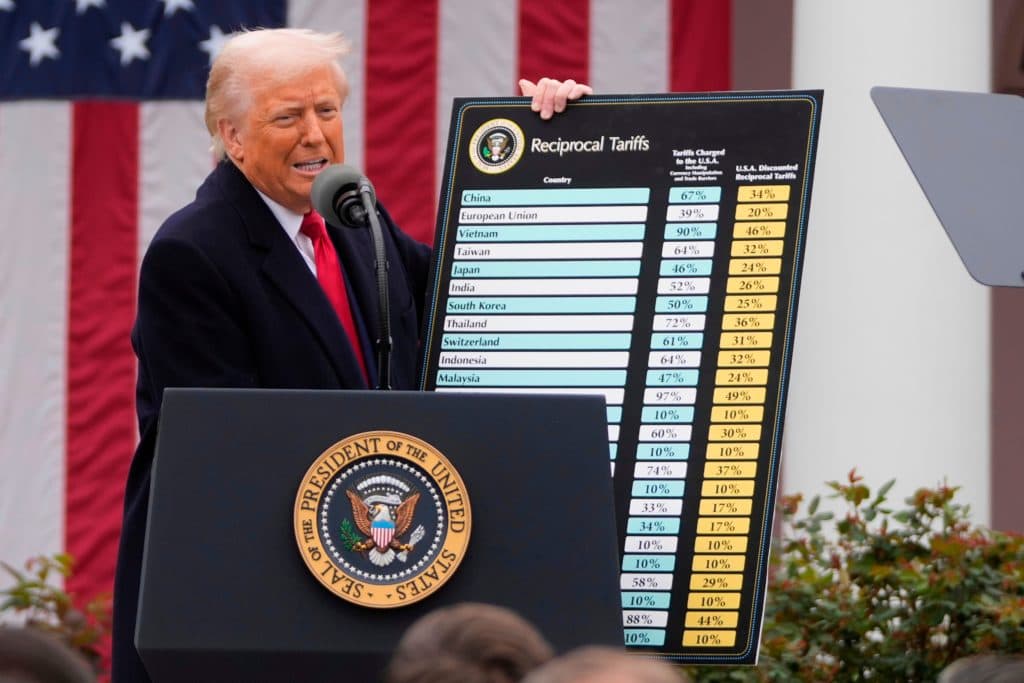
 Trump displays reciprocal tariffs chart during Rose Garden announcement
States, Small Businesses Sue Again Over Trump's 'Third' Tariff Try
Left says
- •The administration is accused of using forced-labor claims as a pretext to revive tariffs the Supreme Court already struck down, simply relabeling the same trade agenda under a different legal authority.
- •State attorneys general argue the president lacks constitutional power to impose sweeping tariffs unilaterally, calling the pattern of repeated legal defeats and workarounds an abuse of executive power.
- •Critics note the tariffs function as a tax on American families and businesses rather than a penalty on foreign governments, since importers ultimately bear the cost.
- •Some commentators argue the forced-labor justification is hypocritical given the US's own history with prison labor loopholes, suggesting the real motive is trade protectionism rather than human rights.
Right says
- •The White House maintains Section 301 tariffs are a legally durable tool that has withstood scrutiny since Trump's first term, distinct from the invalidated emergency powers tariffs.
- •Officials argue that trading partners' failure to crack down on forced-labor imports is a legitimate and unreasonable trade practice that justifies targeted tariff action under the statute.
- •Supporters see the tariffs as part of a broader strategy to rebuild American manufacturing and correct decades of trade policy that favored foreign producers over domestic industry.
- •Some business voices note the new tariffs are considerably smaller than earlier rounds and that refunds from previous invalidated tariffs are already being processed, suggesting the economic disruption is more manageable this time.
Common Take
High Consensus- Both sides agree the new tariffs of 10% to 12.5% apply to goods from roughly 60 trading partners, including major economies like the UK, Japan, and China.
- Both sides acknowledge this is the third distinct legal framework the administration has used to impose broad tariffs after prior versions were invalidated or expired.
- Both sides recognize that forced labor in global supply chains is a real and serious problem worth addressing through trade policy.
- Both sides agree the courts, specifically the Court of International Trade, will be the venue that determines the legality of this latest tariff regime.
The Arguments
Left argues
State attorneys general and small businesses argue the administration reverse-engineered country-specific 'forced labor' findings to justify tariff rates it had already decided on, stretching Section 301 far beyond its intended use as a targeted trade remedy into a near-universal tariff regime covering 99.4% of imports.
Right counters
The White House counters that Section 301 explicitly authorizes the president to act against 'unreasonable' foreign trade practices, and a widespread failure by dozens of countries to police forced-labor imports is a legitimate, broadly applicable finding rather than a pretextual one.
Right argues
Unlike the IEEPA tariffs the Supreme Court struck down, Section 301 has already survived legal scrutiny during Trump's first term when used against China, giving the administration a durable statutory basis distinct from the invalidated emergency-powers approach.
Left counters
Plaintiffs argue that surviving past scrutiny for a narrow, country-specific tariff doesn't legitimize using the same statute to impose sweeping, near-global tariffs that mirror the exact rates and pattern of the tariffs courts already rejected, which is precisely the 'workaround' they're suing over.
Left argues
Critics highlight that tariffs are paid by American importers, not foreign governments, meaning the practical effect is a tax increase on U.S. businesses and consumers regardless of which statute is invoked, as evidenced by Collective Horology's $160,000 in costs and still-outstanding refunds.
Right counters
Supporters respond that short-term costs to importers are the price of correcting decades of trade imbalance, and note the new tariffs are considerably smaller (10-12.5% vs. up to 145%) with refunds from earlier rounds already flowing, suggesting the disruption is manageable and temporary.
Left argues
Commentators like Joseph Stiglitz argue the forced-labor rationale is hypocritical and suspiciously convenient, since the new tariff rates closely track the old trade-deficit-based rates and China—a major forced-labor concern—was largely spared, suggesting the real driver is trade leverage rather than human rights.
Right counters
Officials maintain the investigation produced country-specific findings and that inconsistent application doesn't undermine the legitimacy of the underlying legal authority, which targets a genuine and well-documented problem of forced-labor goods entering U.S. markets.
Right argues
Supporters frame the tariffs as one piece of a broader, consistent strategy to rebuild American manufacturing and end trade policies that have favored foreign producers for decades, arguing the administration is using every lawful tool available rather than abandoning its goals after legal setbacks.
Left counters
State AGs counter that persistently pivoting to new legal authorities after repeated court losses—rather than seeking congressional authorization—reveals an attempt to bypass constitutional limits on executive power, not a legitimate policy strategy.
Challenge Questions
These questions target genuine internal contradictions — meant to provoke honest reflection.
Right asks Left
“If the forced-labor problem the administration identified is real and acknowledged even by critics like Stiglitz, what specific evidentiary standard should the administration have met that wouldn't also invalidate legitimate country-specific trade remedies under Section 301?”
Left asks Right
“If Section 301 findings were made independently based on each country's forced-labor practices, why do the resulting tariff rates so closely mirror the earlier IEEPA rates that were based on trade deficits rather than labor practices, and why was China—a widely cited forced-labor concern—largely exempted?”
Outlier Report
Left Fringe
Figures like Sen. Bernie Sanders and progressive economists such as Joseph Stiglitz go further, framing tariffs as fundamentally hypocritical and tied to broader critiques of US labor practices (e.g., prison labor); this represents maybe 15-20% of the left, more focused on systemic critique than the narrower legal/economic argument most Democrats make.
Right Fringe
Figures like Peter Navarro and some MAGA-aligned commentators argue for even more aggressive, expansive tariff authority regardless of legal setbacks, representing maybe 15-20% of the right that prioritizes economic nationalism over legal or process concerns raised by business-aligned conservatives.
Noise Assessment
Moderate-to-high noise: much of the vocal discourse comes from state AGs, trade lawyers, and pundits with strong institutional stakes, while average consumers and small business owners (as the Guardian piece notes) are largely unbothered or unaware of this specific round of tariffs.
Sources (8)
<p>The small businesses behind high-profile <a href="https://www.axios.com/2025/04/16/trump-tariffs-main-street-lawsuit" target="_blank">legal challenges</a> to President Trump's trade agenda are suing again to block his latest import taxes.</p><p><strong>Why it matters:</strong> The lawsuits set up another legal test of Trump's <a href="https://www.axios.com/economy/tariffs" target="_blank">tariff</a> agenda after courts this year rejected one tariff regime and another remains tied up in court.</p><hr /><p><strong>What's new: </strong>One lawsuit was filed on behalf of Burlap & Barrel, which previously challenged <a href="https://www.axios.com/politics-policy/donald-trump" target="_blank">Trump's</a> temporary <a href="https://www.axios.com/2026/02/24/trump-tariffs-supreme-court-section-122" target="_blank">Section 122 tariffs</a>, and watch retailer Collective Horology. </p><ul><li>The other was brought by toymaker Learning Resources, along with a flooring manufacturer and affiliated firms.</li><li>Learning Resources was a party to the consolidated Supreme Court litigation in which the justices invalidated Trump's emergency powers tariffs, though its own case was dismissed on jurisdictional grounds.</li></ul><p><strong>Catch up quick: </strong>The lawsuits challenge <a href="https://www.axios.com/2026/07/23/trump-tariffs-trade-labor" target="_blank">the administration's new tariffs</a> imposed under Section 301 of the Trade Act, which took effect last week as the White House's temporary Section 122 levies expired. </p><ul><li>The action generally imposes tariffs of 10% or 12.5% on imports from more than 60 economies that the Trump administration says failed to adequately block goods made with forced labor.</li></ul><p><strong>What they're saying:</strong> The Liberty Justice Center, representing Burlap & Barrel and Collective Horology, argues that the administration stretched what Congress intended as a targeted trade remedy into a sweeping global tariff regime.</p><ul><li>U.S. Trade Representative Jamieson Greer "determined the tariff rates first ... and assembled economy-specific findings afterward to justify them," the public interest law firm, which previously represented businesses challenging Trump's tariffs, alleges in a complaint.</li></ul><p><strong>The suit filed on behalf </strong>of Learning Resources says Trump officials relied on generalized findings rather than demonstrating how each country's practices burdened U.S. commerce, as the statute requires.</p><ul><li>The complaint alleges that the administration imposed the same set of sweeping global tariffs after earlier legal defeats: "The third time's not the charm," the complaint says.</li></ul><p><strong>What they're saying:</strong> Collective Horology co-founder Asher Rapkin tells Axios that the earlier tariff regimes cost the watch retailer more than $160,000, with refunds from the earlier invalidated tariffs still outstanding.</p><ul><li>"Section 301 tariffs are most definitely going to hamstring my business in the exact same way that the previous two phases of tariffs have," Rapkin says.</li><li>The company imports watches from Switzerland, where Rapkin says there is virtually no U.S. manufacturing alternative.</li></ul><p><strong>Flashback:</strong> Courts have already rejected Trump's first attempt to impose sweeping tariffs under emergency powers, while a separate challenge to his temporary replacement tariffs under Section 122 remains on appeal. </p><ul><li><strong>Now:</strong> The challenge has shifted from whether the administration has tariff authority to how officials are exercising their trade power.</li></ul><p><strong>The other side:</strong> The White House says the tariffs lawfully target foreign failures to block forced labor imports.</p><ul><li>"Section 301 tariffs have proven to be a legally durable tool since the President's first term, and they remain so now," White House spokesman Kush Desai tells Axios in a statement.</li></ul><p><strong>The bottom line: </strong>Small businesses have been consequential players in the fight over Trump's tariff power, repeatedly forcing the administration back into court as it pivots from one legal authority to the next.</p><p><em>Editor's note: This story was updated with comment from the White House. This story was corrected to clarify Learning Resources' role in the Supreme Court litigation over President Trump's emergency powers tariffs.</em></p>
The duties were imposed over claims that 60 US trading partners have failed to tackle forced labour.
The coalition says the president’s new justification for imposing tariffs is just a “pretext” to replace the old ones.
The United States last month imposed double-digit tariffs on 59 countries and the European Union, charging that they had not done enough to crack down on imports produced by forced labor.
<p>Coalition of 25 states asks US Court of International Trade to halt tariffs and declare them them unlawful</p><ul><li><p><a href="https://www.theguardian.com/us-news/2026/jul/23/trump-administration-trade-tariffs">Trump imposes fresh tariffs on dozens of trading partners</a></p></li></ul><p>A coalition of 25 US states sued the Trump administration on Monday over <a href="https://www.theguardian.com/us-news/2026/jul/23/trump-administration-trade-tariffs">new tariffs</a> pegged at 10% to 12.5% on goods from 60 trading partners, calling them a pretext for replacing import taxes struck down by the supreme court in February.</p><p>The states are asking the US Court of International Trade to halt the tariffs, declare them unlawful and order refunds of duties that have already been paid.</p> <a href="https://www.theguardian.com/us-news/2026/aug/03/states-sue-trump-administration-tariffs">Continue reading...</a>
<p>The president’s pretext of stopping forced labour is only a ruse – he is trying to grab a share of global trade for the US</p><p>Here he goes again. The US President, Donald Trump, is increasing and decreasing tariffs willy-nilly, violating international agreements that he himself signed and almost surely violating federal law. The only difference this time is that he has a new pretext for abusing tariffs: stopping forced labour.</p><p>Of course, the administration is right that too little is being done about forced labour. But its stated concern is a ruse. With the new tariffs closely tracking the ones that Trump imposed on the basis of trade balances, are we supposed to believe that bilateral trade deficits just so happen to be highly correlated with the use of forced labour?</p> <a href="https://www.theguardian.com/business/2026/aug/03/donald-trump-tariffs-us-eu-forced-labour">Continue reading...</a>
<p>Tariffs are annoying and disruptive, but this round is less impactful – and business owners are taking them in their stride</p><p>Rebounding from his defeat at the supreme court in February, Donald Trump has recently announced a new round of tariffs, invoking sections of <a href="https://www.wsj.com/opinion/donald-trump-tariffs-301-canada-f3e90f13?st=7oghtk">various trade acts</a> to levy amounts on industries and countries based on reasons ranging from “forced labor” to “excess capacity”.</p><p>And how are small and medium-sized businesses in the US reacting? One word: snoozefest.</p> <a href="https://www.theguardian.com/business/2026/aug/02/us-small-businesses-trump-tariffs">Continue reading...</a>
Roughly two dozen Democratic-controlled states sued President Trump on Monday over his new global tariffs, calling them “equally unlawful” to the ones the Supreme Court has invalidated. The lawsuit adds to legal challenges launched by small businesses in response to the latest round of tariffs in recent days. The new tariffs, announced last month, add a surcharge…