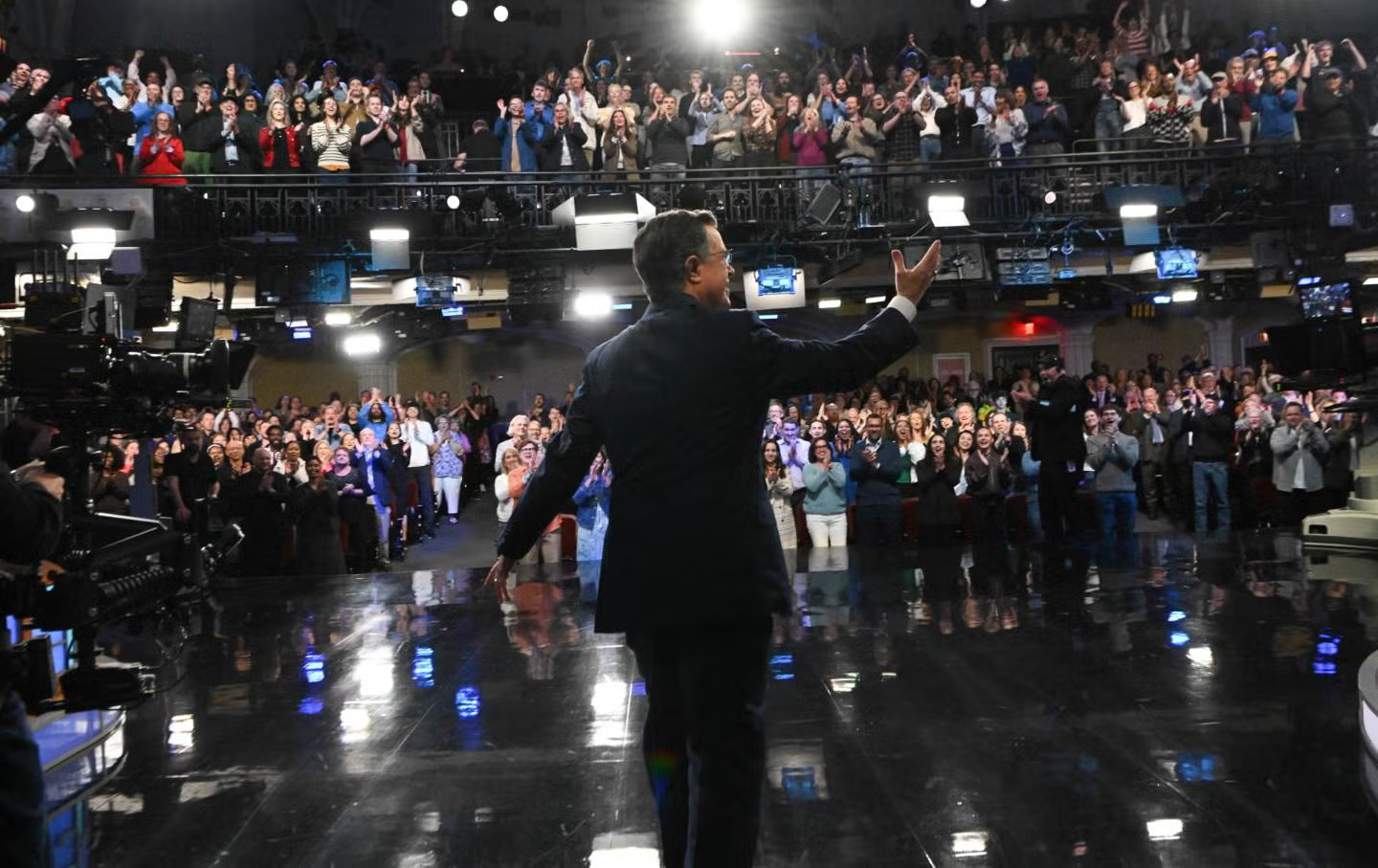
 Stephen Colbert acknowledges applauding audience during Late Show taping
Stephen Colbert's Cancellation Sparks Debate Over Political Pressure
Left says
- •Trump's administration pressured CBS and the Ellison family to cancel Colbert's show as retaliation for his political satire and criticism
- •The cancellation represents a dangerous erosion of press freedom and the ability of comedians to hold power accountable
- •Colbert's departure marks the end of an influential institutional form of political satire that shaped national political discourse
- •The timing coincided suspiciously with the Ellison family's FCC approval process and other Trump-friendly changes at CBS
Right says
- •CBS made a business decision to cancel an expensive show that wasn't generating sufficient profit despite high ratings
- •The cancellation reflects market forces and corporate restructuring rather than political interference
- •Colbert's show represented biased liberal commentary masquerading as comedy rather than balanced entertainment
Common Take
High Consensus- Stephen Colbert's Late Show has been officially cancelled by CBS
- The show had high ratings but was expensive to produce
- Colbert was known for his political commentary and criticism of various political figures
- The cancellation marks the end of a significant late-night television program
The Arguments
Left argues
The timing of Colbert's cancellation alongside the Ellison family's FCC approval process, CBS's $16 million settlement with Trump, and the hiring of conservative editor Bari Weiss strongly suggests political retaliation rather than a business decision.
Right counters
Correlation doesn't prove causation - major media acquisitions naturally involve multiple simultaneous decisions about programming, personnel, and legal settlements as new ownership evaluates all aspects of the business.
Right argues
CBS explicitly stated that despite high ratings, Colbert's show was too expensive to generate sufficient profit, which represents a straightforward business decision that networks make regularly when costs exceed revenue potential.
Left counters
If the show truly had high ratings and broad audience reach, the revenue potential should have justified the costs - the 'unprofitable' explanation becomes suspicious when the show was demonstrably successful at attracting viewers.
Left argues
Colbert's show represented a unique institutional form of political satire that shaped national political discourse and created a broad interpretive community, making its loss a significant blow to democratic accountability through comedy.
Right counters
Political satire will continue through other comedians and platforms - no single show is indispensable to democratic discourse, and the market will naturally fill any genuine demand for this type of content.
Right argues
Colbert's show had become biased liberal commentary disguised as entertainment rather than balanced comedy, making it more of a partisan political program than genuine satirical content that appeals to broad audiences.
Left counters
Political satire has always been inherently critical of those in power - calling it 'biased' misunderstands the fundamental role of comedic commentary in holding authority figures accountable regardless of party affiliation.
Left argues
The fact that a sitting president was 'hell-bent on getting you off the air' demonstrates that Colbert's satire was effectively challenging power and making a meaningful difference in political discourse.
Right counters
Presidential criticism of media figures is nothing new and doesn't prove the content was valuable - it could equally suggest the show had become so partisan that it warranted legitimate criticism for abandoning journalistic standards.
Challenge Questions
These questions target genuine internal contradictions — meant to provoke honest reflection.
Right asks Left
“If Colbert's show was truly as influential and valuable to democracy as you claim, why didn't market forces and audience demand prevent its cancellation - doesn't the failure to maintain profitability suggest the audience for this type of content was actually smaller and less committed than you believe?”
Left asks Right
“If this was purely a business decision based on profitability, why would CBS simultaneously settle with Trump for $16 million and hire a conservative editor - doesn't this pattern of Trump-friendly moves undermine the claim that political considerations played no role in programming decisions?”
Outlier Report
Left Fringe
Progressive media figures like those at The Nation and Salon who frame this as part of a broader authoritarian crackdown on dissent, representing roughly 15-20% of the left who see direct Trump administration pressure as the primary cause.
Right Fringe
MAGA influencers and Trump loyalists who celebrate Colbert's cancellation as deserved comeuppance for 'unfair' coverage, representing about 25-30% of the right who view this as justified political retribution rather than a neutral business decision.
Noise Assessment
Moderate noise level - while partisan media amplifies the political persecution vs. business decision narratives, most Americans likely view this through the lens of corporate entertainment decisions rather than constitutional crisis.
Sources (4)
Stephen Colbert's cancellation was political. But the brilliance of his shows also belonged to the writers, producers, and staff.
We'll see Stephen Colbert again, but his broadcast exit closes out David Letterman's absurdist TV legacy
While the late-night host's departure is a real loss, his brand of political commentary will survive
<p>Ben Schwartz</p> <div><img alt="" src="https://www.thenation.com/wp-content/uploads/2026/05/stephen-colbert-late-show-gt-img.jpg" /></div> <div> <div class="wp-block-the-nation-dek article-title__dek"> <p>Trump would have all his comedian critics fired if he could. But Colbert represents a particular loss.</p> </div> </div> <p>The post <a href="https://www.thenation.com/article/society/stephen-colbert-late-show-trump/">Why Losing Colbert Hurts So Much</a> appeared first on <a href="https://www.thenation.com">The Nation</a>.</p>