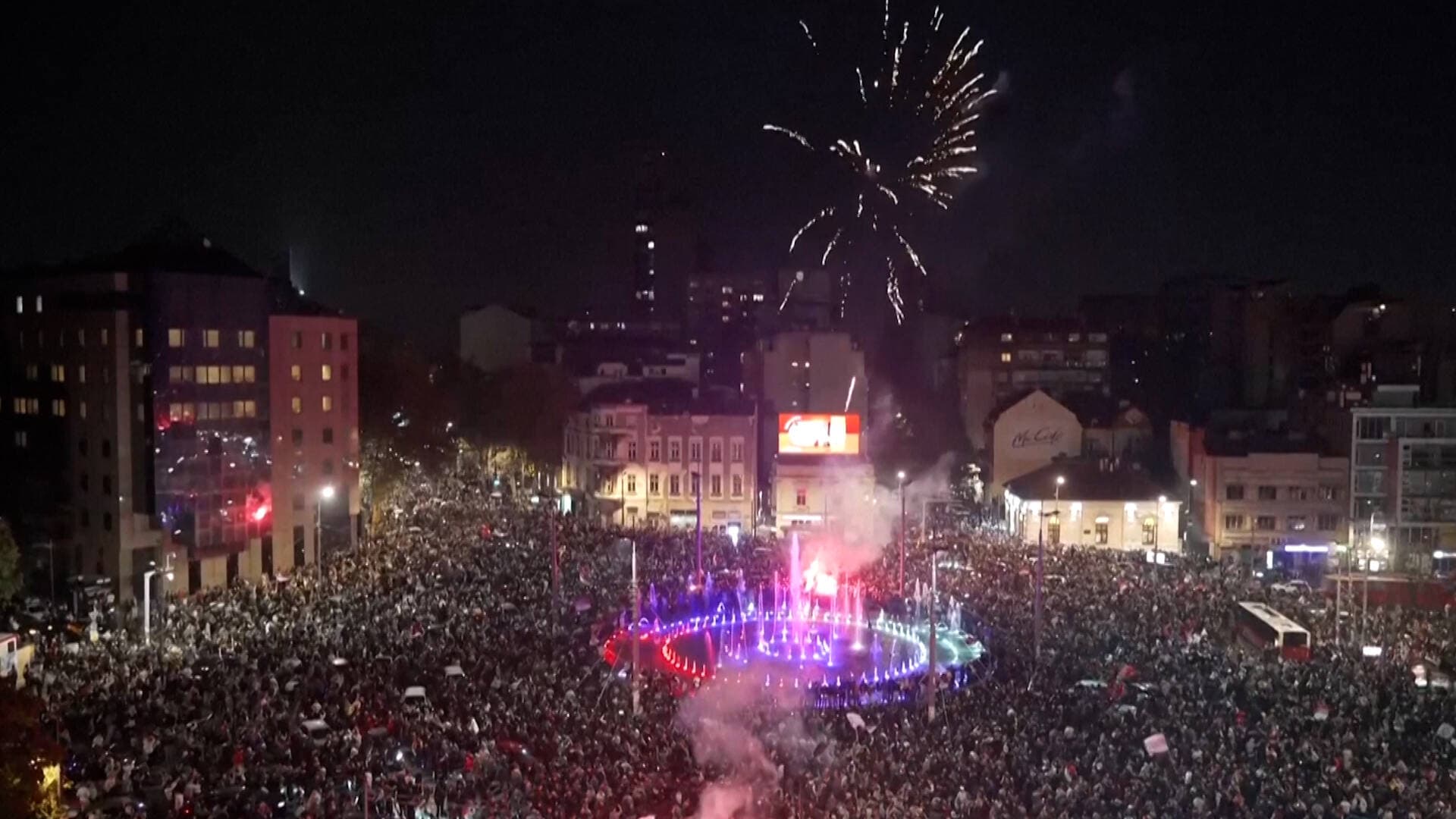
 Mass student protest in Belgrade square with fireworks and crowd celebrating movement against Vucic
Student Movement Topples Vucic—But What Comes Next?
Left says
- •The movement's victory represents a grassroots democratic awakening, proving that sustained citizen organizing can defeat an entrenched strongman who consolidated power over 14 years.
- •The Novi Sad canopy collapse that killed 16 people crystallized years of public anger over corruption, cronyism, and political violence under Vučić, and voters held his government accountable.
- •The decentralized, non-traditional leadership of the Student List reflects a broader European youth wave rejecting old-guard political establishments in favor of transparency and institutional reform.
- •This echoes Serbia's 2000 uprising against Milošević, showing that popular mobilization remains a powerful check on authoritarian drift even within a nominally democratic system.
Right says
- •Vučić's ouster raises real uncertainty about Serbia's future foreign policy direction, particularly whether Belgrade will continue warming ties with the United States or drift back toward Russia's orbit.
- •The outgoing government had cultivated significant relationships with American political figures, including Trump family members and allies, investments that now hang in limbo under an untested new leadership.
- •A coalition led by first-time politicians with no governing experience and an intentionally decentralized structure faces serious questions about its ability to actually govern a country and form a stable government.
- •Economic and development deals, including projects tied to prominent American investors, became entangled in controversy and now face an unclear path forward under new leadership.
Common Take
High Consensus- The Student List movement decisively defeated Vučić's Serbian Progressive Party after 14 years in power, with projections showing 135-140 seats versus 105 for Vučić's coalition.
- The November 2024 Novi Sad train station canopy collapse, which killed 16 people, served as the catalyst that ignited the protest movement.
- Serbia now faces a genuinely uncertain political transition, including forming a new government and holding a separate presidential election in December.
- The outcome marks a historic shift in Serbian politics, drawing direct comparisons to the student-led movement that helped topple Milošević in 2000.
The Arguments
Left argues
The movement's victory demonstrates that sustained grassroots organizing can peacefully remove an entrenched strongman, proving Serbia's democratic institutions still function even after 14 years of consolidation under Vučić.
Right counters
Winning an election is not the same as governing; a coalition of first-time politicians with deliberately no central leadership may struggle to translate protest energy into the compromises and administrative competence required to run a state.
Right argues
Vučić's government had built substantial working relationships with the Trump administration and allied investors, and the abrupt change in leadership creates genuine uncertainty about whether Serbia will honor existing agreements or pivot its foreign alignment entirely.
Left counters
Those relationships were built on personal patronage and controversial deals, like the Kushner project, that embodied exactly the cronyism voters rejected; a government accountable to its citizens rather than foreign dealmakers is a feature of the outcome, not a bug.
Left argues
The Novi Sad canopy collapse that killed 16 people exposed years of corruption and institutional neglect, and the electoral result shows voters legitimately held the ruling party accountable for that failure rather than being swayed by foreign interference or chaos.
Right counters
Accountability for a tragedy doesn't automatically confer governing capacity; punishing the old guard at the ballot box is a different task than managing a national budget, foreign policy, and coalition politics with no prior experience.
Right argues
A decentralized movement without a clear single leader may find it extremely difficult to form a stable government, choose a prime minister, and negotiate coherently with international partners, risking a period of paralysis or fragmentation.
Left counters
Decentralization was a deliberate safeguard against the kind of personality-driven, one-man consolidation of power that produced Vučić's 14-year rule in the first place, and the movement has already shown discipline by unifying around the Student List ticket to win decisively.
Left argues
This victory fits a broader European pattern of youth-led movements successfully challenging entrenched political establishments, suggesting a genuine generational shift toward demanding transparency over old-style patronage politics.
Right counters
Youthful enthusiasm and viral mobilization are not substitutes for the institutional knowledge needed to navigate Serbia's complex balancing act between Russia, the EU, and the US, and inexperience could leave the country more vulnerable to external pressure, not less.
Challenge Questions
These questions target genuine internal contradictions — meant to provoke honest reflection.
Right asks Left
“If decentralized, inexperienced leadership is celebrated as a democratic virtue now, how should the left respond if that same structure proves unable to form a government or make basic governing decisions in the coming months?”
Left asks Right
“If the concern is really about stable governance and reliable foreign partnerships, how does that square with having previously praised or worked closely with a leader who was consolidating power in ways widely described as authoritarian?”
Outlier Report
Left Fringe
Tankie-adjacent commentators and some DSA-aligned voices (e.g., certain Jacobin contributors) who are suspicious of the movement due to its potential Western/NATO sympathies or skeptical that electoral change under capitalism represents genuine revolution; roughly 10-15% of the left.
Right Fringe
Pro-Vucic nationalist commentators and figures like Richard Grenell-aligned voices who frame Vucic's ouster as a loss for U.S. strategic interests and view the student movement with suspicion as possibly destabilizing or Soros-funded; roughly 15-20% of the right, echoing rhetoric common in some Trump-aligned foreign policy circles.
Noise Assessment
Moderate noise; most American public discourse on this story is thin since it's a niche foreign policy topic, with engagement concentrated among foreign policy wonks, Balkan diaspora communities, and Trump-world commentators focused on the Kushner/Trump Jr. business angle rather than broad public sentiment.
Sources (5)
'Will we continue to enhance our relations with the United States?' Vucic ally asks
Brazil is not the only country to have had dramatic election results this weekend. In Serbia, longtime leader Aleksandar Vucic lost a historic election that brought down his government.
By unseating longtime leader Aleksandar Vucic in Sunday's election, Serbia's student protest movement did what demonstrators in other European capitals can only dream of.
<p>A student-led protest movement has ended the 14-year rule of Serbia's right-wing party, former President <a href="https://www.axios.com/2022/04/04/serbia-president-reelection-vucic-russia-putin" target="_blank">Aleksandar Vučić</a> conceded Sunday.</p><p><strong>Why it matters: </strong>The historic upset sidelines a Balkan strongman who <a href="https://www.reuters.com/world/donald-trump-jr-visits-serbia-meets-president-aleksandar-vucic-2025-03-11/?utm_source=chatgpt.com" target="_blank">courted</a> President <a href="https://www.axios.com/politics-policy/donald-trump?utm_source=chatgpt.com" target="_blank">Trump's</a> family and allies, raising questions about future U.S. relations with a country that has balanced ties with Russia and the West.</p><hr /><ul><li><a href="https://www.axios.com/2022/04/04/serbia-president-reelection-vucic-russia-putin" target="_blank">Vučić</a>'s outreach has included the president's <a href="https://www.reuters.com/world/donald-trump-jr-visits-serbia-meets-president-aleksandar-vucic-2025-03-11/" target="_blank">son</a> Donald Trump Jr. and longtime <a href="https://www.washingtonpost.com/politics/2024/03/28/richard-grenell-trump-envoy-serbia-guatemala" target="_blank">ally</a> Richard Grenell, while a proposed development <a href="https://www.reuters.com/world/jared-kushners-withdrawal-serbia-will-hurt-investment-official-says-2025-12-23/" target="_blank">involving</a> Trump's son-in-law <a href="https://www.axios.com/2025/11/18/trump-business-serbia-saudi-profit" target="_blank">Jared Kushner</a> became embroiled in controversy.</li></ul><p><strong>The big picture:</strong> The movement's electoral breakthrough reflects a broader <a href="https://www.axios.com/2026/10/07/europe-student-protests-france-belgium" target="_blank">wave of youth activism</a> in Europe, where young people have mobilized over corruption, education and economic pressures.</p><ul><li>The victory could usher in democratic reforms in Serbia, where Vučić consolidated power.</li></ul><p><strong>Driving the news: </strong>Vučić said Sunday evening it was "clear" that his Serbian Progressive Party had lost to the student-backed electoral movement, although official results had yet to be announced, according to translations of his <a href="https://x.com/clashreport/status/2114457618609500635" target="_blank">announcement</a>.</p><ul><li>He <a href="https://www.reuters.com/world/europe/serbias-vucic-concedes-defeat-student-led-movement-parliamentary-election-2026-10-25/" target="_blank">projected</a> the Student List would win between 135 and 140 seats in the 250-seat parliament, compared with 105 for his coalition.</li><li>Cardiologist Ilija Srdanović <a href="https://www.nacionale.com/en/articles/who-is-ilija-srdanovic-student-list-leader" target="_blank">heads</a> the Student List, though the grassroots movement emphasized its decentralized leadership.</li><li>The result echoes the student-led movement that helped topple Slobodan Milošević in <a href="https://www.theguardian.com/education/2000/oct/31/highereducation.theguardian1" target="_blank">2000</a>, with Serbians reviving that era's "He's finished!" rallying <a href="https://x.com/chemu_optimizam/status/2114255073828073976" target="_blank">cry</a> as they celebrated Sunday.</li></ul><p><strong>Context: </strong>The movement emerged from mass <a href="https://www.theguardian.com/world/2026/oct/21/protest-movement-serbia-student-list-try-to-take-power" target="_blank">protests</a> after the November 2024 collapse of a railway station canopy in Novi Sad that killed 16 people, fueling public anger over alleged government corruption. </p><ul><li>It subsequently evolved into an electoral movement campaigning for accountability and institutional reform.</li></ul><p><strong>What's next:</strong> The Student List must choose a prime minister and form a government while Serbia faces a separate presidential election in December to replace Vučić.</p>
Serbia’s longtime leader Aleksander Vučić has been swept out of power by a historic student-led opposition movement against Vučić’s right-wing Serbian Progressive Party. Candidates from the Student List, who are not students themselves but largely first-time politicians selected by student-led popular assemblies, won a majority of seats in Sunday’s parliamentary elections, marking a seismic shift in Serbian politics. Their victory comes two years into a student-led movement sparked by the collapse of a roof at a train station in the city of Novi Sad, which killed 16 people. The disaster became a focal point for anti-government protests over corruption, cronyism, political violence and democratic backsliding.</p> <p>“Students really changed the whole political landscape of the country, and maybe even more important, they changed political imagination. They changed our understanding of what’s politically possible for all of us,” says journalist Lela Vujanić, who speaks to us from Belgrade about the groundbreaking elections. “This was a great democratic opening and democratic awakening, not only for the students, but for the rest of the country also.”