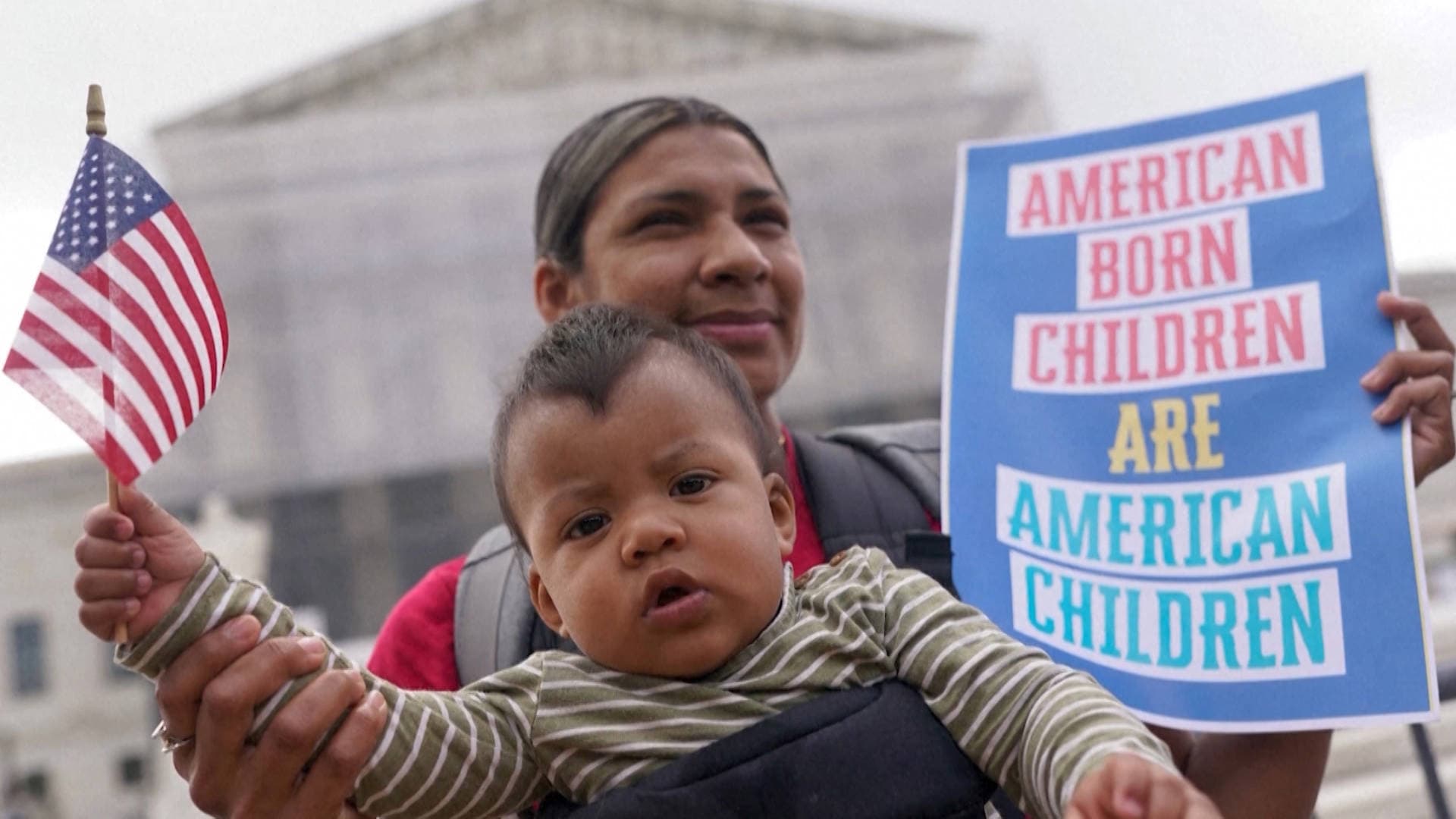
 Mother and baby at Supreme Court protest with 'American Born Children Are American Children' sign
Supreme Court appears skeptical of Trump's birthright citizenship ban
Intra-Party Split Detected
Some conservative justices appeared skeptical of Trump's executive order, with Chief Justice Roberts calling the legal reasoning 'quirky' and Justice Kavanaugh dismissing comparisons to other countries
Left says
- •The executive order violates the plain language of the 14th Amendment, which grants citizenship to all persons born in the United States with narrow exceptions like diplomats and invading armies
- •The policy would disproportionately affect children of color, with 75% being Latino, creating a caste system that denies millions access to work authorization, Social Security, passports, and voting rights
- •The order undermines 125 years of legal precedent established in the 1898 Wong Kim Ark case and represents an attack on equal protection under the law
- •Some children could become stateless if their parents' home countries refuse to grant citizenship, violating international treaties that discourage statelessness
Right says
- •The 14th Amendment's phrase 'subject to the jurisdiction thereof' requires parents to be permanently and legally settled in the United States, not merely physically present
- •America is one of only 27 countries worldwide that grants automatic birthright citizenship, making it an outlier compared to most developed nations
- •The original meaning of the 14th Amendment was intended for children of slaves, not for modern immigration circumstances involving undocumented immigrants
- •The policy would restore proper meaning to citizenship and enhance national security by ensuring only those with legal ties to America automatically become citizens
Common Take
High Consensus- The case centers on interpreting five specific words in the 14th Amendment: 'subject to the jurisdiction thereof'
- The Supreme Court's 1898 Wong Kim Ark decision established important precedent regarding birthright citizenship
- Multiple justices, including conservatives, expressed skepticism about the administration's legal arguments during oral arguments
- The final Supreme Court ruling will have significant consequences for millions of children and families across America
The Arguments
Right argues
The 14th Amendment's phrase 'subject to the jurisdiction thereof' was intended to require genuine legal allegiance to the United States, not mere physical presence, and the original meaning focused on children of slaves who had permanent ties to America rather than temporary visitors or those here illegally.
Left counters
The Supreme Court definitively settled this interpretation in 1898's Wong Kim Ark case, ruling that children born on U.S. soil are citizens regardless of their parents' immigration status, with exceptions only for diplomats and invading armies who are not subject to U.S. jurisdiction.
Left argues
Trump's order would create a discriminatory caste system where 75% of affected children would be Latino, denying millions of U.S.-born children access to fundamental rights like work authorization, Social Security, passports, and voting, while potentially rendering some stateless in violation of international law.
Right counters
The policy would simply align America with most developed nations that don't grant automatic birthright citizenship and would restore proper meaning to citizenship by ensuring only those with legal ties to the country become citizens, enhancing national security.
Left argues
The plain language of the 14th Amendment grants citizenship to 'all persons born in the United States' with only narrow exceptions, and overturning 125 years of established precedent would undermine the constitutional principle of equal protection under the law.
Right counters
Constitutional interpretation should focus on original meaning rather than precedent when that precedent misread the text, and the founders never intended birthright citizenship to apply to children of those who entered the country illegally or temporarily.
Right argues
America is an outlier among developed nations in granting automatic birthright citizenship, with only 27 countries worldwide maintaining this policy, suggesting it's not a universal or necessary practice for modern nation-states.
Left counters
The vast majority of countries in the Americas grant birthright citizenship, and American constitutional interpretation should be based on American law, history, and precedent rather than foreign practices, as Justice Kavanaugh noted during oral arguments.
Left argues
Even conservative Supreme Court justices appeared skeptical during oral arguments, with Chief Justice Roberts calling the government's reasoning 'quirky' and Justice Kavanaugh rejecting comparisons to other countries' policies, suggesting the constitutional text is clear.
Right counters
Oral argument reactions don't always predict final rulings, and the Court should focus on the constitutional text's original meaning rather than being swayed by political pressure or maintaining flawed precedent that expanded citizenship beyond the amendment's intended scope.
Challenge Questions
These questions target genuine internal contradictions — meant to provoke honest reflection.
Right asks Left
“If the 14th Amendment's language is as unambiguous as you claim, why did it take until 1898 for the Supreme Court to definitively rule on birthright citizenship for children of non-citizen immigrants, and doesn't this 30-year gap suggest the text was less clear than you argue?”
Left asks Right
“If originalist constitutional interpretation matters and you argue the 14th Amendment should be read according to its original meaning for freed slaves, how do you reconcile this position with conservative judicial philosophy that typically emphasizes textualism and original intent over evolving interpretations?”
Outlier Report
Left Fringe
Progressive activists like those in certain immigrant rights organizations who frame this purely through racial lens and claim it's entirely about white supremacy represent about 15% of the left coalition, as most Democrats focus on constitutional and legal arguments rather than racial motivations.
Right Fringe
Immigration hardliners like Stephen Miller and some America First commentators who argue the 14th Amendment never applied to any immigrants represent about 20% of the right, as most conservatives who support the policy focus on the 'jurisdiction' clause rather than rejecting birthright citizenship entirely.
Noise Assessment
Moderate noise levels - while Trump's Supreme Court appearance generated headlines, the core constitutional debate reflects genuine policy differences rather than pure political theater.
Sources (5)
<p>President Trump became the first sitting president to attend <a href="https://www.axios.com/2026/01/01/2026-trump-supreme-court-cases-tariffs" target="_blank">Supreme Court</a> oral arguments on Wednesday and watched as key justices cast doubt on his effort to <a href="https://www.axios.com/2025/01/21/trump-birthright-citizenship-14th-amendment" target="_blank">restrict birthright citizenship</a>.</p><p><strong>Why it matters: </strong>Even <a href="https://www.axios.com/politics-policy/donald-trump" target="_blank">Trump's</a> unprecedented courtroom appearance couldn't shield his executive order from skeptical questioning by justices, a sign the court may reject his attempt to redefine who counts as an American.</p><hr /><p><strong>The latest: </strong>A majority of justices — including some conservatives — appeared skeptical of the administration's bid to narrow birthright citizenship during more than two hours of oral arguments.</p><ul><li>Chief Justice John Roberts called the government's legal reasoning "quirky." When Solicitor General John Sauer cited the advent of flight, Roberts replied: "It's a new world. It's the same Constitution."</li><li>Justice Brett Kavanaugh dismissed Sauer's comparisons to other countries' citizenship policies. "We try to interpret American law with American precedent based on American history."</li></ul><p><strong>Reality check: </strong>The vast majority of countries in the Americas — 27 — grant automatic birthright citizenship, according to <a href="https://www.pewresearch.org/short-reads/2026/03/31/us-style-birthright-citizenship-is-uncommon-around-the-world/" target="_blank">Pew Research Center</a> data.</p><ul><li>It is rare outside the Western Hemisphere. No European country offers unconditional birthright citizenship, and only six countries outside the Americas do.</li></ul><p><strong>Context: </strong>Trump, on his first day back in office, signed the executive order at the center of the case, restricting a right rooted in the <a href="https://www.axios.com/2022/05/01/1898-asian-american-history-wong-kim-ark" target="_self">U.S. Constitution</a> that the Supreme Court affirmed more than 125 years ago.</p><ul><li>Wednesday's arguments centered on the meaning of five words in the 14th Amendment: "subject to the jurisdiction thereof."</li><li>The administration argued that those words require parents to be permanently and legally settled in the U.S. </li><li>The American Civil Liberties Union (ACLU), which is representing the plaintiff in the case, said the phrase covers virtually everyone on U.S. soil, with exceptions like diplomats and invading armies.</li></ul><p><strong>After oral arguments</strong> concluded, Trump posted on Truth Social, "We are the only Country in the World STUPID enough to allow 'Birthright' Citizenship!"</p><p><strong>Between the lines: </strong>The president's order acted on a once-fringe belief that U.S.-born children of undocumented immigrants are not entitled to citizenship, a view linked by critics to a racist "white replacement" <a href="https://www.axios.com/2021/09/29/white-replacement-theory-gains-ground-among-gop" target="_self">conspiracy theory</a>, per <a href="https://www.axios.com/2025/01/21/trump-birthright-citizenship-14th-amendment" target="_self">Axios' Russell Contreras</a>.</p><ul><li>Trump posted on <a href="https://truthsocial.com/%40realDonaldTrump/posts/116317726153845042" target="_blank">Truth Social</a> this week that birthright citizenship "is about the BABIES OF SLAVES" and was never meant for immigrants.</li><li>"Dumb Judges and Justices will not a great Country make!" he <a href="https://truthsocial.com/%40realDonaldTrump/posts/116317726153845042" target="_blank">wrote</a> on Monday.</li><li>Courts have held since 1898 that the amendment applies to virtually all children born on U.S. soil.</li></ul><p><strong>Zoom out: </strong>Trump railed against Supreme Court <a href="https://www.axios.com/2026/02/20/trump-response-tariffs-supreme-court" target="_self">justices who struck down</a> his sweeping tariffs agenda in a majority ruling in February.</p><ul><li>However, the high court sided with him in several cases last year, including letting him fire <a href="https://www.axios.com/2025/07/08/supreme-court-trump-fire-federal-workers" target="_self">federal workers</a>, resume <a href="https://www.axios.com/2025/06/23/supreme-court-trump-deportations-non-origin-countries" target="_self">mass deportations</a> and ban transgender people <a href="https://www.axios.com/2025/05/06/transgender-military-ban-scotus-trump" target="_self">from military service</a>.</li></ul><p><strong>Go deeper: </strong><a href="https://www.axios.com/2026/01/01/2026-trump-supreme-court-cases-tariffs" target="_self">The Supreme Court cases that could shape 2026</a></p><p><em>Editor's note: This story has been updated with additional information throughout and to update the headline. </em></p>
<p>The <a href="https://www.axios.com/2025/12/05/supreme-court-trumps-birthright-citizenship-order" target="_blank">Supreme Court</a> will hear arguments Wednesday over President <a href="https://www.axios.com/politics-policy/donald-trump" target="_blank">Trump's</a> executive order restricting <a href="https://www.axios.com/2025/12/05/birthright-citizenship-supreme-court-trump-14th" target="_blank">birthright citizenship</a> in a case that could decide who gets to be an American.</p><p><strong>Why it matters:</strong> A ruling in Trump's favor could reshape America's racial makeup and create a caste system that leaves millions without rights. </p><hr /><p><strong>Threat level:</strong> Trump's order — which limits citizenship to children born in the U.S. with at least one parent legally in the country — would bar entire swaths of children from work authorization, certain jobs, Social Security, passports, SNAP, Medicaid, and voting.</p><ul><li>According to a 2025 <a href="https://latino.ucla.edu/wp-content/uploads/2025/02/UCLA-LPPI-Birthright-Costs-02132025.pdf" target="_blank">report</a> by UCLA's Latino Policy and Politics Institute, the order disproportionately affects immigrants of color. About 75% of children born to noncitizens are Latino, 12% are Asian American, 6% are white, and 5% are Black.</li></ul><p><strong>Between the lines:</strong> Some children could end up stateless, should their parents' home nation(s) refuse to grant them citizenship after a U.S. birth.</p><ul><li>International treaties <a href="https://www.supremecourt.gov/DocketPDF/25/25-365/399434/20260226163656150_25-365%20Amicus%20Brief.pdf" target="_blank">discourage</a> statelessness because it can leave people without legal rights.</li><li>The policy could also force noncitizens to choose between remaining in the U.S. while risking their children's status or seeking documentation from countries they left.</li></ul><p><strong>The intrigue: </strong>The order effectively undermines more than a century of legal precedent interpreting the 14th Amendment.</p><ul><li>The amendment, ratified after the Civil War, guarantees citizenship to all people born on U.S. soil, with narrow exceptions. The Supreme Court affirmed that understanding in <a href="https://www.axios.com/local/san-francisco/2025/04/10/wong-kim-ark-legacy-birthright-citizenship-trump-lawsuit" target="_blank">United States v. Wong Kim Ark</a> in 1898, in which a child of Chinese immigrants was ruled to be a citizen even though his parents <a href="https://www.axios.com/2021/03/27/anti-asian-racism-violence-history#:~:text=1882%20%E2%80%94%20Chinese%20Exclusion%20Act%3A%20The,wasn't%20repealed%20until%201943." target="_blank">were not</a>.</li><li>The Supreme Court upholding the policy would also mean children of DACA recipients, H-1B visa holders, people with temporary protected status, and those granted humanitarian parole could lose automatic citizenship.</li></ul><p><strong>"It's the irony of it all,"</strong> Abraham Paulos, deputy director of the Black Alliance for Just Immigration, tells Axios.</p><ul><li>He said the 14th Amendment aimed to prevent Confederates from stripping Black people of equal protection under the law, and now advocates are fighting off similar attacks from the president.</li><li>"I see the Trump regime attack on the 14th Amendment… as a part of a white supremacist, white nativist messaging and narrative," he said.</li></ul><p><strong>What they're saying: "</strong>The Supreme Court has the opportunity to review the Fourteenth Amendment's Citizenship Clause and restore the meaning of citizenship in the United States to its original public meaning," a White House spokesperson told Axios in an emailed statement.</p><ul><li>"This case will have enormous consequences for the security of all Americans. The Trump Administration looks forward to making its case on the issue of birthright citizenship on behalf of the American people."</li></ul><p><strong>Zoom out:</strong> Cody Wofsy, deputy director of the ACLU's Immigrants' Rights Project, tells Axios that he thinks the Supreme Court is likely to rule against the president.</p><ul><li>He says a decision to the contrary would be like declaring "open season on questioning the citizenship" of Americans and "suggesting that there are 'real Americans,' and then there are other people who don't belong in this country."</li><li>"That's part and parcel with the broader effort by the Trump administration to use immigration tools to reshape the <a href="https://www.axios.com/2025/08/21/trump-immigration-jobs-agriculture-meatpack" target="_blank">demographics</a> of this country," he said.</li></ul><p><strong>What we're watching:</strong> Wofsy said a ruling reaffirming birthright citizenship will "go a long way to diffusing the harm that's done by the executive order and sending the right message to all Americans that we're all of us equal."</p><p><strong>Go deeper:</strong> <a href="https://www.axios.com/2025/12/06/trump-racism-somalis-maga-immigration" target="_blank">How Trump flipped America's race conversation</a></p>
The Supreme Court heard oral arguments Wednesday about President Donald Trump’s attempt to abolish birthright citizenship, which is enshrined in the 14th Amendment of the U.S. Constitution. Several justices seemed highly skeptical of the administration’s arguments, though a final ruling is not expected for months.</p> <p>“I think the oral arguments went really well for our side,” says Aarti Kohli, the executive director of the Asian Law Caucus and co-counsel in the Supreme Court case.</p> <p>We also speak with Norman Wong, a descendant of Wong Kim Ark, whose landmark 1898 Supreme Court case affirmed birthright citizenship under the 14th Amendment. Citing the Bruce Springsteen song, Wong says that being “Born in the U.S.A.” means someone is part of the national community. “We need to stand as Americans together, regardless of color or religion or where we came from,” he says. “We haven’t always gotten it right with all the people here. But that doesn’t mean we should make it worse.”
The Supreme Court is hearing arguments this week on the constitutionality of President Trump’s move to end birthright citizenship. An executive order, signed on Trump’s first day back in office, declares children born to parents without permanent legal status would no longer be automatically granted citizenship.</p> <p>The policy “is deeply illegal, unconstitutional and morally wrong,” says Cody Wofsy, deputy director of the <span class="caps">ACLU</span> Immigrants’ Rights Project. The <span class="caps">ACLU</span> is representing all children targeted by Trump’s executive order in a class-action lawsuit. Wofsy says roughly 5 million U.S.-born children would be affected by the order over the next 20 years.
Will the Trump administration lose another high-profile case?