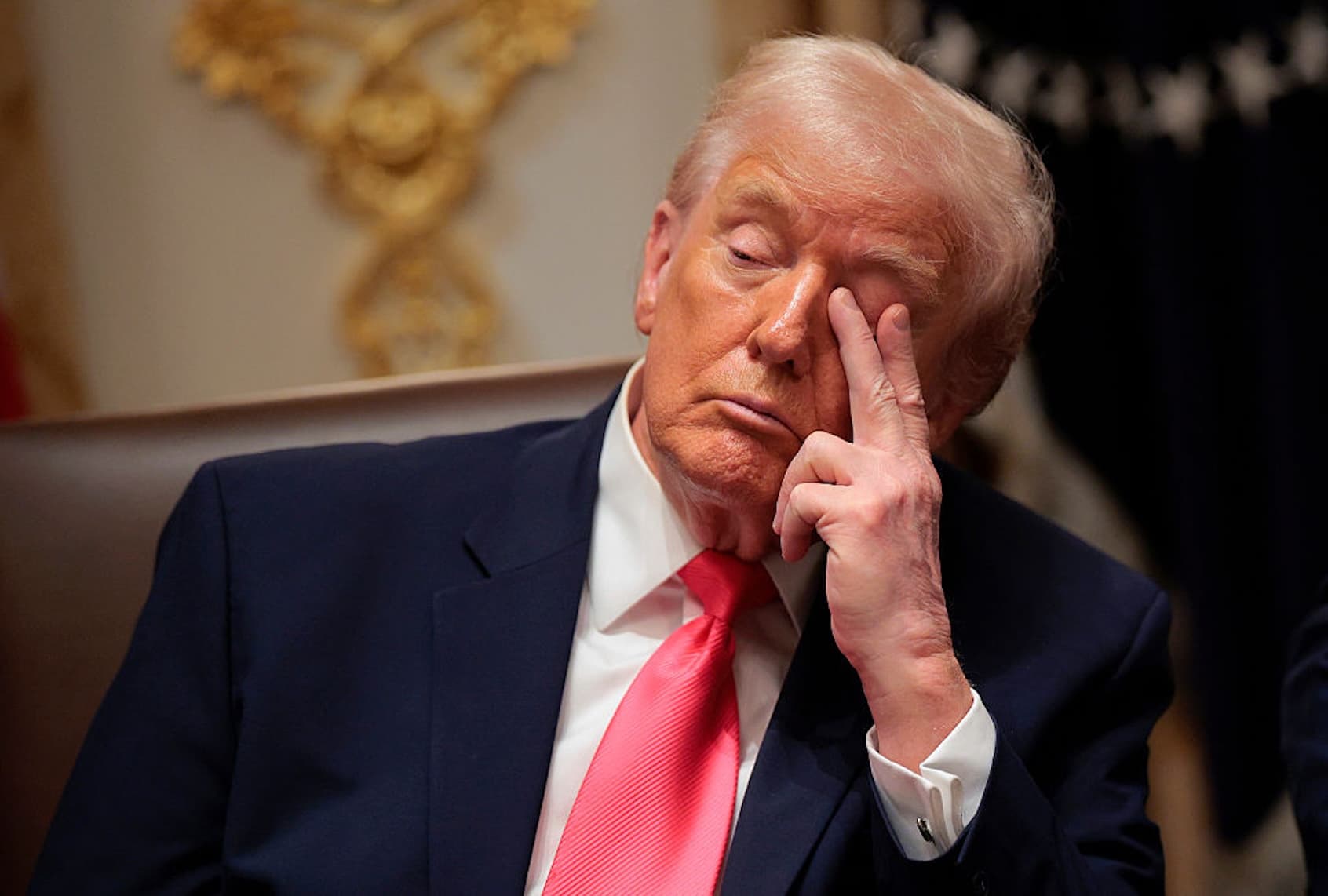
 Donald Trump reacts amid ongoing debate over mail-in voting rules.
Supreme Court blocks Trump's mail-ballot rules for midterms
Intra-Party Split Detected
Conservative justices split: Kavanaugh concurred with blocking the rule for timing reasons while agreeing USPS may have authority in principle, whereas Alito and Thomas dissented, arguing the rule should be allowed to proceed.
Left says
- •The ruling protects a mail voting system already used safely by roughly a third of American voters, preventing last-minute chaos just weeks before ballots go out or have already gone out in states like North Carolina, Alabama, and Wisconsin.
- •The proposed rules stemmed from an executive order widely viewed by legal experts as unconstitutional, since federal law generally leaves election administration to the states rather than the White House.
- •A whistleblower's account that USPS built the verification portal in weeks rather than the nine months to a year normally required underscores that the rollout was reckless and risked mass ballot rejections.
- •Trump's furious reaction, including attacking the same conservative justices he once appointed, reflects a pattern of trying to delegitimize any check on his authority over elections.
Right says
- •The White House maintains these were commonsense safeguards meant to protect ballot security and ensure only eligible Americans vote, not an attempt to disenfranchise anyone.
- •Justice Kavanaugh's concurrence acknowledges the rule likely falls within the Postal Service's legal authority, meaning the Court's objection was about timing rather than the substance of the policy.
- •The administration argues election officials had ample time since March to prepare for the new requirements, and delays were driven by resistance rather than genuine impossibility.
- •Dissenting justices Alito and Thomas argue the challengers' claims of harm were vague and that Congress has clearly empowered USPS to set such rules, suggesting the legal case against the policy is weaker than portrayed.
Common Take
High Consensus- The Supreme Court's decision leaves the 2026 midterm mail voting system operating largely as it has in past elections.
- Multiple courts, including two district judges and a circuit panel, found problems with how and when the rule was being implemented.
- A USPS whistleblower raised credible concerns that the ballot-verification portal was built too quickly to be reliable.
- The ruling does not resolve whether the Postal Service could implement similar rules in future elections under normal timelines.
The Arguments
Left argues
The ruling protects a mail voting system already trusted by roughly a third of American voters from last-minute disruption, given that states like North Carolina, Alabama, and Wisconsin had already begun mailing ballots when the rules were being fought over.
Right counters
The White House argues officials had known about these requirements since March, so any last-minute chaos stems from resistance and slow implementation by opponents of the rule, not from an unreasonable timeline set by the administration.
Right argues
Justice Kavanaugh's concurrence explicitly states there is a 'fair prospect that the final rule falls within the Postal Service's statutory authority,' meaning the Court's rejection was about implementation timing for this election, not a repudiation of the policy's legality or purpose.
Left counters
Even if the rule might survive on the merits eventually, a lower court found it violates both the Constitution and federal statute, and the practical effect of the ruling is a total, unanimous-in-outcome block of the administration's plan for this election cycle.
Left argues
A whistleblower's account that USPS built the verification portal in weeks instead of the nine months to a year normally required shows the rollout was reckless, risking a single scanning error causing mass rejection of legitimate ballots.
Right counters
The administration frames the rules as commonsense ballot-security measures, and operational hiccups during a rushed rollout reflect implementation problems, not proof that verifying voter eligibility before mailing ballots is inherently flawed policy.
Right argues
Dissenting Justices Alito and Thomas argue Congress clearly empowered USPS to set such rules and that the challengers' claims of harm were vague and 'cryptic,' suggesting the legal case against the policy is weaker than the outcome implies.
Left counters
Two separate district courts and a federal circuit court all independently concluded the rule was unlawful or exceeded statutory authority, so the weight of judicial analysis — not just the Supreme Court's brief order — cuts strongly against the administration's position.
Left argues
Trump's furious Truth Social response attacking the same conservative justices he appointed reveals a pattern of trying to delegitimize any institutional check on his attempts to control election administration.
Right counters
A president publicly criticizing a court ruling he believes is wrong is a normal exercise of free speech and political expression, not evidence that the underlying policy — which sought only to verify voter eligibility — was itself improper or dangerous.
Challenge Questions
These questions target genuine internal contradictions — meant to provoke honest reflection.
Right asks Left
“If Justice Kavanaugh, whose vote was necessary to the outcome, believes the rule likely falls within USPS's statutory authority, can the left credibly frame this decision as a repudiation of the policy itself rather than merely its timing?”
Left asks Right
“If the administration truly believes officials had 'ample time' since March, how does the White House explain the whistleblower's account that USPS built the verification portal in weeks rather than the nine months to a year such systems normally require?”
Outlier Report
Left Fringe
Figures like Marc Elias and some progressive election-law commentators who frame this as evidence of an authoritarian plot to steal the midterms represent maybe 15-20% of the left; most Democrats simply see it as a procedural win rather than existential.
Right Fringe
Trump himself and allies like Stephen Miller who cast the ruling as a betrayal by 'his own' justices represent a vocal but narrow slice (roughly 20-25%) of the right; many mainstream Republicans and even some conservative legal commentators (e.g., those citing Kavanaugh's concurrence) accept the timing-based rationale without claiming judicial betrayal.
Noise Assessment
High noise ratio: Trump's Truth Social attacks on Alito/Thomas-adjacent justices and left-leaning framing of 'authoritarian overreach' dominate social media engagement far more than the underlying, relatively technical administrative-timing dispute that most Americans have only passing awareness of.
Sources (6)
<p>The <a href="https://www.axios.com/politics-policy/supreme-court-legal-decisions" target="_blank">Supreme Court</a> struck down the <a href="https://www.axios.com/2026/08/25/usps-mail-voting-rule-injunction" target="_blank">U.S. Postal Service's rule</a> restructuring mail-in voting Monday,<strong> </strong>halting a major <a href="https://www.axios.com/politics-policy/donald-trump" target="_blank">Trump</a> administration priority.</p><p><strong>The big picture: </strong>The <a href="https://www.supremecourt.gov/opinions/25pdf/26a305_4g15.pdf" target="_blank">decision</a>, which two justices publicly dissented from, is a major win for voting rights advocates and the states that challenged the administration's plan; it also reverses the Supreme Court's earlier <a href="https://www.axios.com/2026/08/24/supreme-court-mail-in-ballot-rules" target="_blank">green light</a> for President Trump's mail-in voting order.</p><hr /><ul><li>The justices' prior unsigned order allowing the rule to proceed was not a ruling on the merits — but this time around,<strong> </strong>they decided the government is "unlikely to succeed on the merits of its challenge." </li><li>The rule would require states to submit lists of eligible voters to USPS, and the agency would then verify that those voters were receiving mail-in ballots before sending them out. The rule also had strict requirements on envelope design. </li></ul><p><strong>Driving the news:</strong> While the court rejected the administration's stance, at least one concurring justice disagreed on the merits of the case. </p><ul><li>Justice Brett Kavanaugh wrote in a concurring opinion that "there is at least a fair prospect that the final rule falls within the Postal Service's statutory authority" but that applying the proposed rules would be "arbitrary and capricious" for the midterm elections as state and local officials "do not have sufficient time to reasonably implement the rule." </li><li>Justices Samuel Alito and Clarence Thomas dissented in a separate opinion.</li><li>In their opinion, they called the filings claiming harm by some plaintiffs "cryptic" and that the USPS has the authority to implement a rule because Congress has empowered it to do so. </li></ul><p><strong>Zoom out: </strong>The decision is likely the final say on the rule during this election cycle, with even U.S. District Court Judge Indira Talwani saying from the bench earlier this month that it was unclear how the government <a href="https://www.democracydocket.com/news-alerts/trump-doj-cant-tell-judge-whether-usps-mail-ballot-portal-is-ready-to-launch/" target="_blank">would</a> <a href="https://www.cbsnews.com/news/postal-service-mail-voting-rules-block/" target="_blank">implement</a> the plans with November just around the corner.</p><ul><li>Steven Monteith, executive vice president at the Postal Service, <a href="https://storage.courtlistener.com/recap/gov.uscourts.mad.298449/gov.uscourts.mad.298449.280.1.pdf" target="_blank">said</a> in a declaration filed Sept. 3 that the agency continues to make "refinements" to the portal, which he predicted would be available for "voluntary use by sometime next week."</li><li>He added that under Talwani's restraining order, USPS was not mandating design review for state mail but has made review available for states that want to "voluntarily submit" envelopes to ensure they comply with the rule.</li><li>The case has been full of legal twists and turns, with Talwani <a href="https://storage.courtlistener.com/recap/gov.uscourts.mad.298449/gov.uscourts.mad.298449.218.0_1.pdf" target="_blank">blocking</a> key parts of the rule last month and a second judge doing the same <a href="https://www.axios.com/2026/09/14/trumps-mail-ballot-rules-blocked" target="_blank">earlier this week</a>. </li></ul><p><strong>Friction point: </strong>While the administration has dismissed concerns, <a href="https://www.axios.com/2026/09/01/usps-whistleblower-mail-ballots-warning" target="_blank">a USPS whistleblower recently alleged</a> that the agency defied court orders and rushed to build out the new ballot system, putting thousands of mail ballots at risk.</p><ul><li>The whistleblower said the Postal Service built the system in weeks, not the nine months to a year typically needed for a project of this complexity, <em>Axios' Andrew Pantazi and Donica Phifer reported.</em></li></ul><p><strong>The bottom line: </strong>The rule is just one front in the <a href="https://www.axios.com/2026/08/27/trump-voting-agenda-mail-ballots-save-act-voter-rolls" target="_blank">myriad ways</a> the administration has tried—at times, unsuccessfully—to reshape elections, as seen in attempts to obtain state <a href="https://www.axios.com/2026/08/05/trump-doj-voter-roll-lawsuits-fail" target="_blank">voter rolls</a> and <a href="https://www.axios.com/2026/05/09/2026-midterms-redistricting-trump-virginia" target="_blank">redraw congressional maps</a>. </p><ul><li>Some of those efforts have been snuffed out in the courtroom, while others could have <a href="https://www.axios.com/2026/06/07/redistricting-gerrymander-house-republicans-democrats" target="_blank">real impacts</a> in November.</li></ul><p><em>Editor's note: This story was updated with additional information throughout. </em></p>
<p>A second federal judge <a href="https://www.axios.com/2026/09/04/trump-mail-in-voting-rule-blocked-judge" target="_blank">blocked</a> the U.S. Postal Service's new mail-ballot rules for the Nov. 3 midterms as the <a href="https://www.axios.com/local/boston/2026/09/09/mail-in-voting-massachusetts" target="_blank">Supreme Court weighs</a> whether to allow the restrictions in another case.</p><p><strong>Why it matters: </strong>Sunday's order adds another hurdle to the <a href="https://www.axios.com/politics-policy/donald-trump" target="_blank">Trump</a> administration's bid to <a href="https://www.axios.com/2026/08/24/trump-usps-federal-power-state-elections-mail-voting" target="_blank">upend mail voting</a>. The blocked rules would allow the USPS to refuse ballots that don't clear new standards, with mail voting already underway in some states.</p><hr /><p><strong>The latest: </strong>U.S. District Judge Carl Nichols, a Trump appointee in Washington, D.C., <a href="https://storage.courtlistener.com/recap/gov.uscourts.dcd.291053/gov.uscourts.dcd.291053.192.0.pdf" target="_blank">concluded</a> Congress empowered the Postal Service to move mail, not to force states to enroll mail voters in a federal portal or to refuse ballots that fail its checks.</p><ul><li>Nichols' ruling follows a similar order from U.S. District Judge Indira Talwani in Boston blocking parts of the same rule. The 1st U.S. Circuit Court of Appeals left Talwani's injunction in place on Sept. 10.</li><li>Talwani's order found the postal rules violate the U.S. Constitution and federal statute, while Nichols' new ruling relied entirely on his finding that Congress' Postal Reorganization Act doesn't allow many of the new rules. </li><li>The USPS did not immediately return requests for comment.</li></ul><p><strong>What they're saying:</strong> The White House wouldn't say if it planned to appeal this ruling but spokesperson Lauren Bis said election officials have had "ample time to prepare for the 2026 election."</p><ul><li>Bis added in the emailed statement, "These are commonsense measures to protect the security of mail-in ballots and ensure only Americans vote in American elections."</li><li>Kristen Clarke, NAACP general counsel, said in an email that two district courts and a federal circuit court have now blocked the Trump administration's "unlawful attempt to weaponize the U.S. Postal Service to hijack our mail voting system in the middle of an ongoing midterm election."</li><li>Clarke noted that the election is just 49 days away. "We urge the Supreme Court to reject this administration's request to green light this unlawful scheme and leave in place our mailing voting system which is safe, secure, and orderly," Clarke added.</li></ul><p><strong>Catch up quick: </strong>President Trump has long attacked mail voting, despite repeatedly using the method himself, including in August's <a href="https://www.politico.com/news/2026/08/17/trump-vote-by-mail-primaries-florida-01039292" target="_blank">Florida primaries</a>.</p><ul><li>His March executive order directed the Postal Service to develop new envelope, tracking and voter-list requirements for mail voting.</li><li>The Supreme Court already lifted an earlier injunction because the final rule hadn't been published yet. But after its publication, challengers returned to court and won new injunctions in Boston and D.C.</li><li>The Trump administration is now asking the high court to stop Talwani's order and allow the new rules.</li></ul><p><strong>Between the lines: </strong>Nichols said USPS might have the authority to issue rules on ballot-envelope designs, but he blocked the whole rule, finding its design, portal and rejection provisions too intertwined.</p><p><strong>Friction point: </strong>Even with enforcement blocked, voluntary preparations have exposed how exacting the new system could be.</p><ul><li>USPS <a href="https://www.tallahassee.com/story/news/local/2026/09/11/usps-oks-leon-county-mail-ballots-after-dispute/91706003007/" target="_blank">initially rejected</a> envelope designs from Florida's Leon County, a heavily Democratic area that includes Tallahassee, because the words "Return Service Requested" were 0.014 inches too close to other text, according to the Tallahassee Democrat.</li><li>An anonymous USPS <a href="https://www.axios.com/2026/09/01/usps-whistleblower-mail-ballots-warning" target="_blank">whistleblower</a> also told Congress the Postal Service's portal was rushed, and a single scanning error could cause a batch of ballots to be rejected.</li></ul><p><strong>The bottom line:</strong> The Supreme Court could rule on Talwani's injunction at any time. But Nichols' order now gives the administration a second injunction to overcome before it can enforce its mail ballot rules.</p><p><em>Editor's note: This story has been updated with comment from the White House and NAACP general counsel Kristen Clarke.</em></p>
While the Trump administration's bid to overhaul mail-in voting remains blocked by the lower courts, North Carolina will be the first state to send ballots on Friday.
The Supreme Court ruling marked the culmination of a frenzied, monthslong legal battle
<p>The extraordinary danger is that a president who believes he is the law, and the law is him, remains intent on disrupting the electoral process</p><ul><li><p><a href="https://www.theguardian.com/us-news/2026/sep/04/sign-up-to-the-stakes-2026-your-weekly-guide-to-the-us-midterms">This was originally published in The Stakes 2026, a newsletter about the midterm elections. Sign up to get it in your inbox</a> </p></li></ul><p>For the millions of Americans who vote by mail – almost <a href="https://www.theguardian.com/us-news/2026/sep/13/trump-voting-by-mail-explainer">a third of the country</a> – the week began with significant uncertainty that they would be able to easily submit their ballot this fall, thanks to a March executive order from <a href="https://www.theguardian.com/us-news/donaldtrump">Donald Trump</a> that aimed to restrict mail-in ballots. By Monday night, the supreme court restored a measure of order by rebuking the president and <a href="https://www.theguardian.com/us-news/2026/sep/14/supreme-court-rejects-mail-ballot-restrictions">rejecting</a> his plan – but Trump’s frothing response portends more danger for the rapidly approaching midterms.</p><p>Trump’s March order <a href="https://www.theguardian.com/us-news/2026/mar/31/trump-executive-order-restrict-mail-in-ballots">forbade</a> the US Postal Service from delivering mailed ballots to anyone the administration deemed ineligible. The Department of Homeland Security, working with the Social Security Administration, would have devised that list of supposedly ineligible, noncitizen voters. On its face, the move appeared plainly illegal. One expert <a href="https://www.theguardian.com/us-news/2026/mar/31/trump-executive-order-restrict-mail-in-ballots">told</a> the Guardian’s Sam Levine, “This is a wholly unconstitutional EO,” because ultimately the federal government cannot set election rules; only states can.</p> <a href="https://www.theguardian.com/us-news/2026/sep/17/trump-mail-voting-explained-stakes-newsletter">Continue reading...</a>
The top official at the U.S. Postal Service said Thursday that the agency has stopped work on developing a controversial computer system that was central to President Donald Trump's effort to limit mail voting after the Supreme Court rejected his executive order this week.