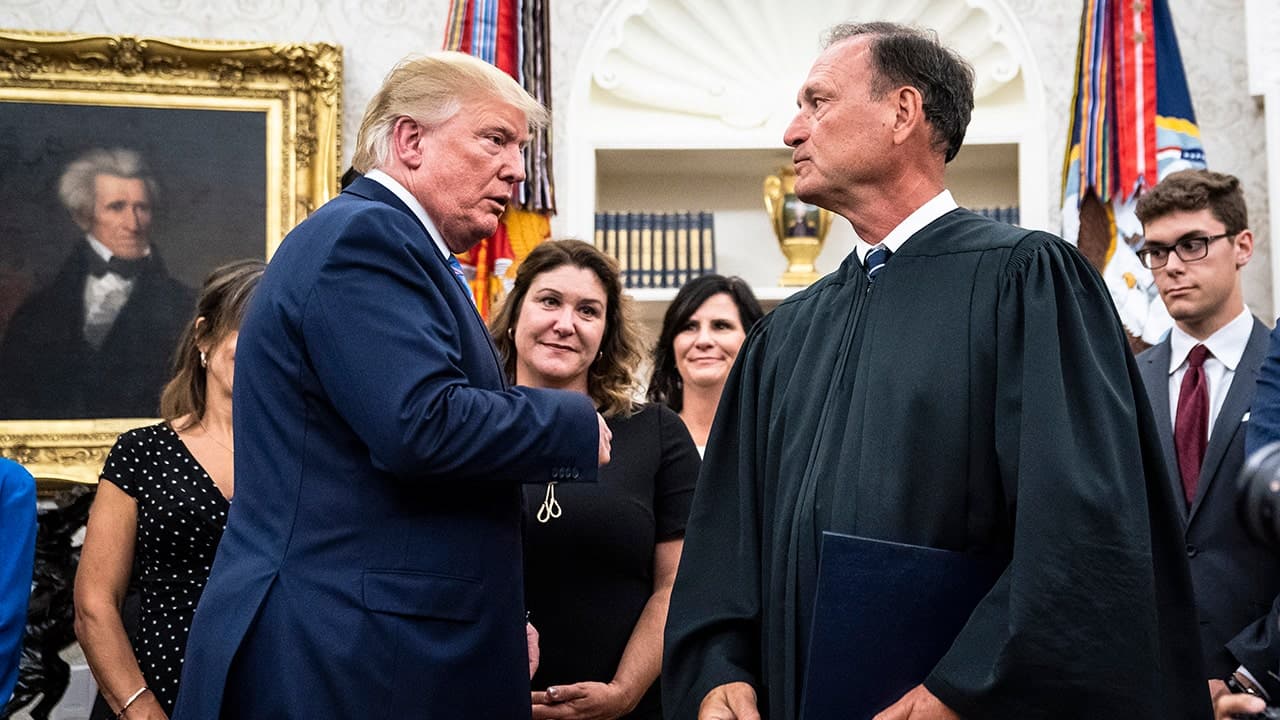
Supreme Court Conservatives Alito and Thomas Reject Retirement Speculation
Left says
- •The conservative supermajority on the Supreme Court will remain entrenched for years to come, limiting opportunities for progressive judicial appointments
- •Thomas and Alito's continued tenure means controversial decisions on abortion, voting rights, and environmental regulations will likely persist
- •The Court's ideological balance will remain tilted heavily conservative, potentially blocking progressive policy initiatives for another decade
Right says
- •Constitutional originalists Thomas and Alito will continue protecting fundamental rights and limiting government overreach
- •The Court's conservative majority ensures stability in constitutional interpretation and prevents judicial activism
- •Trump praised both justices as exceptional legal minds who have strengthened the rule of law through principled decision-making
Common Take
High Consensus- Both Thomas, 77, and Alito, 76, are the oldest sitting justices on the Supreme Court
- Alito has already begun hiring law clerks for the next term, indicating his intention to continue serving
- Thomas and Alito are widely recognized as core members of the Court's conservative wing
- Supreme Court retirement decisions have significant long-term implications for American jurisprudence
The Arguments
Left argues
Thomas and Alito's continued tenure locks in a conservative supermajority that will block progressive policy initiatives for potentially another decade, undermining democratic efforts to address climate change, reproductive rights, and voting access.
Right counters
These justices provide constitutional stability by interpreting law based on original text and meaning rather than political preferences, ensuring the Court remains above partisan politics and protects fundamental rights as written.
Right argues
Alito and Thomas represent principled constitutional originalism that prevents judicial activism and maintains the rule of law, with Trump correctly recognizing them as exceptional legal minds who strengthen constitutional interpretation.
Left counters
Their brand of 'originalism' selectively applies historical interpretation to reach predetermined conservative outcomes, effectively imposing their ideological preferences while claiming judicial neutrality.
Left argues
The Court's current composition creates an undemocratic situation where a conservative minority can overturn decades of established precedent and block the will of electoral majorities on critical issues like abortion and environmental protection.
Right counters
The Supreme Court's role is specifically to be countermajoritarian when necessary to protect constitutional rights and prevent government overreach, regardless of popular opinion or electoral outcomes.
Right argues
Both justices remaining on the Court ensures continuity in constitutional interpretation and prevents the kind of radical judicial shifts that would destabilize legal precedent and undermine confidence in the judiciary.
Left counters
This 'stability' argument ignores that these same justices have already overturned major precedents like Roe v. Wade, showing they're willing to create instability when it serves conservative goals.
Challenge Questions
These questions target genuine internal contradictions — meant to provoke honest reflection.
Right asks Left
“If you believe the Supreme Court should reflect democratic will and popular opinion, how do you reconcile this with the Court's fundamental constitutional role as a check on majoritarian power, including protecting minority rights against popular tyranny?”
Left asks Right
“If originalism truly provides neutral, principled constitutional interpretation, why do originalist justices so consistently reach conclusions that align with contemporary conservative political positions rather than producing a more random distribution of outcomes?”
Outlier Report
Left Fringe
Progressive activists like those from Demand Justice and some Squad members like Alexandria Ocasio-Cortez who have called for expanding the Supreme Court or imposing term limits represent about 20-25% of the left. Their more aggressive court reform positions go beyond mainstream Democratic views.
Right Fringe
Some MAGA hardliners and figures like Steve Bannon who view any potential retirement as betrayal or weakness represent about 15-20% of the right. Most conservatives simply want qualified originalist justices and don't demand specific retirement timing.
Noise Assessment
Moderate noise level. While partisan media amplifies retirement speculation for clicks, most Americans don't follow Supreme Court personnel decisions closely unless there's an actual vacancy. The discourse is more insider-focused than reflective of broad public engagement.
Sources (4)
Despite retirement rumors, sources said Justice Samuel Alito is not planning to step down this term and is already hiring clerks for the next term.
Justices Clarence Thomas, 77, and Samuel Alito, 76, the oldest members of the Supreme Court and two of its most conservative, are not planning to step down once the court's current term ends in late June or early July.